

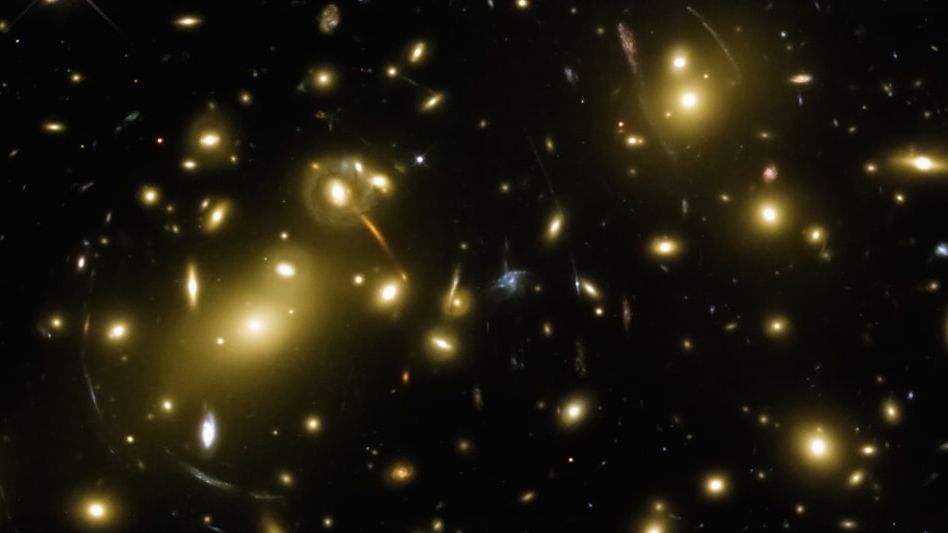
How Gravity Bends Light Without a Physical Barrier (Image Credits: Unsplash)
Gravitational lensing captivates astronomers by warping light from remote galaxies around massive foreground structures, creating arcs and rings that unveil otherwise hidden cosmic details. A frequent puzzle emerges from comparisons to everyday optics: why does the lensing object not obscure the view like a physical lens might? Astronomers observe the deflecting galaxy or cluster directly in these images, positioned amid the distorted background light.[1]
How Gravity Bends Light Without a Physical Barrier
Gravitational lensing arises when the immense mass of a galaxy or cluster curves spacetime itself, deflecting light rays from objects farther away. This effect, predicted by Einstein’s general relativity, produces magnified and multiply imaged views of background sources. Unlike a glass lens, which requires photons to traverse its material, gravity acts across empty space surrounding the massive body.
The deflection occurs gradually as light skims the gravitational well, not by passing through the stars or gas within the lens. Telescopes capture these altered paths, revealing elongated arcs or complete Einstein rings encircling the central lensing mass. This geometry ensures the foreground object remains observable, its own emitted light traveling straight to Earth unimpeded.[1]
Optical Lenses Versus Cosmic Deflectors
Optical lenses work through refraction, where light interacts with electrons in glass or plastic, bending rays as they penetrate the medium. Observers notice the lens because it lies directly in the line of sight, often tinting or distorting the view subtly. In contrast, gravitational lensing demands no such transit; the influence extends outward like an invisible halo.
| Aspect | Optical Lens | Gravitational Lens |
|---|---|---|
| Light Path | Passes through material | Bypasses mass, curves in field |
| Visibility of Lens | Often superimposed | Separate, central position |
| Image Formation | Focused at observer | Distorted arcs/rings |
This table highlights the fundamental distinctions that resolve the apparent invisibility. The lensing galaxy appears as a bright core, with background features arrayed around it.[1]
Iconic Examples from Hubble Observations
Astronomers first documented strong gravitational lensing in quasars during the 1970s, but galaxy-scale effects shone in Hubble Space Telescope images. The cluster Abell 1689 exemplifies this: its yellow galaxies cluster at the heart, tracing the gravity well’s depth. Blue-white arcs nearby represent stretched images of distant galaxies, bent by the foreground mass.
Such configurations confirm the lens’s presence. Density maps of member galaxies or X-ray emissions from hot gas further delineate the deflecting potential. These observations, spanning decades, have mapped dark matter distributions and refined cosmic distance measures.[1]
Exploring Related Phenomena
Beyond pure gravity, other scattering mimics lensing. X-ray light from background sources can form halos when interacting with electrons in foreground dust clouds, echoing Einstein rings observed since 1983. If the dust stayed opaque to visible light, these rings would puzzle viewers much like early gravitational discoveries.
Key Insight: Geometric analysis of such halos aids cosmology, paralleling gravitational techniques for distance scales.
Researchers continue probing these effects to unlock universe expansion rates and matter content. Gravitational lensing thus not only magnifies the distant but spotlights its own machinery.[1]
These cosmic displays underscore gravity’s subtle power, rendering the deflectors unmistakable amid the spectacle they create.