

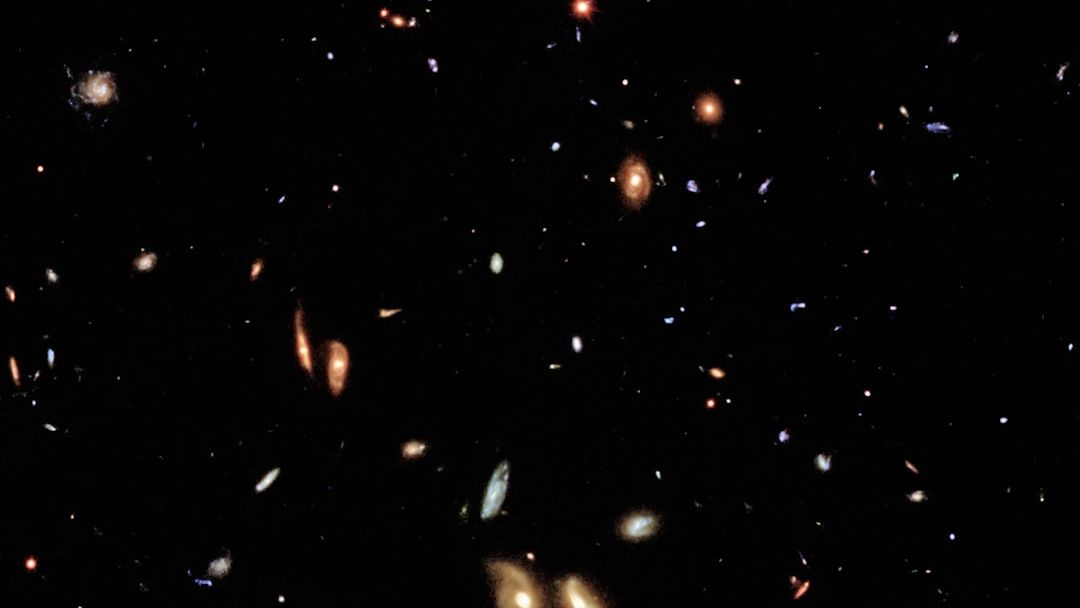
Cosmic Fossils in Our Galactic Neighborhood (Image Credits: Unsplash)
Amid discoveries of surprisingly massive galaxies in the distant cosmos by the James Webb Space Telescope, astronomers have turned to the Milky Way’s own backyard for insights into the universe’s infancy. Ultra-faint dwarf galaxies, the tiniest satellites orbiting our galaxy, emerged from recent high-resolution simulations as remarkably sensitive record-keepers of primordial conditions.[1][2] These fragile systems, a million times less massive than the Milky Way, preserved clues about radiation levels and star formation from when the universe was less than 500 million years old.
Cosmic Fossils in Our Galactic Neighborhood
Dwarf galaxies have long accompanied the Milky Way, but the ultra-faint variety pushed the limits of observation due to their dimness. Researchers identified them as potential cosmic fossils, remnants that withstood billions of years while retaining imprints from the early universe. Formed within small dark matter halos predicted by the standard Lambda-CDM model of cosmology, these galaxies tested the boundaries of galaxy formation theories.
Their extreme fragility set them apart from larger neighbors. While the Milky Way grew robustly, ultra-faint dwarfs hovered on the edge, vulnerable to the harsh radiation environment shortly after the Big Bang. This sensitivity made them ideal probes, though modeling their evolution demanded unprecedented computational power.[2]
LYRA Simulations Break New Ground
A team led by Associate Professor Azadeh Fattahi of the Oskar Klein Centre in Stockholm unveiled the LYRA simulation suite, the largest and highest-resolution set ever dedicated to these faint galaxies. Collaborators from Durham University and the University of Hawaii ran the models on the COSMA 8 supercomputer, consuming six months and generating 300 terabytes of data. The effort updated algorithms to handle the massive output, yielding a systematic view of how ultra-faint dwarfs form and evolve.[1]
“In this work we presented a brand-new suite of cosmological simulations focused on the faintest galaxies in the universe, with an unprecedented resolution,” Fattahi stated. The simulations zoomed into dark matter clumps around 700 million years after the Big Bang, tracking stars and gas under varying radiation scenarios. Published April 24, 2026, in Monthly Notices of the Royal Astronomical Society, the study marked a major advance.[2]
Echoes of Primordial Radiation
The simulations tested two radiation backgrounds, including the Lyman-Werner flux from the first stars, to gauge impacts on dwarf formation. Ultra-faint galaxies reacted sharply: elevated radiation suppressed star formation in some halos, leaving them starless, while others ignited briefly before quenching. Larger galaxies like the Milky Way remained unaffected, highlighting a size-dependent vulnerability.
A useful analogy is to plants and crops and how they grow is sensitive to the weather conditions. In the same way that the yield of a crop in summer can indirectly tell you a lot about what the weather in spring must have been like, the properties of faint dwarf galaxies today can tell us a lot about the conditions, or weather, of the universe at a much earlier time.
– Shaun Brown, study leader from the Oskar Klein Centre and Durham University
These results explained gaps in observed small-galaxy populations and why some halos stayed dark. Early conditions thus dictated visibility today, turning local dwarfs into archives of the universe’s “climate.”[1]
Linking Nearby Relics to Distant Surprises
The findings gained urgency against James Webb Space Telescope observations of unexpectedly bright early galaxies. While distant views offered snapshots, ultra-faint dwarfs provided complementary local evidence from the same epoch. Their properties promised constraints on infant-universe physics inaccessible through remote telescopes alone.
Upcoming data from the Vera C. Rubin Observatory could deliver a near-complete census of Milky Way satellites. “Excitingly, in the near future we will have data from the Vera C. Rubin Observatory which will be able to find many more of these ultra faint dwarfs around the Milky Way,” Fattahi noted. Such observations might test simulation predictions and refine models of dark matter and first stars.[2]
Toward Deeper Cosmic Insights
The LYRA team eyed further applications, from locating the universe’s first stars to probing dark matter’s nature. Challenges persisted in simulating such small scales, but the framework opened doors. These faint neighbors underscored how the earliest radiation sculpted the cosmic landscape, influencing growth patterns still visible today.
Ultra-faint dwarf galaxies thus offered a quiet testament to the universe’s turbulent youth, their survival a bridge across 13 billion years. Astronomers anticipated how Rubin data might illuminate those hidden chapters, refining the story of our cosmic origins.