

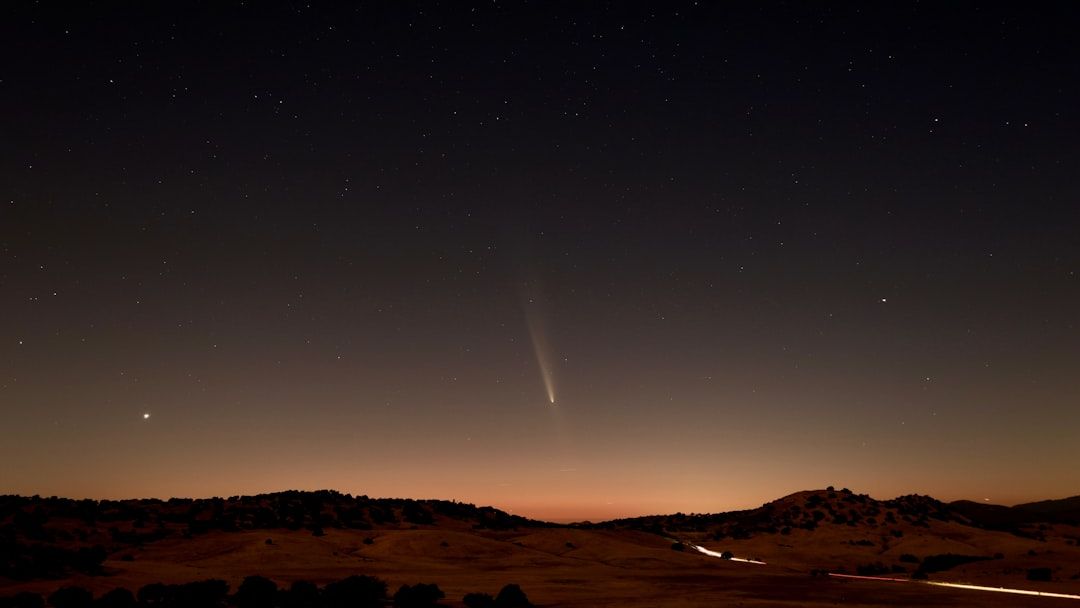
The Close Encounter Unfolds (Image Credits: Unsplash)
As Comet C/2025 R3 PanSTARRS swept within 45 million miles of Earth on April 26, 2026, its ion tail suddenly became prominent, creating a striking visual effect against the sun’s glare.[1] Observatories like the NASA/ESA Solar and Heliospheric Observatory captured the moment the narrow, bluish tail shifted direction, pointing directly away from the sun. This development marked a key highlight in the comet’s journey through the inner solar system.
The Close Encounter Unfolds
Comet C/2025 R3 PanSTARRS reached its closest point to Earth at approximately 0.489 astronomical units, or 73 million kilometers, on April 26.[2]) Just a week earlier, the comet had passed perihelion – its nearest approach to the sun – on April 19 at 0.499 AU.[2]) During this flyby, the ion tail emerged clearly in observations from space-based instruments, which block the sun’s overwhelming light to reveal faint cometary features.
Solar wind played a pivotal role in this activation. High-speed particles from the sun pushed the ionized gases in the comet’s coma, forming the straight, narrow tail that astronomers noted as particularly vivid.[1] The event occurred as the comet moved between Earth and the sun, enhancing its visibility for certain instruments despite the challenging geometry.
Journey from Distant Oort Cloud to Inner Solar System
Discovered on September 8, 2025, by the Pan-STARRS survey using a 1.8-meter telescope at Haleakala, Hawaii, the comet started as a faint object at magnitude 20.[2]) Hailing from the Oort cloud, it followed a hyperbolic path with an orbital period of about 170,000 years inbound, marking it as a one-time visitor destined for ejection from the solar system.[2])
The comet brightened rapidly as it neared the sun. By mid-March 2026, it reached magnitude 9, becoming visible in binoculars. Naked-eye sightings followed by April 11 at magnitude 5.1, with further gains to 4.5 by April 17.[2]) Peak brightness hovered around magnitude 3 to 4, aided by forward scattering of sunlight off dust particles post-perihelion.
Early tails appeared soon after discovery, with a broad 10-arcsecond feature noted in follow-up images. By March 21, the tail extended one degree. The ion tail grew prominent by April 8, stretching at least 7 degrees, though a dust tail remained subtle initially.[2])
Dust and Ion: The Dual Tails Explained
Comets develop tails through solar heating, which vaporizes ices in the nucleus and releases dust and gas into a surrounding coma. The dust tail, broader and curved, forms from heavier particles gently repelled by radiation pressure, reflecting sunlight to appear yellowish.[1]
In contrast, the ion tail arises from ultraviolet light ionizing gas molecules, creating charged particles swept away by the solar wind at hundreds of kilometers per second. This produces a straight, bluish streamer always aligned anti-sunward, often showing complex structures like jets, streamers, and disconnection events.[1][3] For PanSTARRS, observers noted fans of jets near the head, a main streamer, and diffuse filaments farther out, with a possible tail disconnection resembling shed skin.
Catching the Comet in the Post-Flyby Sky
Following its Earth approach, the comet entered solar conjunction on April 25 at 3.5 degrees from the sun, complicating ground-based views.[2]) In the Northern Hemisphere, morning observations in Pisces and Pegasus proved tricky due to low altitude before dawn. Southern observers gained better evening views from late April into early May.
By late April 2026, magnitude sat around 0.7 to 4, with a gas tail exceeding 10 degrees and hints of an anti-tail from dust geometry.[4] Viewers needed dark skies, binoculars, or small telescopes 45 to 60 minutes before sunrise in the east for northern sites, or post-sunset for southern ones.
- Locate near the Great Square of Pegasus early on, transitioning to Cetus, Taurus, Eridanus, and Orion by May.
- Avoid full moon periods around May 1; target new moon windows.
- Expect fading to magnitude 9-10 by late May, favoring telescopes.
This fleeting visitor offered a rare display of solar system dynamics, underscoring how comets transform under stellar influence. As PanSTARRS fades into the evening or morning twilight, it leaves behind images of tails shaped by the sun’s relentless wind – a cosmic reminder of our dynamic neighborhood.