

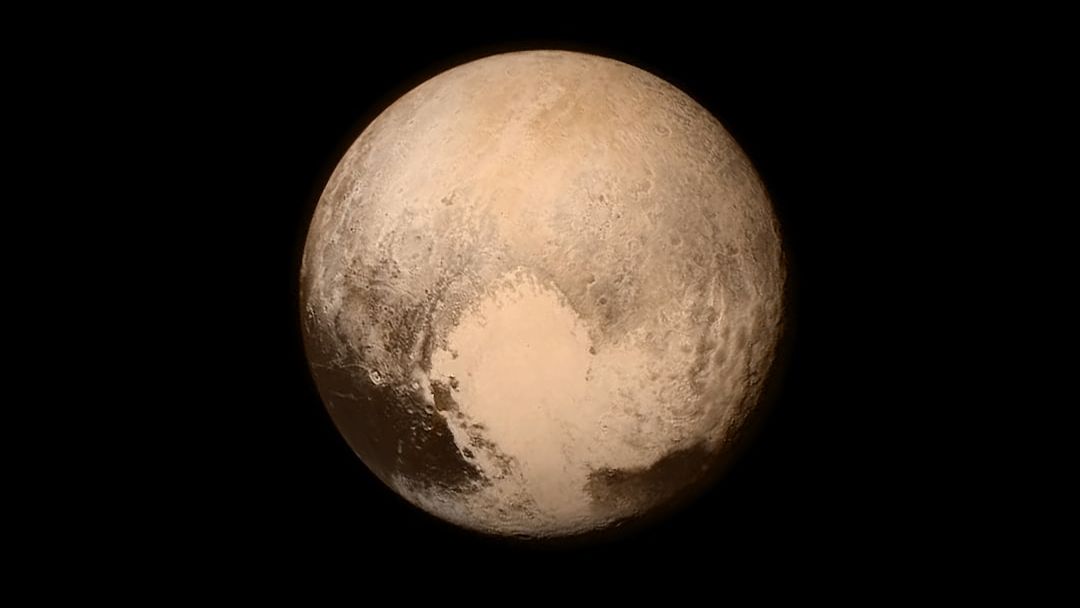
The 2006 IAU Definition’s Core Flaws (Image Credits: Unsplash)
NASA’s New Horizons spacecraft flew past Pluto in 2015 and revealed a world of flowing glaciers, towering mountains, and a hazy atmosphere, defying expectations of a frozen relic. These discoveries have intensified a long-simmering debate over the International Astronomical Union’s 2006 decision to reclassify Pluto as a dwarf planet. Planetary scientists argue that the demotion relied on a flawed definition, one that overlooks Pluto’s complexity and fails to align with how experts actually study worlds in our solar system.
The 2006 IAU Definition’s Core Flaws
The IAU established three criteria for planethood: orbiting the sun, achieving a spherical shape through self-gravity, and clearing the orbital neighborhood of other objects. Pluto met the first two requirements easily but fell short on the third due to its location in the Kuiper Belt, surrounded by similar icy bodies. Yet this standard proved problematic from the start, as none of the eight accepted planets fully clear their paths – Earth shares space with asteroids, and Neptune encounters Kuiper Belt objects.
Proponents of the rule emphasized gravitational dominance over time, but critics highlighted its dependence on distance from the sun. Alan Stern, New Horizons’ principal investigator, pointed out that placing Earth at Pluto’s orbit would disqualify it under the same test, along with Mercury, Venus, and Mars. This location-based approach contradicted fundamental taxonomy principles, which classify objects by intrinsic properties rather than position. The decision emerged amid the discovery of Eris, a Kuiper Belt object initially deemed larger than Pluto, prompting a rushed vote by just 424 of the IAU’s roughly 9,000 members – many planetary scientists stayed away.
New Horizons Uncovers a Dynamic World
Mission data transformed perceptions of Pluto, showing nitrogen-ice glaciers in motion and water-ice mountains as tall as the Rockies. The surface featured Sputnik Planitia, a vast, nearly crater-free ice plain the size of Texas, alongside tectonic scars from internal expansion. A layered atmosphere extended over 200 kilometers high, laced with organic hazes, while structures like Wright Mons and Piccard Mons suggested cryovolcanic activity.
Evidence pointed to a subsurface ocean, 100 to 180 kilometers thick, sustained by radioactive decay in Pluto’s core. A recent study identified signs of a supervolcanic eruption at Kiladze crater within the last few million years, hinting at ongoing processes. Jeff Moore, the mission’s geology lead, compared Pluto’s surface complexity to Mars, an undisputed planet. These traits painted a picture of geological activity rivaling inner solar system worlds.
Planetary Scientists Sideline the IAU Rule
Research has exposed the IAU definition’s irrelevance in practice. A 2018 analysis of over two centuries of literature found the “cleared orbit” concept absent from planetary science papers. Philip Metzger of the University of Central Florida described Pluto as more dynamic than Mars, noting that experts classify bodies by geophysical traits, not orbital isolation.
A 2022 study reviewed 400 years of usage, revealing that large, round moons historically counted as planets – a convention Galileo followed. Metzger and co-authors, including Stern, affirmed this in their work, showing the IAU’s narrow view as an outlier. Practitioners routinely ignored the 2006 rule in publications, favoring evidence-based assessments over taxonomic labels.
| IAU Definition | Geophysical Definition |
|---|---|
| Orbits sun, spherical, clears neighborhood | Hydrostatic equilibrium, no nuclear fusion |
| Location-dependent; fails for exoplanets | Intrinsic properties only; applies universe-wide |
| 8 planets in solar system | ~110-150, including Pluto, Ceres, large moons |
A Simpler, More Robust Path Forward
The geophysical definition offered a cleaner alternative: any body in hydrostatic equilibrium without fusion qualifies as a planet, regardless of orbit or neighbors. This approach relied solely on physical characteristics, mirroring classifications for stars or galaxies. It accommodated exoplanets in crowded systems, where clearing orbits made little sense amid thousands of discoveries.
Applied here, it elevated Pluto, Eris, Makemake, Ceres, and moons like Europa and Titan to planetary status – about 110 to 150 bodies total, a modest expansion amid countless minor objects. Kirby Runyon’s team at Johns Hopkins advocated this in 2017, emphasizing Pluto’s surface processes as quintessentially planetary. The shift promised consistency as telescopes like James Webb probed habitable worlds.
The push to reinstate Pluto transcends sentiment, rooted in data that reshaped our view of distant realms. As exoplanet hunts accelerate toward the 2030s, a coherent definition will guide discoveries without contradiction. Pluto’s glaciers, ocean, and activity remind us that science evolves with evidence, urging classifications to reflect the solar system’s true diversity.