

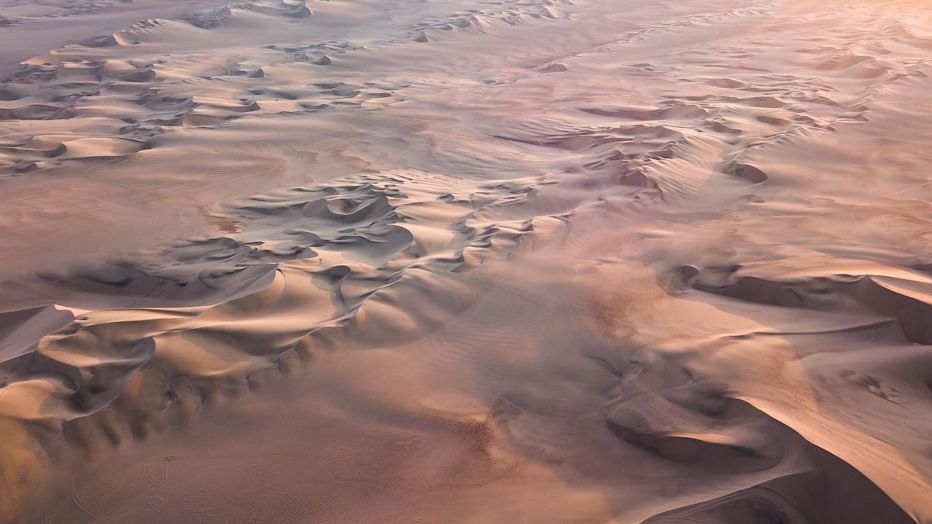
A Monumental Imaging Feat on a Remote Ridge (Image Credits: Unsplash)
NASA’s Curiosity Mars rover produced one of its most expansive images yet, a 1.5-billion-pixel panorama that captures the intricate details of Martian terrain. The mosaic, assembled from over 1,000 individual shots, reveals low ridges resembling giant spiderwebs in a region nicknamed Nevado Sajama. Scientists now have a comprehensive view of these geologic features, which the rover has been studying since earlier in 2025.
A Monumental Imaging Feat on a Remote Ridge
Curiosity gathered the images between November 9 and December 7, 2025, spanning the 4,714th to 4,741st sols of its mission. The rover positioned itself atop a ridgetop at Nevado Sajama, a site selected for both its vantage point and scientific value. There, the robotic arm’s drill extracted a rock sample, adding to the mission’s growing collection of Martian materials.
This panorama stands out for its scale. It surpasses many previous efforts, though it falls just short of the rover’s all-time record of 1.8 billion pixels. The resulting view immerses viewers in the alien landscape, highlighting formations that appear abstract from orbit but resolve into tangible structures up close.
Unveiling the Boxwork Formations
Since May 2025, Curiosity has traversed a zone rich in boxwork, geologic ridges that crisscross the surface over miles. From space, these patterns evoke vast spiderwebs, but the ground-level perspective tells a different story. The ridges rise 3 to 6 feet high and span about 30 feet across, separated by sandy hollows.
The panorama lays bare this texture in unprecedented detail. Researchers can now trace the ridges’ contours and assess their composition more precisely. Such features offer clues about Mars’ watery past, when minerals may have precipitated along fractures in the rock.
Behind the Mastcam Mosaic
The images came from Curiosity’s Mastcam instrument, specifically its right-eye camera with a 100-millimeter focal length lens. Engineers on Earth stitched the 1,031 frames into a seamless whole after transmission. This process demanded careful alignment to eliminate seams and distortions.
Two versions of the panorama emerged to suit different needs. The high-resolution edition, dubbed Figure A, clocks in at 1.8 gigabytes and prioritizes sharpness. Figure B, captured by the left camera’s 34-millimeter lens, offers a lighter 276-megabyte file that includes the rover’s own deck for scale.
| Version | Camera/Lens | File Size | Key Features |
|---|---|---|---|
| Figure A | Right (100mm) | 1.8 GB | Ultra-high resolution; rover deck omitted |
| Figure B | Left (34mm) | 276 MB | Lower resolution; includes rover deck |
Curiosity’s Enduring Mission Legacy
NASA’s Jet Propulsion Laboratory in Pasadena, California, built the rover and manages the mission for the agency’s Science Mission Directorate. Malin Space Science Systems in San Diego developed and operates the Mastcam. These partnerships have sustained Curiosity’s exploration of Gale Crater for over a decade.
The Nevado Sajama panorama underscores the rover’s technical prowess and scientific yield. As Curiosity continues its work amid these enigmatic ridges, each image refines our understanding of Mars’ geologic history. For ongoing updates, visit NASA’s Curiosity mission page.
This latest vista not only documents a striking corner of the Red Planet but also reminds us of the patient ingenuity driving robotic exploration. Future analyses of the boxwork could reveal more about ancient environmental shifts, keeping the mission’s discoveries relevant long after the images arrived.