

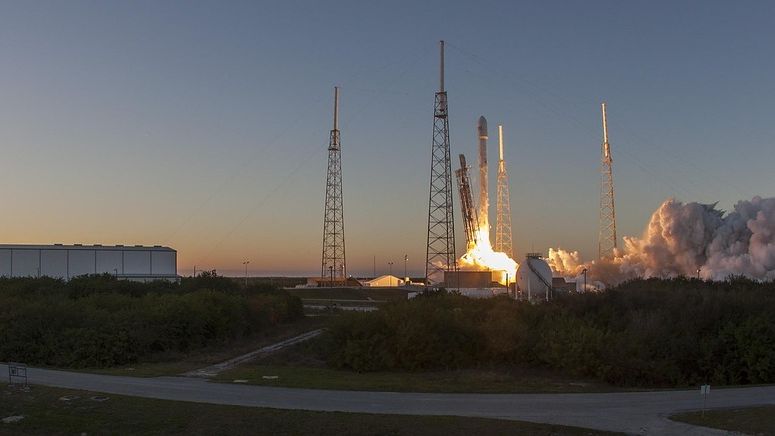
Launch Legacy and Orbital Drift (Image Credits: Pixabay)
A drifting remnant from a SpaceX Falcon 9 launch threatens to mar the lunar landscape this summer, serving as a stark reminder of unmanaged space junk amid rising human activity on the moon. Amateur astronomer Bill Gray recently pinpointed the upper stage’s trajectory toward an impact near the Einstein crater on the moon’s near side.[1][2] While the collision carries no risk to Earth or orbiting spacecraft, it highlights vulnerabilities for future lunar bases and exploration efforts.
Launch Legacy and Orbital Drift
The upper stage, cataloged as 2025-010D, boosted two commercial lunar landers into space on January 15, 2025, from NASA’s Kennedy Space Center. Firefly Aerospace’s Blue Ghost Mission 1 touched down successfully in Mare Crisium on March 2, marking the first fully commercial lunar landing and the longest such operation to date.[3] Japan’s ispace Hakuto-R Mission 2, named Resilience, met a harsher fate, crashing 90 seconds before touchdown in June 2025 due to a laser rangefinder failure.[2]
After separation, the 45-foot-tall (13.8-meter) stage entered a highly elliptical Earth orbit with a perigee of about 220,000 kilometers and an apogee near 510,000 kilometers, completing a loop every 26 days. This path intersected the moon’s orbit, influenced by gravitational pulls from Earth, the moon, sun, and planets, plus subtle solar radiation pressure.[1] A related payload canister re-entered Earth’s atmosphere over South America on March 15, 2025, but the stage persisted, tracked by over 1,053 observations from asteroid surveys and amateur telescopes through February 2026.[4]
Pinpoint Prediction from Tracking Data
Bill Gray, developer of orbital software at Project Pluto, analyzed the observations and forecasted the impact with precision. His tools, used for near-Earth object tracking, confirmed the stage’s identity and path since its September 2025 detection.[1] Gray’s work echoes a 2022 prediction of another lunar strike, accurate to seconds and miles, though that object turned out to be a Chinese booster rather than SpaceX hardware.[2]
Solar radiation pressure introduces minor uncertainties, as the tumbling stage reflects sunlight unevenly, potentially shifting the site by meters or seconds. Still, Gray expressed confidence: “The motion of space junk is mostly quite predictable; it simply moves under the influence of the gravity of the earth, moon, sun, and planets.”[2] Further observations before August should refine the forecast even more.
Impact Specifics: Time, Place, and Speed
The crash is slated for August 5, 2026, around 2:44 a.m. EDT (06:44 UTC), at lunar coordinates 15 degrees north latitude and 272 degrees east longitude (or 88 degrees west). This spots it in or near the Einstein crater, a heavily pockmarked region straddling the moon’s near and far sides, close to the Earth-facing limb and bathed in sunlight.[1][3]
Traveling at 2.43 kilometers per second – about 5,400 miles per hour, or seven times the speed of sound – the intact stage should excavate a small new crater. Observers from Earth, perhaps in places like Maine, might glimpse a faint flash with small telescopes, though past events like NASA’s 2009 LCROSS impact proved elusive even under better conditions.[3]
We now have another upper stage due to hit the moon, this one on Aug. 5 and (just barely) on the near side of the moon.
– Bill Gray, Project Pluto
Space Junk Wake-Up Call
The event poses zero threat to the moon’s surface integrity or nearby spacecraft, with rubble risks deemed negligible and distances to Chinese rovers ample. Gray noted, “It doesn’t present any danger to anyone,” but added it reveals “a certain carelessness about how leftover space hardware is disposed of.”[3]
Here are key takeaways on the debris challenge:
- Most Falcon 9 upper stages re-enter Earth’s atmosphere and burn up, but high orbits like this evade that fate.
- Rising lunar traffic – NASA’s Artemis missions by 2028, China’s taikonaut landings by 2030 – could crowd south pole sites, demanding better disposal like solar orbits.[2]
- Earth-orbit junk already forces dozens of ISS avoidance maneuvers yearly, risking broader collisions.
Gray suggested operators consider trajectories more carefully: “If I were sending an upper stage to high orbit, I would think about where it was going.”[3] Though preferable to an Earth strike, lunar impacts could complicate surface operations as humanity’s lunar footprint expands.
This summer’s crash, while minor, signals the need for stricter protocols before the moon becomes a busier frontier. Astronomers will watch closely, not just for spectacle, but for lessons in keeping space clean.