

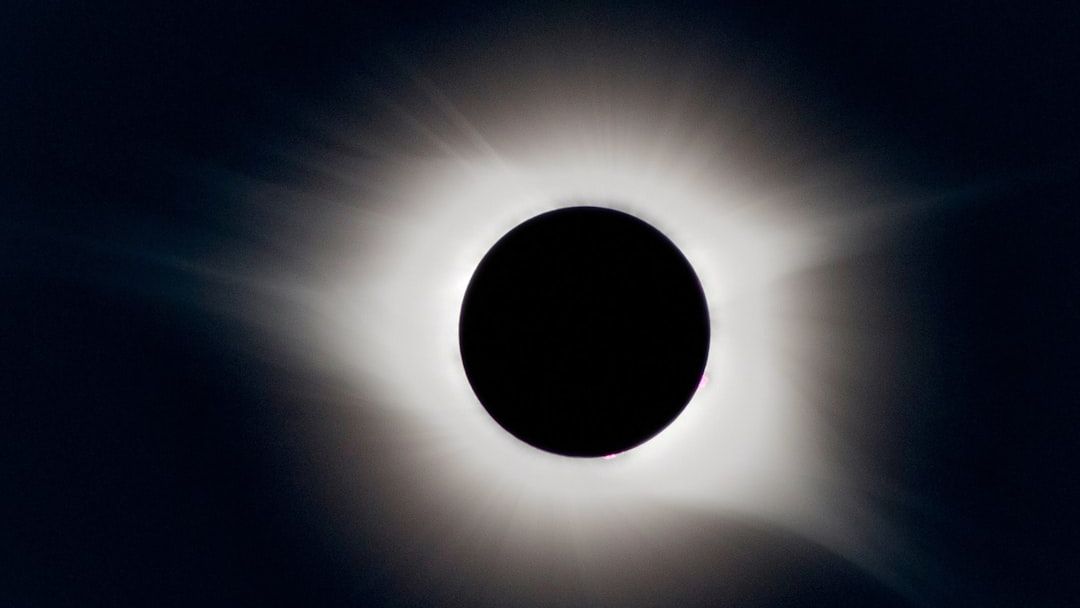
Overcoming the Sun’s Blinding Glow (Image Credits: Unsplash)
Solar wind eruptions have long threatened satellites, power grids, and communication networks on Earth. Researchers faced a persistent obstacle in tracking these events back to their source in the sun’s faint corona. The European Space Agency’s Proba-3 mission, launched in 2024, addressed this by demonstrating a novel technique for generating artificial solar eclipses in orbit. Initial scientific findings from the mission now offer unprecedented insights into space weather’s beginnings, as detailed in a recent Astrophysical Journal Letters publication.
Overcoming the Sun’s Blinding Glow
Astronomers have pursued clearer views of the solar corona for decades. This outermost layer of the sun’s atmosphere fuels the solar wind, yet its subtle glow remains overwhelmed by the star’s intense brightness during most observations. Ground-based telescopes capture it only briefly during natural total solar eclipses, which occur infrequently and unpredictably.
Space-based instruments have employed coronagraphs to block the sun’s disk artificially. These tools, however, struggle with scattered light and internal glare, limiting observation durations to mere minutes. Proba-3 marked a shift by proving the viability of a free-flying coronagraph system, enabling extended, on-demand blockages of solar light.
Precision Formation Flying in Action
The mission relies on two satellites operating in precise tandem. One craft positions itself to occult the sun as seen from the other, which houses scientific instruments. This configuration mimics a total eclipse, allowing clear imaging of the corona for up to several hours at a time.
Launched together in late 2024, the satellites achieved their formation-flying maneuvers successfully. Early tests confirmed the alignment’s stability, a feat requiring sub-millimeter accuracy over vast distances. Such control opens doors to repeated observations, far surpassing the constraints of traditional methods.
First Glimpses into Space Weather Roots
Recent data from Proba-3 has revealed details about the solar wind’s emergence from the corona. Scientists analyzed images capturing dynamic structures in this region, providing a sharper picture of how plasma streams accelerate into space. These observations trace phenomena linked to geomagnetic storms that impact Earth.
The findings highlight variations in coronal features previously obscured. Researchers noted how certain formations correlate with solar wind properties, though fuller analysis continues. Published results underscore the mission’s potential to refine models of space weather propagation.
Pathways to Better Predictions
Enhanced coronal monitoring could transform space weather forecasting. Current predictions rely on indirect proxies, often with hours of delay. Proba-3’s repeatable eclipses promise timelier data, aiding operators of vulnerable infrastructure.
Future campaigns will target specific solar activity phases. The mission’s design supports upgrades, potentially incorporating additional sensors. Key areas for upcoming focus include:
- Tracking streamer evolution over extended periods.
- Mapping magnetic field influences on wind acceleration.
- Validating models against real-time eruptions.
While challenges like orbital adjustments persist, the demonstrated precision bolsters confidence in scaling this approach.
Proba-3 stands as a testament to innovative engineering serving fundamental science. As solar activity ramps up in the coming solar cycle, these orbital eclipses may safeguard technologies reliant on space. Yet questions linger about the corona’s deepest dynamics, awaiting deeper mission dives.