

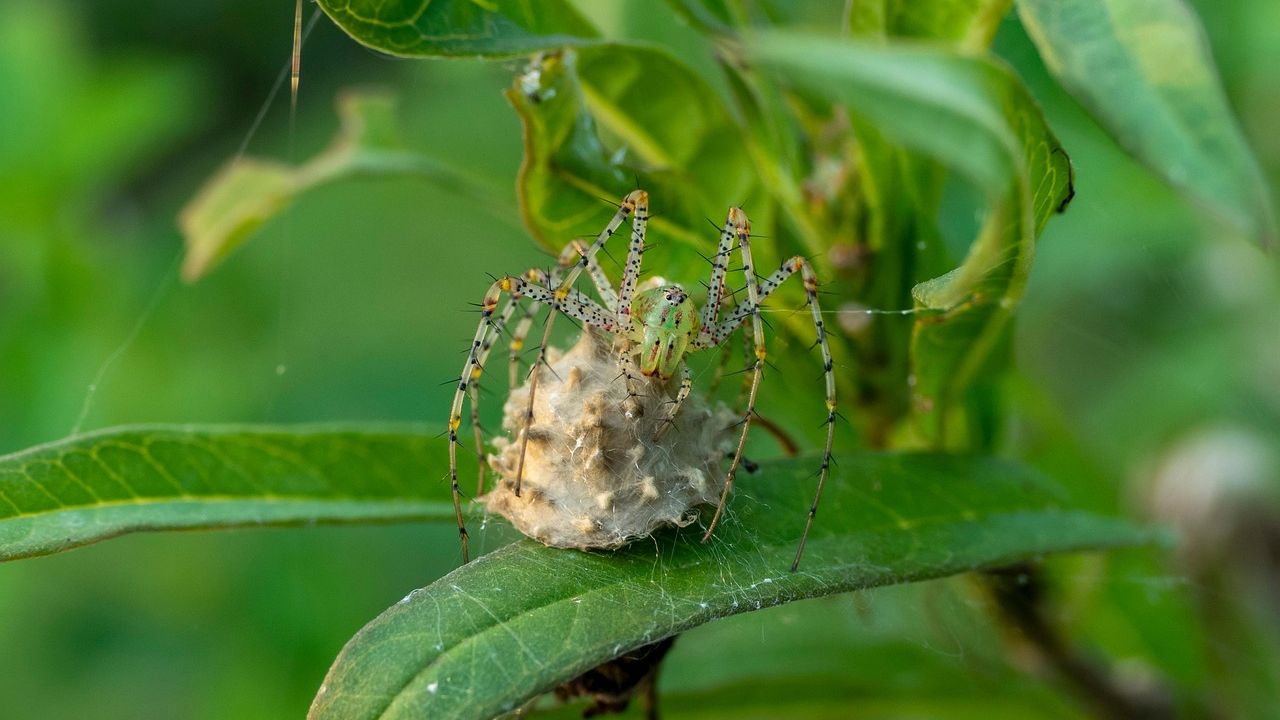
New Insight Into the Evolutionary Arms Race Between Spider Egg Sac Pseudoparasitoids and Active Maternal Care by the Spiders – Image for illustrative purposes only (Image credits: Pixabay)
A wolf spider female meticulously carries her precious egg sac, guarding it against the world’s threats. Yet this devoted behavior, honed by evolution, unwittingly aids a cunning foe lurking in the shadows. Researchers have uncovered how pseudoparasitoid wasps exploit these maternal instincts, turning the spiders’ protective efforts into a lifeline for their own offspring.
The Relentless Pseudoparasitoid Threat
Pseudoparasitoids pose a devastating risk to spider reproduction. These wasps target egg sacs, often leading to complete failure for the host female’s brood. In extreme cases, a single infestation wipes out her entire reproductive output from that sac.
The ichneumonid wasp Hidryta fusiventris exemplifies this strategy. Its larvae develop solely within one spider egg sac, relying on its limited contents for survival. This dependency makes host selection critical for the wasp’s success.
Precision in Oviposition: Size Matters for Wasps
Females of H. fusiventris scrutinize potential hosts with remarkable precision. Their oviposition choices hinge directly on the size of the spider’s egg sac. Larger sacs promise more resources, boosting the chances for larval development.
This targeted behavior highlights an evolutionary counter-adaptation. The wasps evolved to identify high-value targets, maximizing their fitness in a competitive natural world.
The Spider’s High-Stakes First Clutch
Wolf spiders like Pardosa lugubris pour their greatest effort into their initial egg sac. At this stage, their relative reproductive investment peaks, making it a prime target despite timing mismatches.
A notable one-month delay separates the production of this first sac from the wasps’ peak activity. This temporal gap offers P. lugubris a narrow window to evade infestation, preserving some fitness. Still, the overlap in later cycles exposes vulnerabilities.
Unyielding Maternal Instincts Amid Infestation
Even when wasps infiltrate, P. lugubris mothers persist in their care. Infested sacs undergo dramatic transformations – losing spider offspring, altering shape, weight, and texture as wasp pupae form inside. Despite these cues, the spiders continue tending them.
Such persistence benefits the parasites profoundly. The ongoing maternal attention supports proper pupal development, ensuring the wasps’ survival. Researchers observed this behavior across multiple instances, underscoring its reliability from the spider’s perspective.
This dynamic reveals a profound irony in the arms race. The very acts meant to safeguard spider young – carrying, protecting, and maintaining the sac – extend to the invaders. For H. fusiventris, this free labor secures an optimal environment, free from external threats.
Why do the spiders not abandon these doomed sacs? Instinct overrides the physical evidence of loss. This rigidity, while maladaptive here, likely stems from broader survival advantages in unparasitized scenarios.
A Shifting Feast: Eggs, Juveniles, and Chemical Defenses
Once inside, H. fusiventris larvae exploit a versatile food supply. They consume both spider eggs and emerging juveniles, treating them as a prolonged, dynamic resource.
However, the prey evolves too. Chemical changes in P. lugubris during development influence the wasps’ growth and key fitness traits. These shifts could impose limits on the parasites, adding another layer to the ongoing evolutionary contest.
Key Counter-Adaptations:
- Wasp females prioritize larger egg sacs for oviposition.
- Spider peak investment in first sac creates a high-reward target.
- Maternal care continues post-infestation, aiding wasp pupae.
- Larvae feed dynamically on changing spider stages.
Published in Ecology and Evolution, the study by Kostro-Ambroziak and colleagues details these interactions through direct observations (full paper). Their findings illuminate a delicate balance where spider devotion inadvertently tips the scales.
This arms race endures, with each side refining strategies over generations. For now, the wasps hold an edge, courtesy of the spiders’ unyielding motherhood. Such insights not only deepen appreciation for nature’s intricacies but also prompt questions about broader parasite-host dynamics in the wild.