

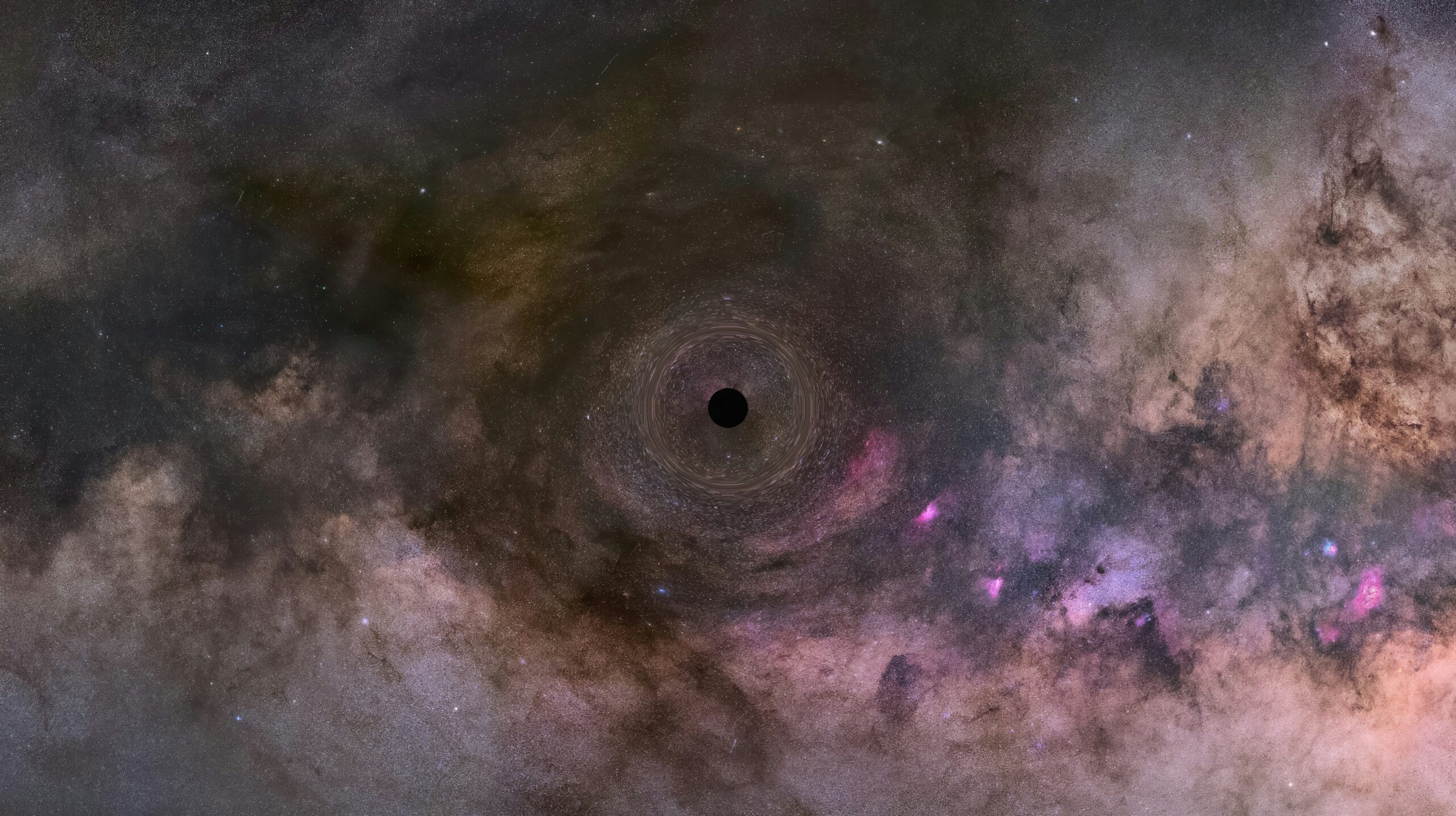
Astronomers Discover Massive Hidden Structures Pointing Straight At Milky Way Black Hole – Image for illustrative purposes only (Image credits: Unsplash)
Researchers have uncovered a population of slender, elongated filaments near the heart of the Milky Way that appear to stretch directly toward Sagittarius A*, the galaxy’s supermassive black hole. These structures, spanning several light-years, challenge long-held views of the galactic center’s radio emissions. Detailed in a recent paper in The Astrophysical Journal Letters, the finding emerged from advanced radio observations and suggests ties to past outbursts from the black hole.
A Startling New Population Emerges
These newly identified filaments measure between 5 and 10 light-years in length and lie flat along the Milky Way’s galactic plane. Unlike the towering vertical filaments previously mapped in the region, which can reach up to 150 light-years high, these run horizontally and cluster on one side of the center. Their orientation creates a radial pattern that converges on Sagittarius A*, hinting at a coordinated origin rather than random placement.
Farhad Yusef-Zadeh, the lead researcher from Northwestern University, described the moment of discovery. “It was a surprise to suddenly find a new population of structures that seem to be pointing in the direction of the black hole,” he said. “I was actually stunned when I saw these.” The team conducted extensive checks to rule out artifacts, confirming the filaments’ reality amid the chaotic radio signals of the galactic core.
MeerKAT’s Sharp Eyes Bring Clarity
The South African MeerKAT radio telescope played a pivotal role in exposing these faint features. Its high sensitivity and resolution allowed astronomers to apply noise-reduction techniques that peeled back layers of interference. Earlier surveys had missed the filaments, overwhelmed by the dense emissions around Sagittarius A*.
“The new MeerKAT observations have been a game changer,” Yusef-Zadeh noted. “The advancement of technology and dedicated observing time have given us new information.” This technical leap not only highlighted the horizontal filaments but also refined maps of the vertical ones, revealing sharper details across the galactic center. Such progress underscores how incremental improvements in instrumentation continue to reshape our understanding of cosmic neighborhoods.
Breaking From the Vertical Filament Mold
Vertical filaments have dominated studies of the galactic center for decades, linked to powerful magnetic fields and fast-moving particles. They stand perpendicular to the galactic plane, emitting non-thermal radiation from near-light-speed electrons. The horizontal filaments, by contrast, show thermal emissions from slower, heated particles interacting with gas clouds and fields.
This difference in emissions and alignment points to distinct formation processes. “We have always been thinking about vertical filaments and their origin,” Yusef-Zadeh remarked. “I’m used to them being vertical. I never considered there might be others along the plane.” The discovery forces a reevaluation of energy flows near the black hole, suggesting layered activity rather than a single dominant mechanism.
Key Distinctions:
- Vertical Filaments: Up to 150 light-years tall, non-thermal emissions, perpendicular to plane.
- Horizontal Filaments: 5-10 light-years long, thermal emissions, parallel to plane, radial toward Sagittarius A*.
Traces of a Black Hole’s Ancient Fury
Observations suggest these filaments arose from an outflow event millions of years ago, when Sagittarius A* underwent a more active phase. Expelled material interacted with surrounding clouds, sculpting the threads into their current form. Their one-sided clustering reinforces this scenario, as the outflow likely followed a preferred direction tied to the black hole’s spin and accretion disk.
“One of the most important implications of radial outflow that we have detected is the orientation of the accretion disk and the jet-driven outflow from Sagittarius A* along the galactic plane,” Yusef-Zadeh explained. “We think they must have originated with some kind of outflow from an activity that happened a few million years ago.” While the finding illuminates past dynamics, it also highlights gaps in direct observations of the black hole’s current quiet state. Future studies with MeerKAT and other telescopes promise to probe deeper into these connections.