

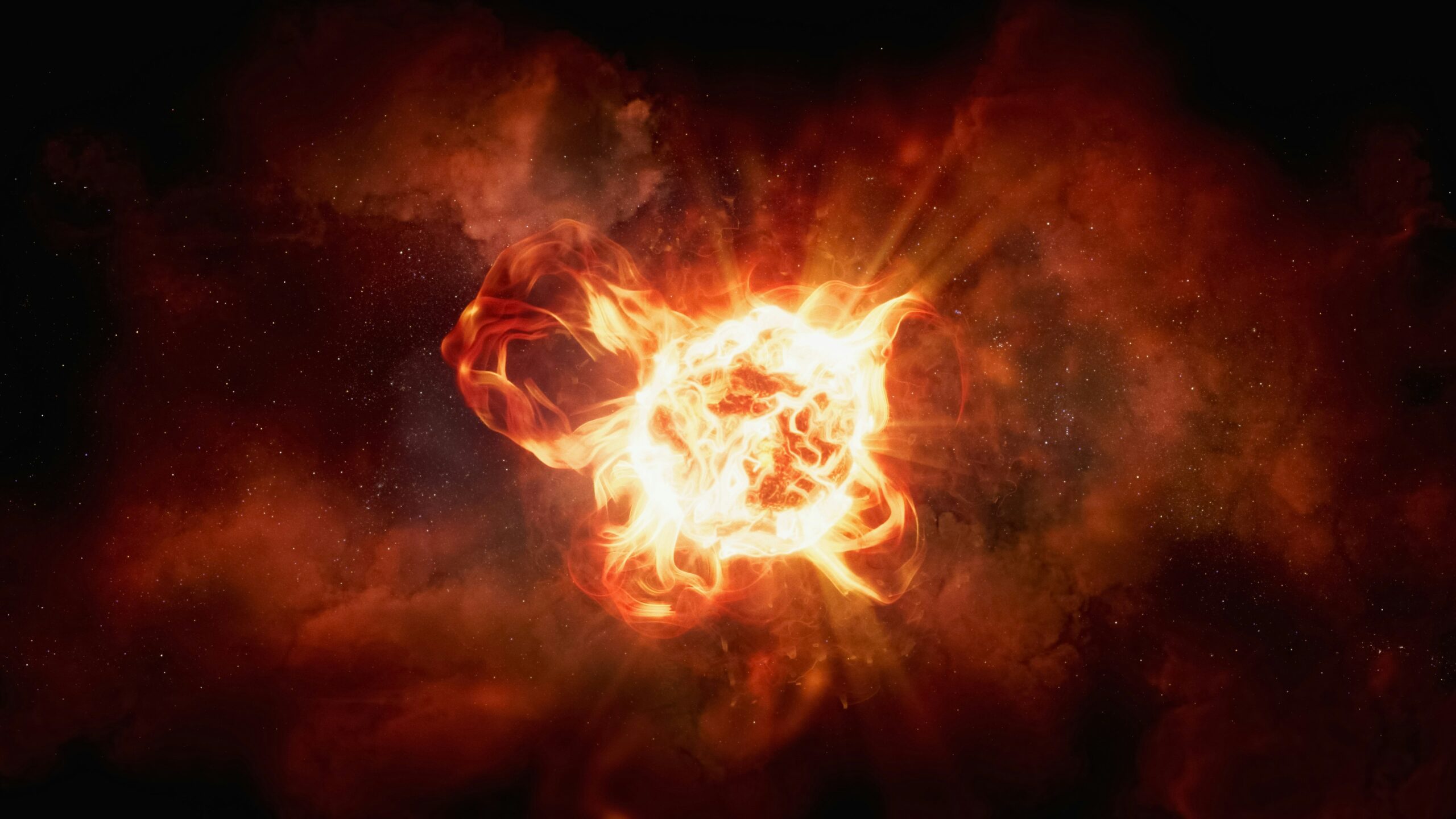
Could violent stellar flares make planets more habitable? – Image for illustrative purposes only (Image credits: Unsplash)
Powerful bursts of radiation from small stars have long raised concerns about their impact on nearby planets. Researchers now argue these events could play a constructive role in fostering conditions for life. A recent analysis published in early April 2026 reveals that such flares might broaden the ultraviolet habitable zone, potentially overlapping with areas suitable for liquid water.
Redefining Zones for Life
Scientists have traditionally defined the habitable zone as the orbital region around a star where temperatures allow liquid water to persist on a planet’s surface. This concept guides much of the search for potentially livable exoplanets. Yet recent work highlights another critical area: the ultraviolet habitable zone, where moderate levels of UV radiation can drive essential prebiotic chemical reactions without overwhelming organic molecules.
The study, detailed in the journal The Innovation on April 6, 2026, integrates both zones for a fuller picture. Low-mass stars like red dwarfs emit less steady UV light, limiting their baseline ultraviolet habitable zones. Flares, however, deliver intense spikes that temporarily boost UV output, effectively widening this zone and bringing it closer to the water-friendly region.
The Dual Nature of Stellar Flares
These explosive releases of energy from M-type red dwarfs and K-type orange dwarfs pose clear risks. Intense radiation and stellar winds can erode planetary atmospheres, especially for worlds in close orbits. For rocky exoplanets, such stripping might render surfaces barren and hostile to life.
Still, the research uncovers a counterbalancing effect. Periodic flares supply the UV doses needed to spark life’s building blocks, compensating for the stars’ otherwise dim output. As the paper notes, “The traditional definition of the circumstellar habitable zone focuses on liquid water, but neglects the crucial role of ultraviolet radiation in prebiotic chemistry.” This perspective shifts flares from mere threats to potential enablers.
Analyzing Nine Promising Exoplanets
The team applied their model to nine exoplanets, eight rocky and one Neptune-like, all circling low-mass stars. These systems represent common setups in the galaxy, where M-type stars alone account for about 70% of stellar population. The TRAPPIST-1 system exemplifies this, hosting seven Earth-sized rocky planets, three within the liquid water zone.
Results showed overlaps between the two habitable zones for three candidates: KOI-8012.01, KOI-8047.01, and KOI-7703.01. Flares enlarged the ultraviolet zone enough to encompass these orbits, suggesting enhanced prospects for chemistry conducive to life. Observations will determine if atmospheres or water persist there.
- KOI-8012.01: Rocky world in overlapping zones post-flare expansion.
- KOI-8047.01: Positioned for balanced UV and water potential.
- KOI-7703.01: Benefits from flare-driven UV boost.
Broader Hunt for Life Beyond Earth
Past efforts prioritized sun-like G-type stars, but low-mass varieties offer more opportunities due to their prevalence. Systems like TRAPPIST-1 draw attention for dense planetary packs near habitable regions. Incorporating flare dynamics refines predictions, identifying overlooked candidates.
Habitability hinges on multiple elements – geology, atmosphere, and composition – beyond zone placement alone. The study emphasizes comprehensive catalogs of dual-zone planets to prioritize targets. “Evaluating habitable zones around stars in various aspects helps us better understand exoplanet habitability,” the authors concluded.
This finding reframes stellar activity as a double-edged sword, urging astronomers to revisit flare-prone systems. While challenges remain, expanded ultraviolet zones hint at hidden potential for life around the Milky Way’s most abundant stars. Future telescopes may soon probe these worlds for signs of biology.