

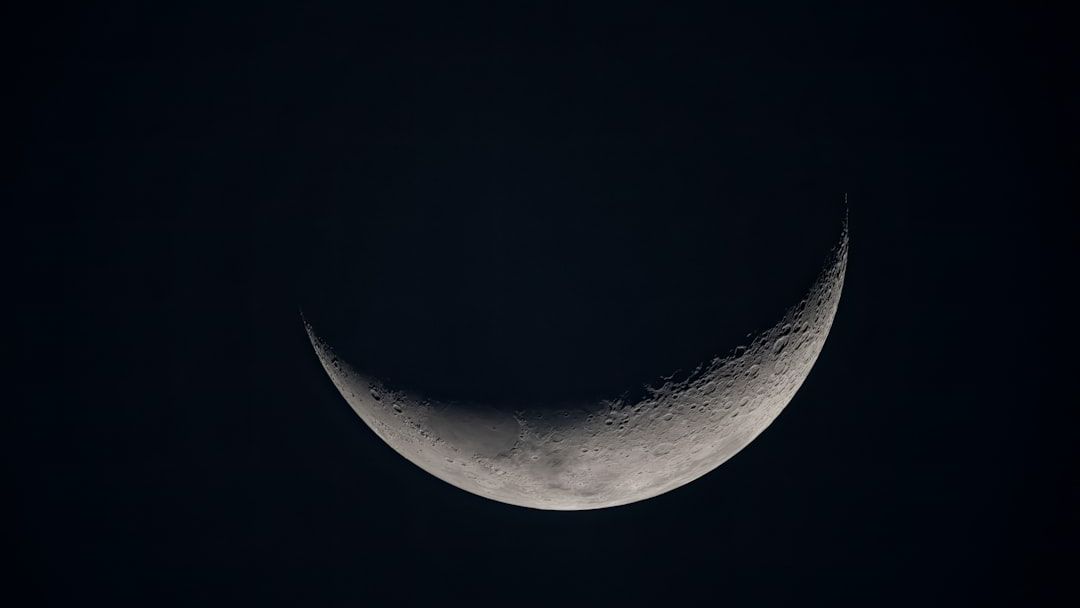
The challenge of celebrating Artemis II as NASA cuts loom – Image for illustrative purposes only (Image credits: Unsplash)
NASA’s Artemis II mission captivated the world last month with its successful crewed flyby of the Moon, the first deep-space human voyage since Apollo 17 in 1972.[1] Four astronauts aboard the Orion spacecraft launched from Kennedy Space Center on April 1, circled the lunar far side, and splashed down safely on April 11 after a 10-day journey.[2][3] This achievement tested critical systems for future landings, yet it arrived amid a stark fiscal challenge: a White House budget proposal that would slash NASA’s science programs by nearly half.[4]
Tracing Artemis II’s Path to Success
The mission began with a flawless liftoff aboard the Space Launch System rocket, propelling Orion beyond low Earth orbit for the first time with humans aboard in over five decades.[5] Crew members conducted dozens of tests on life support, navigation, and communication systems during the outbound leg, which lasted about five days. They captured unprecedented views of the Moon’s far side during a seven-hour flyby, marking the first human eyeball observations of that region.[6]
Reentry proved equally precise, with Orion enduring temperatures exceeding 5,000 degrees Fahrenheit before parachuting into the Pacific Ocean off California’s coast.[7] NASA released thousands of images from the flight, showcasing Earthrise and lunar vistas that echoed Apollo-era wonders while validating technologies for Artemis III’s planned 2028 landing.[8] These steps confirmed Orion’s readiness for sustained lunar operations.
Records Shattered in Deep Space
Artemis II pushed boundaries beyond Apollo’s farthest reach, with Orion venturing farther from Earth than any prior crewed spacecraft.[9] The crew, including NASA’s Reid Wiseman, Victor Glover, and Christina Koch alongside Canadian astronaut Jeremy Hansen, spent time in lunar orbit proximity, performing scientific demos and health checks in microgravity.[10] This diverse team represented international collaboration under the Artemis Accords.
The flight gathered data on radiation exposure and spacecraft performance, essential for mitigating risks on longer Mars journeys ahead. Real-time tracking apps allowed global audiences to follow the trajectory, heightening public engagement with space exploration.[2] Such milestones reinforced NASA’s role in inspiring innovation across engineering and science fields.
Unpacking the Budget Proposal’s Severity
The White House’s fiscal year 2027 request targets NASA’s overall budget at $18.8 billion, a 23% reduction or $5.6 billion less than current levels.[11] Within that, the Science Mission Directorate faces the steepest blow: a drop from $7.3 billion to $3.9 billion, amounting to 47% in cuts.[4] The National Science Foundation would see its funding halved to around $4 billion, curbing grants for basic research.[12]
| Directorate | Current FY (approx.) | Proposed FY2027 | Change |
|---|---|---|---|
| Science Mission | $7.3B | $3.9B | -47% |
| Space Operations | $4.2B | $3.0B | -29% |
| Overall NASA | $24.4B | $18.8B | -23% |
These figures stem from the Office of Management and Budget’s view of certain programs as non-essential, though critics argue they underpin breakthroughs like those enabling Artemis.[13]
Ripples Through Science and Exploration
Proposed eliminations could shutter 41 ongoing or planned missions, from planetary probes to astrophysics observatories already in development.[14] Funding for the Space Launch System, Orion, and Lunar Gateway – core to Artemis – might end prematurely, stalling progress toward a sustainable Moon presence. Earth science and heliophysics efforts, vital for climate monitoring and space weather prediction, would suffer disproportionately.
NSF reductions threaten university research pipelines, where young scientists train on projects feeding into NASA goals. Artemis II’s success relied on decades of such foundational work, from materials science to propulsion advances.[15] Diminished support risks ceding ground to international rivals accelerating their programs.
What Matters Now: Congress holds the purse strings. Lawmakers previously softened similar proposals, boosting NSF and NASA science above requested levels.[16]
Navigating Fiscal Realities Ahead
Senators and representatives, including figures like Ted Cruz, have voiced opposition to the cuts, emphasizing competitive edges in space.[17] Bipartisan spending panels recently increased allocations for science agencies beyond presidential asks. Final appropriations, due later this year, will determine the trajectory.
Historical patterns suggest deep slashes may not materialize, as occurred with prior Trump-era requests.[18] Still, uncertainty lingers, prompting NASA to prioritize core human spaceflight amid tighter resources.
Artemis II demonstrated human ingenuity’s reach, yet sustained exploration demands steady investment in the science that makes it possible. As debates unfold in Washington, the mission’s legacy underscores a fundamental truth: bold steps forward require enduring commitment, not fleeting applause.