

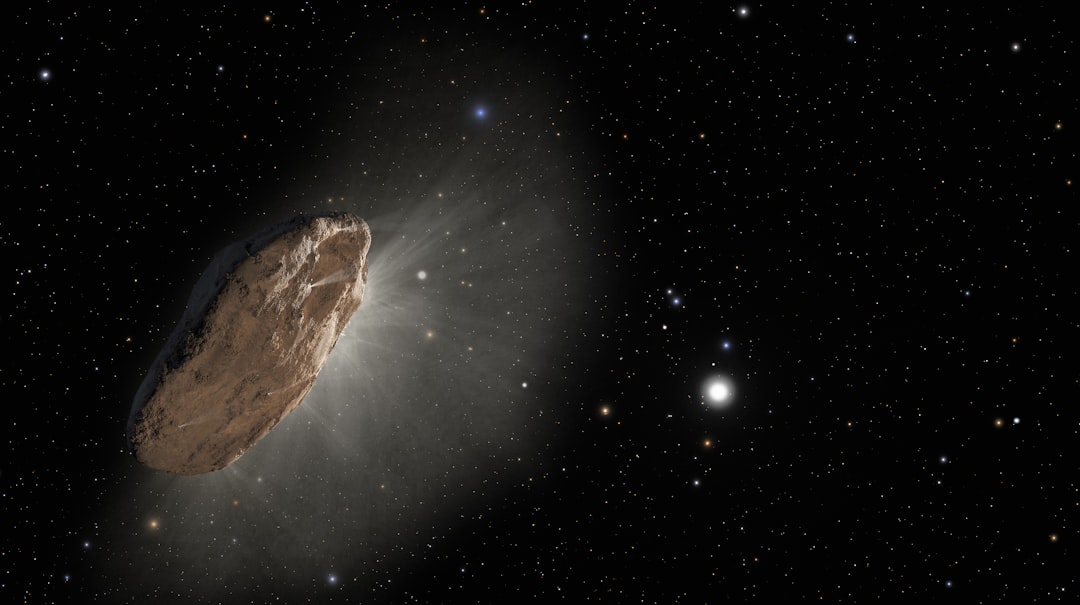
The Week in Space and Physics: The Origins of an Interstellar Comet – Image for illustrative purposes only (Image credits: Unsplash)
Astronomers recently analyzed the composition of an interstellar comet racing through our solar system, uncovering evidence of its formation in an extraordinarily cold environment far beyond familiar cosmic neighborhoods. This visitor, known as 3I/Atlas, carries deuterium levels that dwarf those in Earth’s water or any local comet, hinting at origins around ancient stars in the Milky Way’s distant halo. Such findings reshape assumptions about water’s chemistry across the universe and our own planet’s watery heritage. Meanwhile, parallel advances in physics – from gravity measurements to particle anomalies – remind us how much remains uncertain in the forces shaping reality.
Clues from a Starborn Wanderer
The comet 3I/Atlas hurtled into view not from our solar system’s fringes but from interstellar space, moving too swiftly for the Sun’s gravity to claim it permanently. Scientists tracked its path, speed, and direction, initially suspecting it originated in the Milky Way’s sparse stellar halo, potentially dating back to an earlier era of star formation. As it neared the Sun late last year, observations of its outgassing revealed a comet unlike others, with traits partly attributable to its long, frigid interstellar journey.
Key among these was the deuterium-to-hydrogen ratio in its water – a marker set at formation and preserved through eons. Deuterium, a heavier hydrogen isotope with an extra neutron, enriches water molecules more readily in extreme cold, reversing at higher temperatures. Local solar system bodies reflect this gradient, but 3I/Atlas showed extremes: at least 40 times Earth’s level and 30 times that of known comets. This suggests birth conditions vastly colder and alien to our system, though tracing its full trajectory remains impossible over billions of years.
| Body/Source | Deuterium-to-Hydrogen Ratio | Implication |
|---|---|---|
| Earth’s oceans | 1 in 6,000 hydrogen atoms | Formed in cold outer regions |
| Primordial solar gas (gas giants) | Lower than Earth | Original solar nebula |
| 3I/Atlas comet | 40x Earth’s, 30x other comets | Ultra-cold, extrasolar origin |
Gravity’s Constant Proves Stubbornly Elusive
In 1797, Henry Cavendish devised an ingenious setup to gauge Earth’s density by measuring the faint gravitational tug between lead spheres suspended on a wire. His calculation yielded 5.448 g/cm³ – remarkably close to the modern value of 5.514 g/cm³ – and incidentally revealed the gravitational constant, known as Big G. This value underpins Newton’s law, dictating planetary orbits, satellite paths, and stellar fusion, yet precise measurement has bedeviled scientists ever since.
Gravity’s feebleness and unshieldable nature complicate experiments; even minor disturbances like traffic or wind introduce errors. Recent decades have produced varying results, heightening uncertainty compared to other constants. NIST researcher Stephan Schlamminger revisited a prior setup, identifying overlooked error sources and publishing a new figure in April: 6.67387 × 10⁻¹¹ m³/kg/s². While not resolving discrepancies, it adds a data point, inching toward consensus amid persistent challenges.
Space Tourism Flights Grounded Indefinitely
Blue Origin and Virgin Galactic once heralded a new era, lofting billionaires Jeff Bezos and Richard Branson to space’s edge in a brief 2021 rivalry – Branson edging ahead by days. Blue Origin followed with 17 commercial suborbital hops, reaching higher altitudes than Virgin’s seven flights. Yet both ventures have halted passenger trips, dimming prospects for routine space tourism.
Blue Origin suspended operations earlier this year, redirecting resources to projects like a crewed lunar lander, with no firm resumption date. Virgin Galactic retired its spaceplane in 2024 and unveiled photos last week of a successor ‘Delta class’ vehicle outside a hangar. Test flights may occur soon, with tourist readiness eyed for early next year – if milestones hold. These pauses underscore the field’s fragility, affecting aspiring travelers and the broader vision of accessible space.
LHC Anomaly Hints at Physics Beyond the Standard Model
Over a decade, Large Hadron Collider teams noted deviations in B meson decays, where protons collide to produce these short-lived particles that break into a kaon, pion, and two muons. Researchers scrutinize emergence angles and energies against Standard Model predictions, seeking cracks in our subatomic framework.
Initial signals suggested possible new particles or forces, but statistical flukes often vanish with more data. Here, April analysis showed the discrepancy strengthening with added collisions, bucking the trend. Should this persist, B mesons might unlock novel physics, challenging established theories after years of subtle persistence.
These stories – from a comet’s deuterium signature to gravity’s refinements and particle quirks – highlight humanity’s drive to decode the cosmos despite formidable hurdles. They carry stakes for everyday wonders, like water’s origins on a life-bearing world or the reliability of orbital tech we rely on. As data accumulates, unresolved tensions promise revelations that could redefine our place in an expansive universe.