

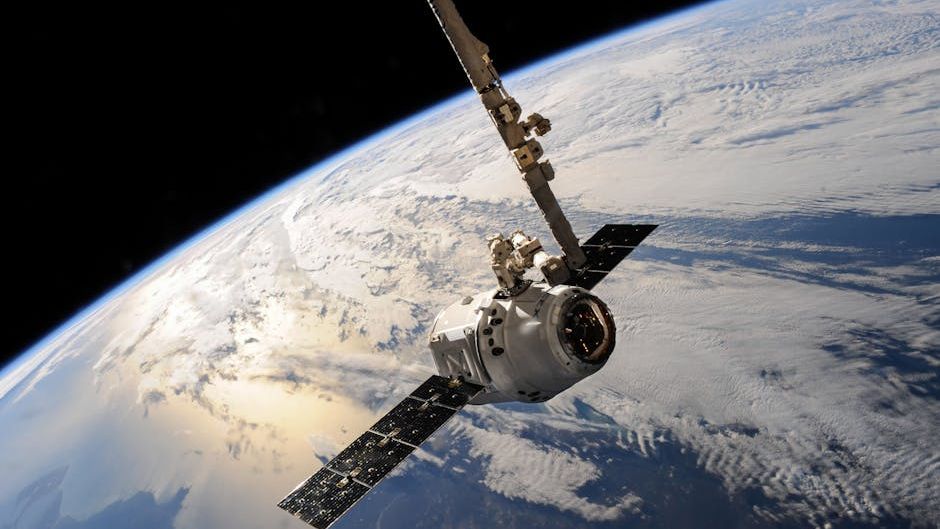
Taking the Pulse of Atmospheric Drag to Predict Satellite Trajectory – Image for illustrative purposes only (Image credits: Pexels)
Atmospheric drag poses the biggest hurdle in forecasting satellite paths in low Earth orbit, where uncertainties in upper atmosphere density models lead to significant errors. Researchers have unveiled a novel inversion tool that leverages energy dissipation rates from individual satellites to derive precise density measurements along their trajectories. This approach promises to sharpen orbit predictions, especially during disruptive events like geomagnetic storms.
Navigating the Drag Dilemma in Low Earth Orbit
Satellites operating below 700 kilometers altitude face constant friction from the thin upper atmosphere, known as the thermosphere. This drag force varies unpredictably, complicating long-term trajectory forecasts essential for collision avoidance and mission planning. Traditional models struggle to capture these fluctuations accurately, often resulting in deviations that grow over time.
Errors stem primarily from incomplete representations of thermospheric density, influenced by solar activity, geomagnetic disturbances, and other space weather factors. Space agencies and private operators alike rely on these predictions to maintain satellite constellations, yet persistent inaccuracies heighten risks in the crowded orbital environment. The new research addresses this head-on by shifting focus to direct, satellite-specific observations.
A Fresh Take on Density Measurement Using EDRs
Mutschler and colleagues introduced an inversion tool that processes energy dissipation rates – EDRs – to estimate neutral mass density directly from a single satellite’s data. Unlike broad atmospheric models, this method generates tailored profiles along the satellite’s path, revealing localized variations. Published in AGU Advances, the study marks the first application of this technique during severe geomagnetic storms.Read the full paper here.
EDRs capture how energy from the atmosphere interacts with the spacecraft, offering a proxy for density that proves more responsive to dynamic conditions. The tool inverts these measurements to produce effective density values, which align closely with independent validations. This single-satellite capability stands out, as it does not require multi-spacecraft coordination.
Probing Responses to Geomagnetic Storms
Geomagnetic storms dramatically alter thermospheric density, expanding the atmosphere and intensifying drag on satellites. The new method excelled in analyzing data from the Kosmos 1508 satellite during such events, highlighting rapid density changes. These observations illuminate how the upper atmosphere reacts to solar wind disturbances, providing data previously hard to obtain from one platform.
By integrating these density estimates, forecasters can better anticipate orbit decays and adjust maneuvers accordingly. The technique also aids in characterizing storm impacts, which could inform broader space weather models. Early results suggest it captures nuances that ensemble models overlook.
Validation Against Established Benchmarks
Researchers compared their tool’s outputs from Kosmos 1508 against densities derived from Swarm-A and Swarm-C satellites, known for precise thermospheric measurements. The effective density curves showed strong agreement, particularly during storm peaks, bolstering confidence in the approach. Space Force effective density estimates further corroborated the findings.
These cross-validations underscore the method’s reliability without relying on assumptions from global models. While initial tests focused on specific storms, the framework holds potential for routine operations across diverse satellites.
- Direct path-specific density from EDRs
- Enhanced storm response characterization
- Alignment with Swarm satellite data
- Path to improved orbit prediction accuracy
As satellite numbers swell in low Earth orbit, tools like this inversion method offer a critical edge in managing drag uncertainties. Alberto Montanari, Editor-in-Chief of AGU Advances, highlighted its value in recent editors’ notes. With further refinements, it could transform how operators safeguard missions amid evolving space weather threats.