

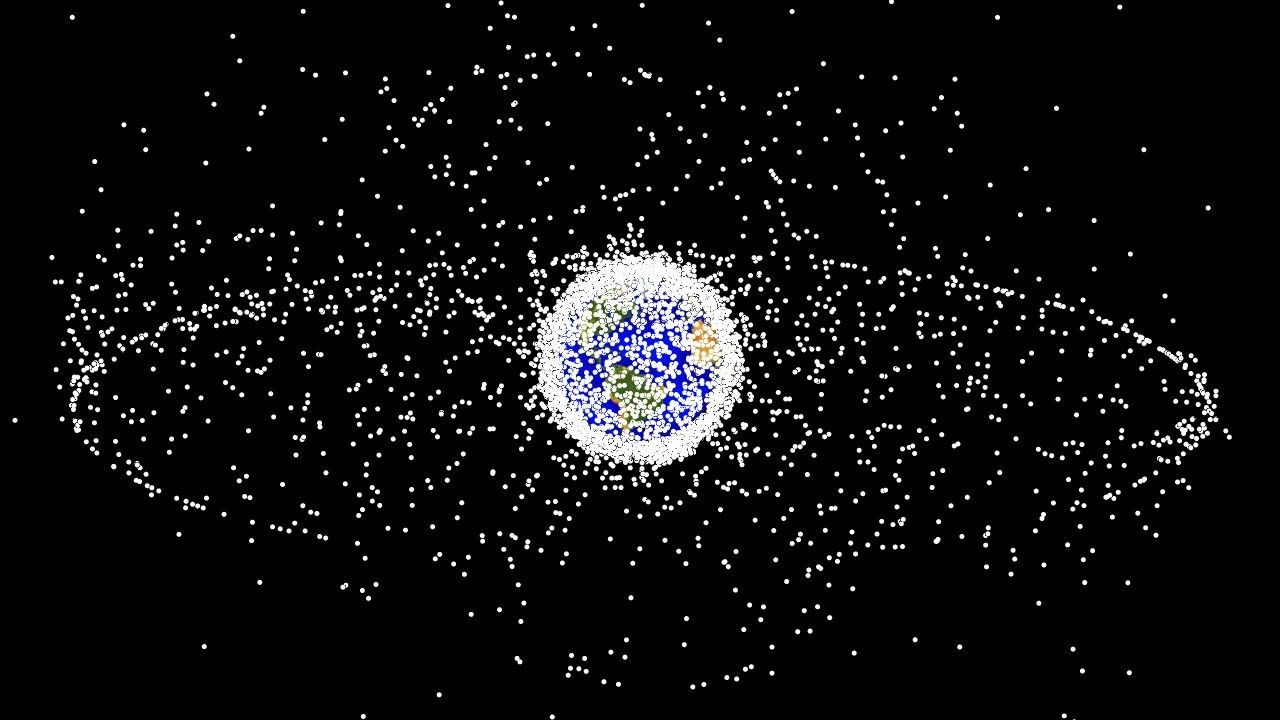
Solar activity makes space junk crash to Earth faster – Image for illustrative purposes only (Image credits: upload.wikimedia.org)
Researchers tracking space junk over three decades have identified a precise tipping point in solar behavior that dramatically hastens its plunge through Earth’s atmosphere. The analysis of 17 low-Earth orbit objects revealed that once sunspot activity surpasses roughly two-thirds of its cycle peak, atmospheric drag intensifies, pulling debris downward at an accelerated rate.[1][2] This discovery, drawn from historical data spanning solar cycles 22 through 24, offers new tools for predicting reentries and safeguarding active satellites.
A Sharp Turn in Orbital Decay
Teams at India’s Vikram Sarabhai Space Centre examined trajectories of debris pieces launched as far back as the 1960s. These objects, circling at altitudes between 600 and 800 kilometers, provided a pure record of natural decay without interference from propulsion systems.[3] Over 36 years, the study correlated their altitude losses with sunspot numbers and solar radio emissions, uncovering a nonlinear response to the sun’s 11-year rhythm.
Decay proceeded steadily until solar activity hit about 67% to 75% of its maximum for each cycle. Beyond that boundary, the rate of descent surged, as confirmed through two-line element sets and atmospheric models.[1] Peak decay diminished across cycles – from stronger effects in cycle 22 to milder ones in cycle 24 – mirroring the sun’s waning output.
Sun’s Heat Swells the Atmosphere
Intense solar emissions, particularly extreme ultraviolet radiation, heat and expand the thermosphere, the uppermost atmospheric layer where low-orbit objects skim. This swelling boosts air density by up to several times, amplifying drag on passing debris.[2] Objects slow incrementally with each orbit, spiraling lower until friction incinerates them upon reentry.
“Here we show that space debris around Earth loses altitude much faster when the Sun is more active,” stated lead author Ayisha M. Ashruf, a scientist at the center.[2] The threshold ties not to absolute radiation levels but to proximity to solar maximum, when processes amplify EUV output. Geomagnetic storms played a minor role, underscoring solar radiation as the dominant force.
- Below threshold: Gradual, linear altitude loss.
- Above threshold: Rapid acceleration due to denser thermosphere.
- Cycle trend: Weaker peaks in recent cycles reduced overall drag impact.
Navigating Risks for Modern Orbits
Nearly 130 million fragments clutter Earth orbit, from defunct satellites to collision shards, posing collision threats to operational craft. While natural decay clears some junk, the process endangers assets below 1,000 kilometers during solar highs.[3]
Satellites mimic debris in facing heightened drag, demanding frequent boosts that consume precious fuel. “Our results imply that when solar activity passes certain levels, satellites – just like space junk – lose altitude faster so that more orbit corrections are required,” Ashruf noted.[3] Missions timed near solar maximum may shorten unexpectedly, complicating designs for constellations like Starlink.
Operators now gain a predictive edge: monitoring sunspots against cycle peaks flags periods of elevated risk. This informs maneuver planning, debris tracking, and even removal strategies, curbing escalation toward cascading collisions.
Legacy Debris Informs Future Skies
Remarkably, 1960s relics endured long enough to yield these insights, proving their value beyond original missions. Refinements to models like MSIS, especially for polar paths, could sharpen forecasts further.[1]
As solar cycle 25 builds toward its crest, space agencies watch closely. The findings underscore a silver lining in solar storms: nature’s occasional sweep of orbital clutter, if harnessed through better forecasting, bolsters the push for sustainable access to space.