

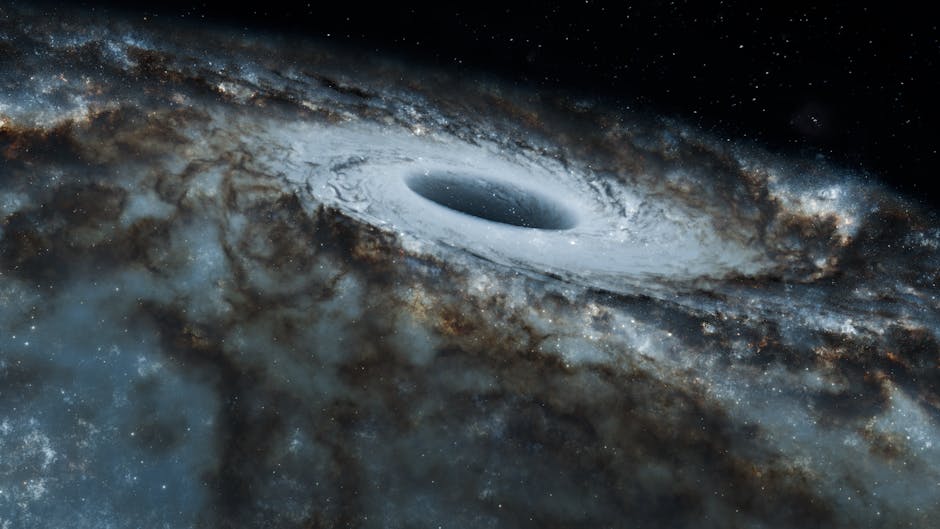
Black Holes Don’t Live Forever, But They Might Live Long Enough To Look Like White Holes – Image for illustrative purposes only (Image credits: Pexels)
Black holes are often portrayed as the ultimate cosmic sinks, swallowing everything that crosses their event horizons. Yet the same quantum processes that allow them to radiate energy also guarantee their eventual disappearance. A recent analysis of how these objects evolve under quantum gravity suggests they do not simply wink out of existence. Instead, they may linger for an extended period in a configuration that closely mimics the behavior of a white hole. This possibility arises from efforts to reconcile general relativity with quantum mechanics, particularly through approaches like loop quantum gravity. The idea challenges the classical view that black holes end their lives in a singular, abrupt termination.
The Slow Leak That Dooms Every Black Hole
Stephen Hawking demonstrated decades ago that black holes are not entirely black. Virtual particle pairs near the event horizon can separate, with one particle escaping as radiation while the other falls inward. Over immense timescales, this Hawking radiation carries away mass and energy, causing the black hole to shrink. For a stellar-mass black hole, the process unfolds over periods far longer than the current age of the universe. Smaller black holes evaporate more quickly, but the largest ones persist for inconceivably long durations. The key point is that evaporation is inevitable once quantum effects are included. No black hole remains static forever.
A Metastable Pause Before the End
As the black hole loses mass and its horizon shrinks, quantum gravity effects become dominant. Calculations indicate that the object can enter a temporary, stable phase where its exterior properties resemble those of a white hole. In this state, the region appears to repel rather than attract matter and light, at least from the perspective of distant observers. The resemblance is not perfect. A true white hole would expel everything that approaches it, but the metastable remnant retains some characteristics of its black hole origins. It remains tiny, with a mass comparable to a small asteroid or less, and its interior may still hold compressed information from everything it once consumed. This phase could last long enough to be considered a distinct stage in the black hole’s life cycle rather than a fleeting transition. The duration of this stage depends on the details of quantum gravity. Current models suggest it could persist for times that dwarf the evaporation period itself, though exact figures remain uncertain and model-dependent.
What Remains Unknown and Why It Matters
Researchers emphasize that this scenario rests on specific assumptions about how spacetime behaves at the Planck scale. Alternative quantum gravity frameworks might produce different outcomes, such as complete disappearance or a different kind of remnant. No direct observational evidence yet confirms the existence of these white hole-like objects, and detecting them would require instruments sensitive to extremely low-energy radiation or subtle gravitational effects. Still, the possibility carries implications for information preservation and the ultimate fate of the universe. If black holes transform rather than vanish, the information they once appeared to destroy could eventually re-emerge. This would ease tensions with quantum mechanics without violating known physics. Future work will focus on refining the transition conditions and exploring whether such remnants could influence late-universe cosmology. For now, the picture remains one of cautious optimism: black holes may not be the final chapter of cosmic evolution but rather a bridge to something quieter and longer-lived.