

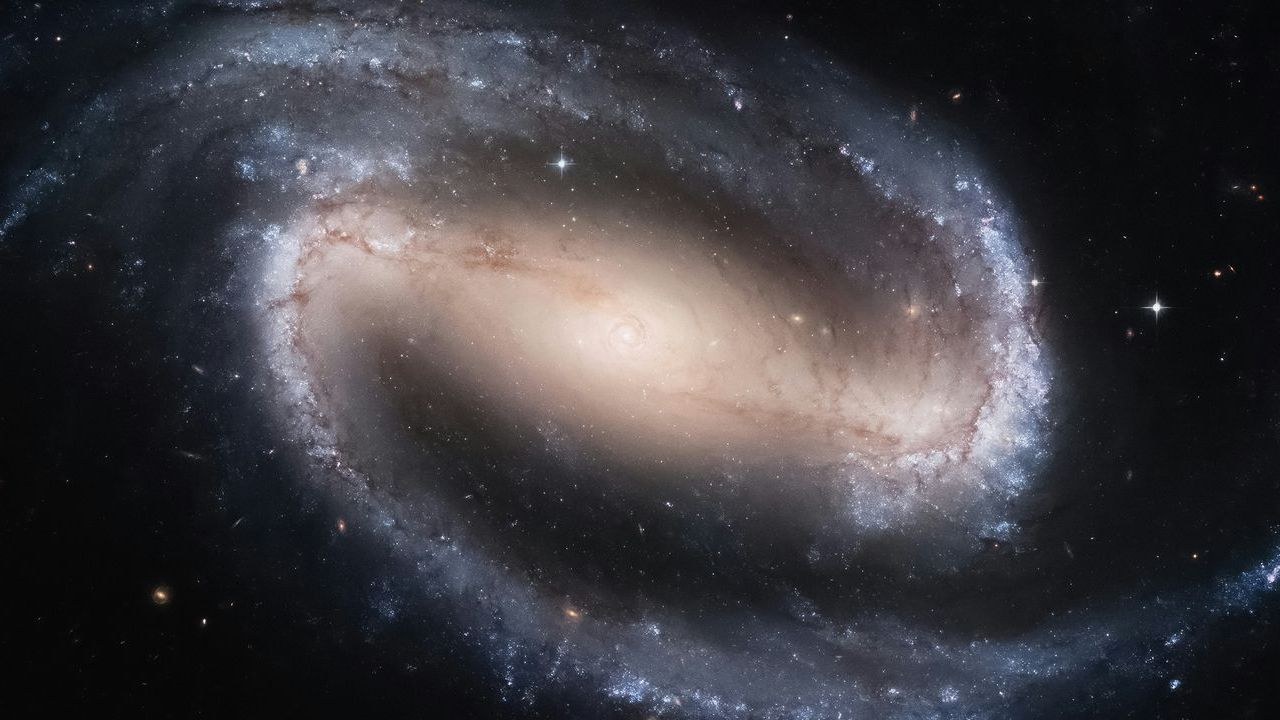
Hubble Capture a Starry Spiral Cosmic Neighbor – Image for illustrative purposes only (Image credits: Unsplash)
The Hubble Space Telescope has delivered a striking new portrait of a spiral galaxy positioned relatively close to our own. The image shows the galaxy tilted at an angle that allows its full disc to stretch across the frame, revealing layers of stellar activity in sharp detail. Astronomers note that such views help map how stars form and evolve within these vast systems.
A Disc Marked by Temperature Gradients
The central region of the galaxy appears in a warm yellow hue, indicating the presence of older, cooler stars that have had more time to settle toward the core. Moving outward, the disc shifts to a pale blue tone, a sign of younger, hotter stars that dominate the outer reaches. This color transition offers a clear visual record of how stellar populations change with distance from the center.
Thin brown filaments of dust thread through the structure, absorbing light and creating subtle shadows against the brighter background. These dust lanes trace the galaxy’s spiral pattern and mark areas where material is concentrated enough to support new star birth. The overall tilt of the disc provides an unobstructed look at these features without the edge-on compression that can obscure details in other galaxies.
Active Regions of Star Birth
Scattered across the disc are glowing pink patches that signal intense star-forming activity. These areas arise where dense gas clouds collapse under gravity, igniting clusters of massive, luminous stars. The pink coloration comes from ionized hydrogen gas energized by the ultraviolet radiation from those young stars.
Interspersed among the pink zones are sparkling blue patches filled with star clusters. These clusters represent groups of stars that formed together and are still tightly bound, shining brightly before they disperse over time. The combination of dust, gas, and young stars creates a dynamic environment that astronomers can study to understand the pace of star formation in spiral systems.
Background Galaxies Add Depth
Behind the main subject, numerous small orange dots appear throughout the frame. These represent galaxies far more distant than the spiral galaxy in the foreground, each contributing to the layered view of the universe captured in a single exposure. Their presence underscores the vast scale of cosmic structures visible even in targeted observations.
The image as a whole demonstrates how Hubble continues to provide high-resolution data on nearby galaxies. Such observations allow researchers to compare star-forming processes across different environments without relying solely on theoretical models.
Key features visible in the image:
- Yellow central disc from cooler stars
- Pale blue outer regions from hotter stars
- Brown dust lanes threading the spiral arms
- Pink glowing spots of active star formation
- Blue sparkling patches of young star clusters
Observations like this one continue to refine our picture of how spiral galaxies maintain their structure while cycling through generations of stars. The details captured here illustrate the ongoing balance between star birth and the distribution of stellar ages across galactic discs.