

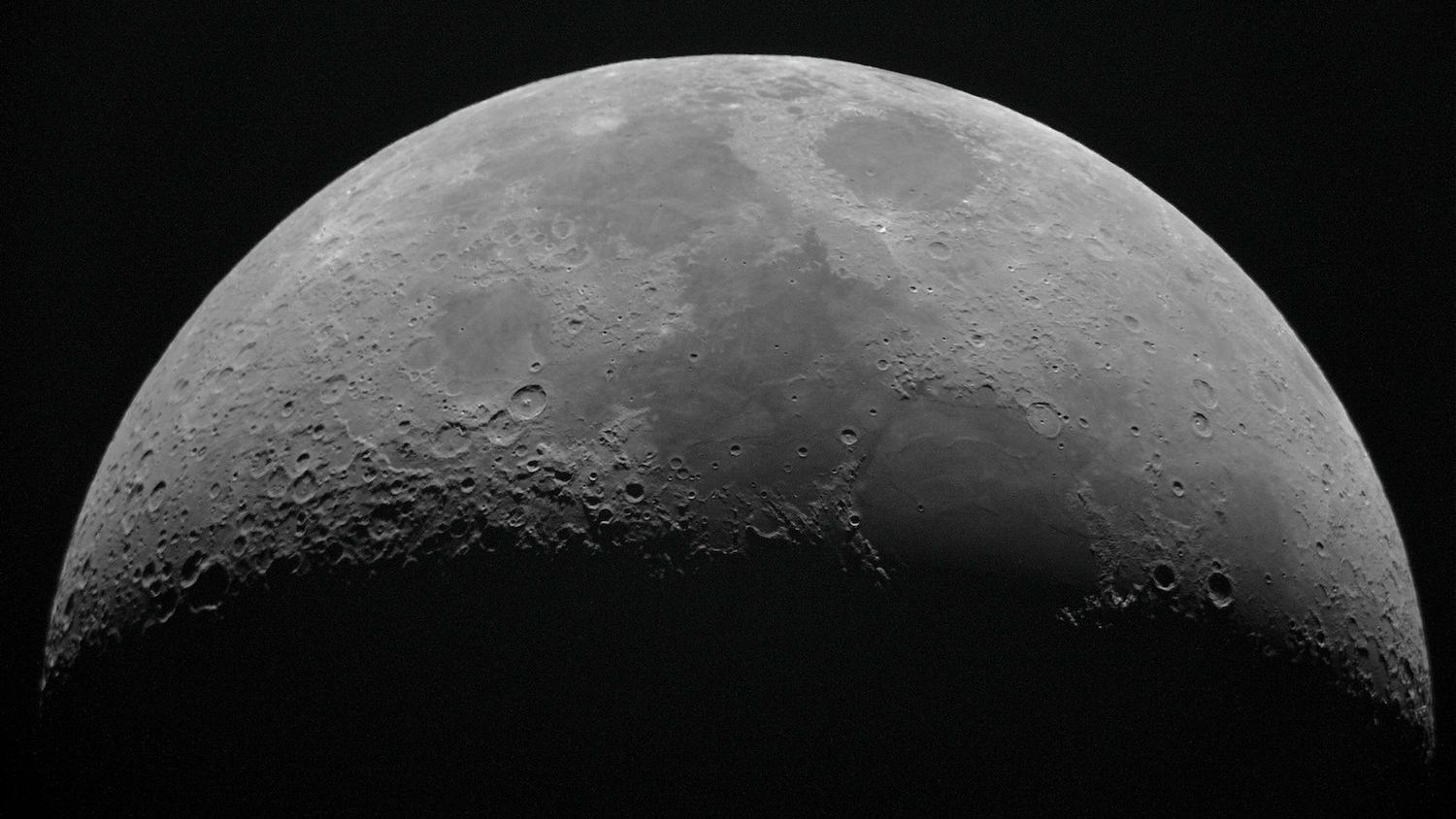
The same precision sensor that kept Webb locked on galaxies 13 billion light-years away has been quietly miniaturized – and it’s about to solve the navigation problem nobody wanted to discuss on the way to the Moon – Image for illustrative purposes only (Image credits: Unsplash)
Lunar missions face a stubborn reality. Spacecraft heading to the Moon’s south pole cannot count on GPS signals, and no dedicated lunar navigation network exists yet. Recent landing attempts have shown how quickly small errors in position or orientation can turn into mission failures. Northrop Grumman has responded by shrinking guidance hardware first proven on the James Webb Space Telescope into a compact unit built for commercial lunar flights.
The Navigation Gap Above Earth
GPS satellites orbit Earth and direct their signals downward. Vehicles in low Earth orbit can still receive them by looking sideways, but once a spacecraft climbs past geostationary altitude the geometry fails. Beyond that point, lunar landers and deep-space probes must rely entirely on what they carry onboard. The absence of external references leaves operators with one practical option: precise inertial sensors that track rotation and acceleration without outside help.
Every inertial measurement unit accumulates small errors over time. The longer a spacecraft flies without a star-tracker update or ground signal, the larger those errors grow. For a lander making a powered descent, even modest drift can shift the touchdown point by hundreds of meters. For a relay satellite holding position in a distant orbit, the same drift limits how long the craft can maintain its pointing before corrections are needed.
Technology Proven at L2
The James Webb Space Telescope reached its station at the Sun-Earth L2 point in January 2022. Keeping its segmented mirror steady enough to observe galaxies billions of light-years away required attitude control far tighter than most missions demand. Northrop Grumman, which built the telescope’s spacecraft bus, developed the original gyroscopes and pointing electronics to meet that standard for years without maintenance.
Engineers have now miniaturized that same lineage into the LR-450 inertial measurement unit. At its core is a miniature hemispherical resonating gyroscope that senses rotation through vibrations in a small resonator rather than spinning parts. The design eliminates wear from moving mass and reduces power draw, making it suitable for smaller commercial spacecraft. The unit is intended for satellites operating from Earth orbit out to deep space, including lunar landers and relay vehicles.
Commercial Demand Rising Fast
NASA’s Commercial Lunar Payload Services program has awarded contracts to several companies, and private operators are scheduling repeated flights. Each mission needs reliable guidance hardware that does not depend on signals from Earth. Northrop Grumman is offering the LR-450 as a ready-made solution that carries flight heritage from a flagship observatory rather than requiring new development from scratch.
The company’s approach fits a broader pattern in aerospace. Hardware refined for high-stakes government missions is later adapted for commercial use once the technology matures. Lunar operations have become one of the newest markets for that transfer. Operators planning water prospecting, cargo deliveries, and science payloads all need spacecraft that can reach their intended locations without repeated failures that raise costs and delay schedules.
Layered Systems for the Future
The LR-450 is not presented as a complete replacement for satellite navigation. Instead, it forms one layer in a combined architecture. Future lunar spacecraft are expected to blend inertial data with star trackers, Earth-based ranging, optical landmark recognition near the surface, and signals from any lunar navigation constellation that eventually launches. Each element compensates for the limitations of the others.
Until those constellations reach full operation, self-contained sensors remain essential. The same precision that kept Webb locked on distant targets is now being applied to keep commercial landers on course during the final minutes of descent. That shift marks a quiet but practical step toward routine lunar traffic rather than isolated demonstrations.