

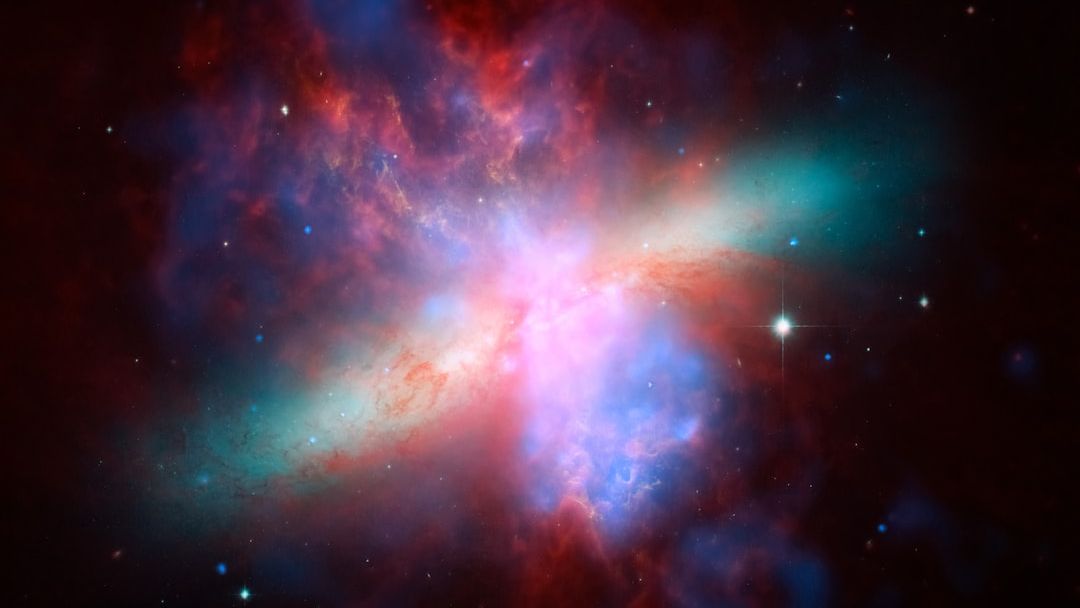
Researchers uncover chemical origins of the Perseus cluster of galaxies – Image for illustrative purposes only (Image credits: Unsplash)
Astronomers have long faced a stubborn mismatch between observed chemical signatures in the Perseus galaxy cluster and what standard supernova calculations predicted. The cluster, a dense collection of galaxies lying in the direction of the Perseus constellation, contains vast reservoirs of hot gas whose elemental makeup records the cumulative output of billions of stellar explosions across cosmic history. An international team has now produced updated stellar and supernova models that align closely with those measurements. Three studies published in The Astrophysical Journal present the revised framework and demonstrate how it accounts for abundance patterns that earlier theories could not explain.
The Scale of the Chemical Record
The Perseus cluster sits among the nearest and best-studied massive galaxy clusters, making its gas properties relatively accessible to X-ray observatories. Within that gas, astronomers measure ratios of elements such as iron, silicon, and oxygen that trace back to different types of supernovae. Each explosion type releases a characteristic mix of heavy nuclei, yet the integrated signal from countless events over billions of years has proven difficult to reproduce with conventional assumptions about stellar masses and explosion energies. The new work shows that modest adjustments to how stars evolve and how their cores collapse can bring theoretical yields into agreement with the data.
Why Earlier Calculations Fell Short
Traditional models assumed relatively uniform supernova populations and fixed yields across different stellar generations. Those simplifications produced abundance ratios that deviated systematically from the cluster observations, particularly for elements produced in the highest-mass stars. Researchers found that incorporating more realistic variations in initial stellar masses, rotation rates, and explosion mechanisms narrows the gap. The studies emphasize that the mismatch was not a flaw in the observations themselves but a limitation in the theoretical inputs used to interpret them.
Refinements Introduced by the New Models
The updated calculations treat the full life cycle of stars more comprehensively, from their formation through core collapse or thermonuclear runaway. They also allow for a broader range of explosion energies and mixing efficiencies inside the ejecta. When these parameters are varied within observationally motivated bounds, the predicted elemental ratios converge on the values measured in the Perseus cluster. The three papers together map how different supernova channels contribute to the final chemical inventory and identify which adjustments produce the strongest improvements in fit.
What the Agreement Implies for Galaxy Evolution
A consistent chemical model strengthens the broader picture of how galaxy clusters assemble their baryonic content. It suggests that the same supernova physics operating in the early universe can explain both the enrichment of the intracluster medium and the metal content of present-day galaxies. At the same time, the studies note that uncertainties remain in the precise fraction of stars that end their lives in each supernova channel. Continued refinement of these fractions will be needed before the models can be applied confidently to more distant clusters where direct measurements are harder to obtain.
Next Steps in Cluster Chemistry Research
Future observations with higher-resolution X-ray spectrometers will test the predictions at greater detail, particularly for rarer elements whose yields are most sensitive to the new parameters. The same modeling approach is already being extended to other nearby clusters to check whether the revised supernova yields hold universally. While the Perseus results mark a clear advance, astronomers stress that the chemical history of the universe still contains open questions about the earliest generations of stars and the role of rare, high-energy events.