

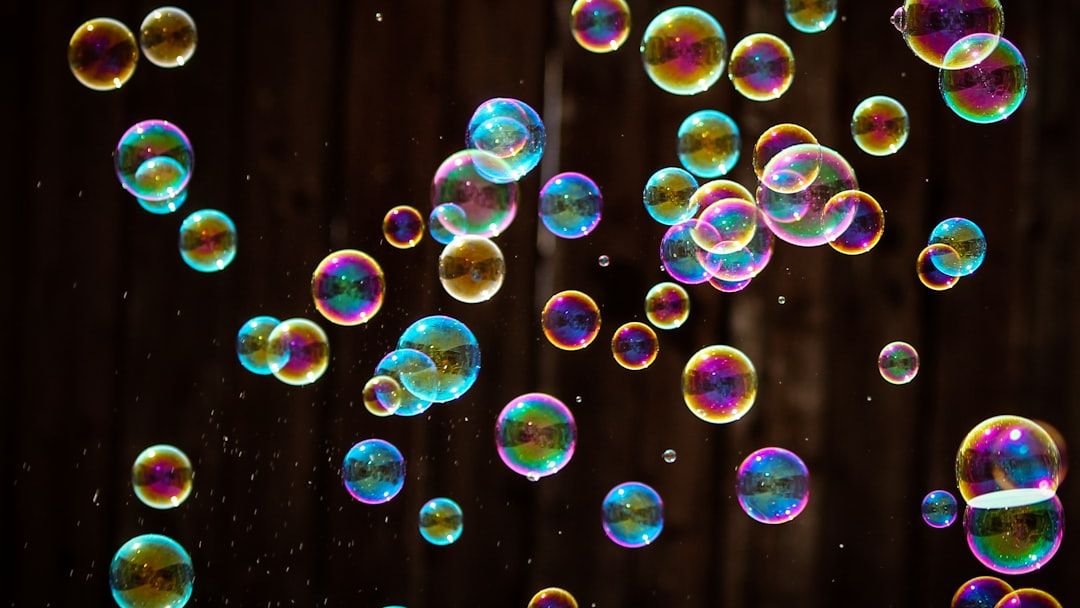
Water drops on soap bubble films act like merging galaxies – Image for illustrative purposes only (Image credits: Unsplash)
Scientists have found that water droplets placed on thin soap films can orbit one another and eventually merge in patterns that closely resemble the collisions of galaxies. The simple laboratory setup offers a controlled way to examine processes that normally unfold across millions of light-years and billions of years. Researchers see the technique as a practical addition to existing tools for studying cosmic evolution, though they stress that it remains an analogy rather than a direct replica of astronomical conditions.
Why the Analogy Holds
Galaxies merge when gravitational forces pull them together, causing their stars, gas, and dark matter to interact in complex ways. In the soap-film experiments, surface tension and fluid dynamics produce similar orbital motion and coalescence. The droplets slow down, spiral inward, and combine without losing the overall structure of the film, mirroring how galaxies retain much of their identity even after a merger.
The parallel is not perfect. Soap films operate under everyday laboratory forces, while galaxies respond to gravity on vastly different scales. Still, the visual and dynamical similarities allow researchers to test ideas about angular momentum and energy transfer that are difficult to isolate in telescope data alone.
Setting Up the Laboratory Version
Creating the films requires a stable frame and a carefully mixed soap solution that forms a thin, flexible membrane. Small water droplets are then introduced onto the surface with precise control over size and placement. Once released, the droplets begin to move under the influence of the film’s tension and any slight air currents or tilts in the apparatus.
High-speed cameras record the motion at thousands of frames per second. The resulting footage shows the droplets tracing curved paths before they touch and combine into a single larger drop. These sequences can be slowed down and measured to extract quantitative data on velocity, separation distance, and final merger time.
What the Observations Reveal
Early results indicate that the droplets conserve angular momentum during their approach, much as galaxies do. The film itself acts as a two-dimensional medium that transmits forces without the three-dimensional complications of interstellar space. This simplification lets scientists focus on specific aspects of the interaction, such as how orbital energy dissipates into the surrounding medium.
Because the experiment can be repeated under identical conditions, it provides statistical samples that are hard to obtain from rare galactic events. Multiple runs reveal consistent patterns in how quickly mergers occur and how the final combined drop settles into equilibrium.
Current Limits and Next Steps
The soap-film model cannot reproduce dark matter, magnetic fields, or the enormous distances involved in real galaxy mergers. It also lacks the ability to simulate the star formation triggered by galactic collisions. Researchers therefore treat the results as complementary insights rather than replacements for computer simulations or telescope observations.
Future work may involve varying the soap solution’s viscosity or introducing controlled disturbances to the film. These adjustments could help isolate how different physical parameters affect merger outcomes. The approach remains inexpensive and repeatable, qualities that make it attractive for testing theoretical predictions before committing resources to more complex models.
The technique underscores how everyday materials can illuminate processes that shape the universe on its largest scales. Continued refinement may allow the method to contribute to broader questions about how galaxies assemble and evolve over cosmic time.