

Apollo 11’s guidance software couldn’t be patched at the last minute. It was woven with copper wire by women at Raytheon, where one mistake could mean starting again – Image for illustrative purposes only (Image credits: Unsplash)
On July 16, 1969, Apollo 11 lifted off carrying a guidance computer whose flight program had already been locked into place weeks earlier. The software existed not as lines of code that could be revised but as a physical pattern of copper wires threaded through thousands of tiny magnetic cores. Once the weaving was complete, any significant change required starting the entire module over from the beginning. That constraint shaped every decision leading up to the mission.
The Computer That Had to Work the First Time
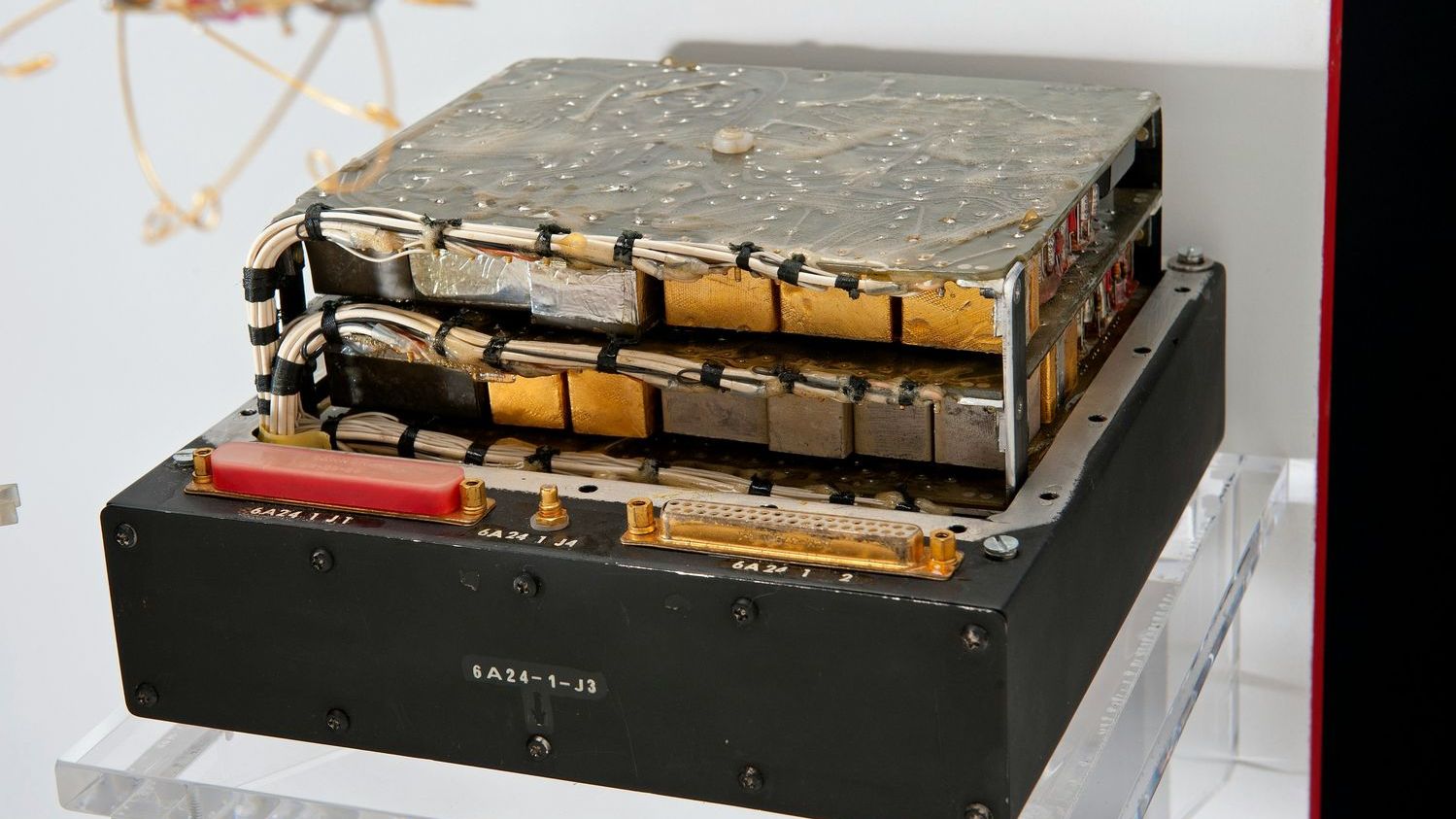
The Apollo Guidance Computer, developed at MIT and manufactured by Raytheon, weighed about 70 pounds and occupied less than a cubic foot inside the spacecraft. Its Block II version ran at roughly 2 megahertz and held 4 kilobytes of erasable memory for calculations plus 72 kilobytes of permanent memory for the flight program. These numbers seem modest today, yet they represented a leap in miniaturization that helped push the early integrated-circuit industry forward. NASA’s purchases of the chips gave manufacturers the volume they needed to refine production techniques that later appeared in consumer electronics.
During the lunar descent, the computer encountered unexpected program alarms numbered 1201 and 1202. It did not shut down. Instead, it automatically dropped lower-priority tasks while preserving the critical guidance functions, allowing the crew to continue. The machine had been engineered from the start for real-time operation and graceful recovery from errors, qualities that set it apart from most ground-based computers of the era.
Core Rope Memory Turned Software Into Hardware
The permanent memory relied on a technique called core rope memory. Tiny ferrite cores, each about the size of a doughnut hole, were arranged in grids. A sense wire passed through the center of a core to represent a binary one; the same wire passed around the core to represent a zero. When current flowed, the cores registered the difference magnetically, and the pattern of wires became the program itself. Once the wires were in place, the code could not be edited without physically rebuilding the module.
Engineers estimated that wiring a single rope module took roughly eight weeks and cost around fifteen thousand dollars in 1960s dollars. Multiple modules were required for the full flight program. Because the memory was read-only and physically fixed, the final version of the software had to be frozen months before launch so the weaving, inspection, and testing could finish on schedule.
The Women Who Performed the Weaving
At Raytheon’s plant in Waltham, Massachusetts, teams of women carried out the actual threading. Many had come from the local textile mills and the Waltham Watch Company, where precision work with small components was already familiar. The task demanded steady hands and near-perfect accuracy across thousands of cores in a precise sequence. A single misplaced wire could render an entire module unusable.
Raytheon and NASA inspectors reviewed each completed module multiple times. Federal oversight teams visited regularly to verify compliance with the contract. The women understood the stakes: they were assembling the guidance system for a mission that would carry astronauts to the Moon. Their work was documented in technical records and later preserved in collections at the Smithsonian National Air and Space Museum.
Why Modern Software Looks So Different
Today’s programs can be updated wirelessly even after a spacecraft has left Earth. Bugs discovered in flight can be corrected in the next build. Apollo 11’s guidance code had none of those options. Every instruction had to be correct before the wires were threaded, because the cost of an error was measured in months of lost work and, more importantly, in the safety of the crew.
The physical permanence of the rope memory forced a discipline that later generations of software development largely left behind. Engineers had to verify the logic thoroughly in advance rather than relying on the ability to patch problems after deployment. That approach produced a system reliable enough to handle the alarms during descent and still complete the landing.
A Lasting Reminder of Careful Engineering
The copper-wire memory of Apollo 11 stands as a concrete example of software that could not be revised once it left the factory floor. The women who wove it, the engineers who designed it, and the inspectors who approved it all worked under the same rule: the final product had to be right the first time. That standard helped carry three astronauts safely to the lunar surface and back, and it continues to illustrate what is possible when error is treated as something to be eliminated rather than corrected later.