

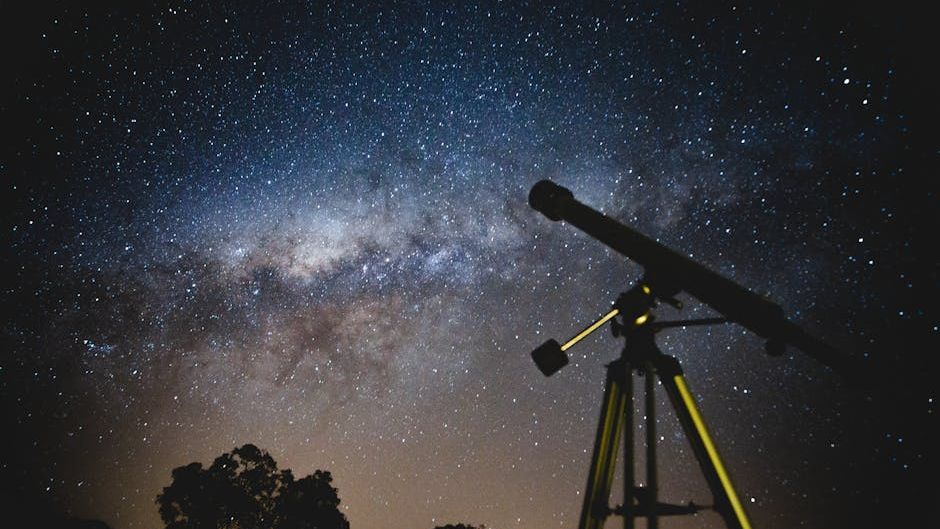
A brief history of the cosmic distance record – Image for illustrative purposes only (Image credits: Pexels)
Human eyes can only reach so far into the night sky. The most distant object visible without aid sits roughly three million light-years away. Telescopes changed that limit almost immediately and have continued to do so ever since.
Early catalogs stretched the visible universe
Charles Messier’s 1779 list included galaxies tens of millions of light-years distant. William Herschel’s 1786 catalog pushed the frontier to more than two hundred million light-years with NGC 1. Those entries remained the record for nearly a century because photographic plates and larger mirrors were still decades away.
By the late 1800s, improved photography captured objects billions of light-years away. The quasar OJ 287, first imaged in 1887, later proved to lie 3.5 billion light-years distant once redshift measurements became reliable in the 1960s. Cluster galaxies in Coma and Hydra soon joined the list, crossing the billion-light-year mark by 1932.
Quasars and radio galaxies took the lead
Radio surveys in the 1960s revealed quasars at redshifts greater than two. One such object, 3C 9, sits sixteen billion light-years away. Quasars held the distance crown until 1997, when a pair of lensed galaxies in cluster CL 1358+62 reclaimed it for ordinary star-forming systems.
Gravitational lensing helped again in 2002. Galaxy HCM-6A, magnified by the foreground cluster Abell 370, reached nearly twenty-eight billion light-years. The record then moved to a gamma-ray burst in 2009, observed at thirty billion light-years with a modest ground-based telescope.
Space telescopes reset the scale
Hubble’s deep fields delivered GN-z11, a galaxy seen when the universe was only about four hundred million years old. That object held the record for several years until the James Webb Space Telescope began operations. JWST’s infrared sensitivity quickly found galaxies at redshifts above thirteen.
The current record belongs to MoM-z14, confirmed in 2025 at 33.8 billion light-years. Light from this galaxy left when the universe was less than three hundred million years old. Spectroscopy from JWST’s NIRSpec instrument verified its distance through the characteristic Lyman break and emission lines from ionized atoms.
What the record still cannot reveal
Each new detection shows galaxies forming earlier than many models predicted. Yet the exact timing of the first stars and the role of dark matter in those earliest structures remain open questions. Future observations, especially of strongly lensed systems behind massive clusters, may push the record even farther while answering some of those puzzles.