

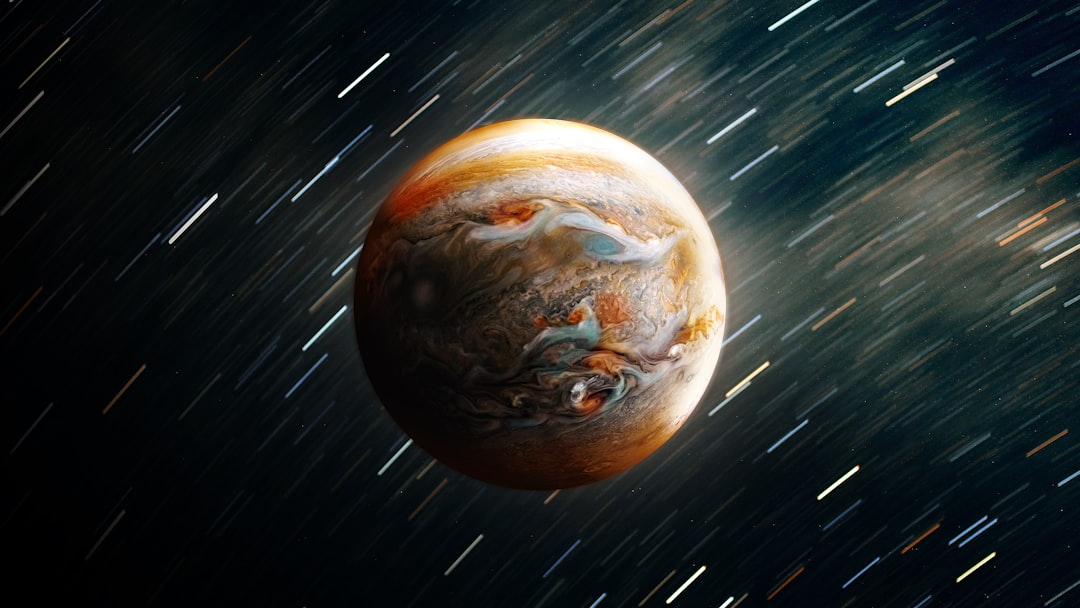
超级闪电之外-隐形超级风暴揭示木星上的闪电 – Image for illustrative purposes only (Image credits: Unsplash)
Lightning on Jupiter has long served as a key marker of active weather systems in the planet’s turbulent atmosphere. Researchers have used these flashes to probe deeper into how convection shapes the gas giant’s climate. Recent analysis of data from NASA’s Juno spacecraft, however, has drawn attention to a different kind of storm that operates largely out of sight.
Earlier Views Focused on the Brightest Flashes
For years, studies of Jupiter’s lightning relied heavily on nighttime observations from distant spacecraft. Those efforts captured the most intense bolts and led many scientists to conclude that Jovian lightning resembled Earth’s rare superbolts. The assumption seemed reasonable because only the strongest events stood out against the planet’s bright clouds.
That picture began to change when Juno’s sensitive star tracker camera recorded faint, shallow lightning during daylight passes. The new detections suggested that weaker flashes occur more often than previously thought and that they might arise under different atmospheric conditions.
Hidden Storms Provide a Clearer Window
Researchers zeroed in on powerful, isolated storms in Jupiter’s North Equatorial Belt during 2021 and 2022. They labeled these features invisible superstorms because the storms remain difficult to spot in visible light yet produce measurable electrical activity. The storms’ concentrated structure allowed scientists to pinpoint lightning locations with greater accuracy than in earlier surveys.
Instead of relying solely on optical cameras, the team examined readings from Juno’s microwave radiometer and Waves instrument. Radio emissions travel through thick cloud layers that block visible light, giving researchers access to lightning signals that would otherwise stay hidden. This approach revealed electrical activity occurring roughly three times per second inside the storms.
The measured radio pulses match the frequency seen in some previous nighttime studies. Intensity comparisons remain less certain. Some signals appear similar in strength to typical Earth lightning, while differences in radio frequencies between the two planets leave open the possibility that others could be far more energetic.
What the Findings Mean for Atmospheric Science
The presence of lightning inside these hidden superstorms points to vigorous upward motion of moist air even in regions that look calm from a distance. Such motion helps drive the planet’s overall heat transport and cloud formation. Understanding where and how often these storms occur could improve models of Jupiter’s deep atmosphere.
Scientists still face limits in translating radio measurements directly into visible-light brightness or total energy release. Continued Juno observations and future missions will help narrow those gaps. For now, the data show that Jupiter’s lightning is more varied and more widespread than earlier snapshots suggested.
Looking Ahead
The Juno results underscore how targeted instrument use can uncover weather processes that remain invisible to standard imaging. As the spacecraft continues its extended mission, similar techniques may reveal additional storm types across other latitudes. Each new detection adds detail to the picture of a dynamic world whose weather never truly settles.