

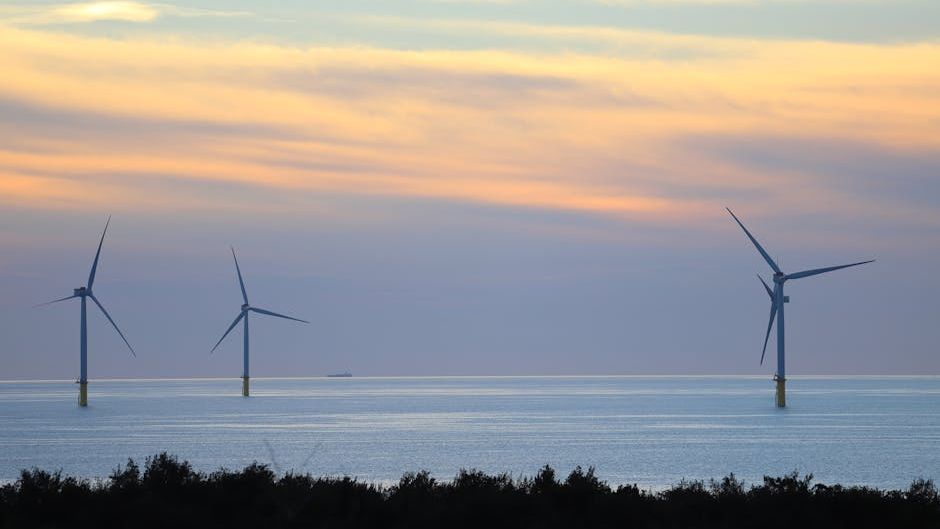
China installs world’s largest floating wind turbine in deep water test – it generates enough energy to power 4,200 homes annually – Image for illustrative purposes only (Image credits: Pexels)
China has completed installation of the world’s largest floating offshore wind turbine as part of a deep-water test program. The unit, named Three Gorges Pilot, carries a 16-megawatt rating and is designed to operate in conditions far from shore where fixed-bottom foundations are impractical. Early performance data indicate the turbine can generate enough electricity each year to supply roughly 4,200 average households, underscoring its potential contribution to national clean-energy targets.
Engineering Scale Behind the Record
The turbine’s size sets it apart from earlier floating prototypes. Its 16-megawatt capacity exceeds previous offshore floating units by a substantial margin, allowing a single platform to replace multiple smaller machines. Engineers achieved this output through an enlarged rotor and optimized blade design that captures more consistent wind resources available farther out at sea. The floating platform itself uses a semi-submersible structure anchored by mooring lines, keeping the entire assembly stable even in rough ocean conditions. Testing focuses on how the system behaves under real-world loads. Sensors monitor platform motion, turbine response, and power delivery to the grid connection point. Results from these trials will guide refinements for commercial-scale arrays planned in deeper waters along China’s coastline.
Strategic Importance for Renewable Expansion
Floating wind technology opens access to vast ocean areas that fixed turbines cannot reach. China’s coastal waters include extensive zones with strong, steady winds yet water depths that rule out traditional foundations. By proving a 16-megawatt unit can function reliably in these locations, the project removes a key technical barrier to large-scale deployment. The development also aligns with broader national goals for carbon reduction. Offshore wind already forms a growing share of China’s renewable mix, and floating platforms extend that reach without competing for limited near-shore space. Industry observers note that successful deep-water tests like this one accelerate the timeline for multi-gigawatt floating wind farms.
Pathway to Commercial Floating Wind Farms
The Three Gorges Pilot serves as a proving ground for supply-chain and installation methods required at scale. Lessons from mooring systems, dynamic cables, and maintenance logistics will inform future projects that could involve dozens or hundreds of similar turbines. Cost reductions are expected as experience accumulates, mirroring the trajectory seen with fixed-bottom offshore wind over the past decade. Continued monitoring will determine long-term reliability and energy yield. If the unit maintains high availability, it will strengthen the case for floating wind as a mainstream power source rather than a niche solution.
– 16-megawatt rated capacity
– Enough annual output for approximately 4,200 homes
– Designed for deep-water floating operation
– Part of ongoing tests to support future commercial arrays