

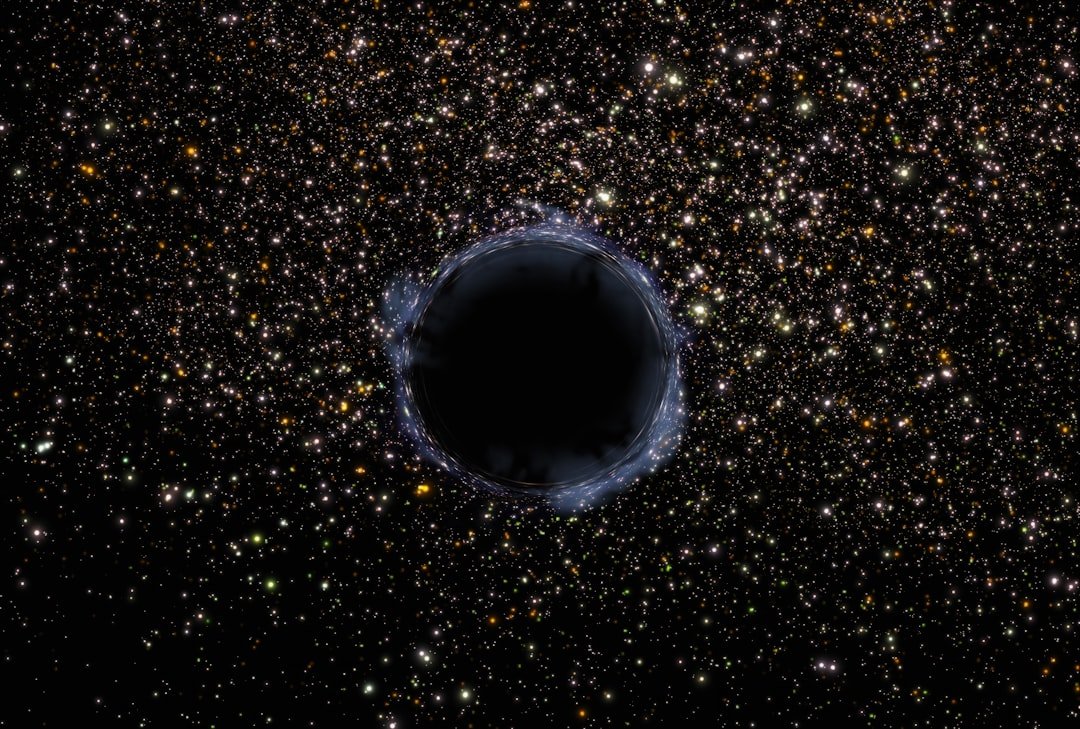
Cosmic Core Plunges into Darkness (Image Credits: Unsplash)
Astronomers recently documented a striking transformation in a galaxy 10 billion light-years from Earth, where the central supermassive black hole abruptly lost its fuel supply. This led to a 95 percent drop in the brightness of the galaxy’s active galactic nucleus over approximately 20 years.[1][2] The phenomenon, observed in galaxy J0218-0036 at redshift z ≈ 1.8, marks one of the fastest such changes ever recorded, offering new insights into the dynamic lives of these cosmic behemoths.
Cosmic Core Plunges into Darkness
Early observations from the Sloan Digital Sky Survey between 2001 and 2009 captured the galaxy’s nucleus shining brightly, powered by material swirling into the black hole.[3] By 2016 to 2024, follow-up data revealed a core faded to just one-twentieth of its former luminosity – a 95 percent decline that unfolded in human timescales.[1]
The dimming extended across optical, near-infrared, and radio wavelengths, confirming a wholesale shutdown rather than mere obscuration by dust.[3] Researchers noted the accretion rate – the speed at which gas fed the black hole – plummeted to one-fiftieth of prior levels within about seven years in the galaxy’s frame.[2] Such rapidity stunned the team, as active galactic nuclei typically fluctuate by only about 30 percent.
Fuel Supply to the Black Hole Severed
Supermassive black holes grow by accreting gas that forms a hot, glowing disk around them, producing the intense light of an active galactic nucleus. In J0218-0036, this process halted dramatically when the inbound gas flow dwindled.[1] The accretion disk likely thinned and cooled as a result, dimming the entire core region.
“It is fascinating that an active galactic nucleus can change its brightness so dramatically over such a short period of time,” said Tomoki Morokuma, principal staff scientist at Chiba Institute of Technology and lead author of the study.[1] He added that the fading stemmed from a large shift in the accretion rate onto the black hole. Theoretical co-author Toshihiro Kawaguchi of the University of Toyama emphasized that standard models fail to explain this variability, calling for new frameworks to match the data.[3]
Possible triggers include a sudden exhaustion of nearby gas reserves or instabilities in the disk itself, though the exact mechanism remains under investigation.
Telescopes and Teams Unite for Discovery
An international collaboration pieced together the story using data from multiple observatories. Initial brightness came from the Sloan Digital Sky Survey, while recent monitoring relied on the Hyper Suprime-Cam on Subaru Telescope, Gran Telescopio Canarias for infrared views, and Keck Observatory.[2][3]
- Sloan Digital Sky Survey (SDSS): Captured peak brightness in early 2000s.
- Subaru Telescope’s Hyper Suprime-Cam: Tracked multi-epoch changes.
- Gran Telescopio Canarias (GTC): Confirmed infrared fading of the central engine.
- W. M. Keck Observatory: Provided additional optical and near-infrared data.
- Radio telescopes: Supported broad-wavelength analysis.
Nieves Castro Rodríguez, a GTC astronomer and co-author, highlighted the infrared data’s role: “The GTC infrared observations were fundamental in showing that the entire central engine was fading, not just part of it.”[3] Contributors hailed from Chiba Institute of Technology, University of Potsdam, University of Toyama, Instituto de Astrofísica de Canarias, National Astronomical Observatory of Japan, and Ritsumeikan University.
Shaking Foundations of Black Hole Science
Prior models assumed accretion onto supermassive black holes evolved over tens of thousands of years or more. This event proves otherwise, demonstrating switches between active and quiescent states can occur in years to decades.[1] José Acosta Pulido of the IAC noted, “We used to think that supermassive black holes changed only over extremely long timescales,” but recent findings suggest otherwise.[3]
The discovery, detailed in a 2025 paper in Publications of the Astronomical Society of Japan, opens doors to studying black hole-galaxy co-evolution.[1] Future wide-field surveys like Hyper Suprime-Cam, Vera C. Rubin Observatory, Euclid, and Nancy Grace Roman Space Telescope may uncover more fading AGN, revealing how these engines start, stop, and influence their hosts.[3]
This rapid shutdown underscores the unpredictable nature of cosmic powerhouses. As Morokuma plans further hunts, the event promises to refine theories on how black holes shape galaxies over billions of years.
Key Takeaways
What do you think about this black hole’s sudden diet? Tell us in the comments.