

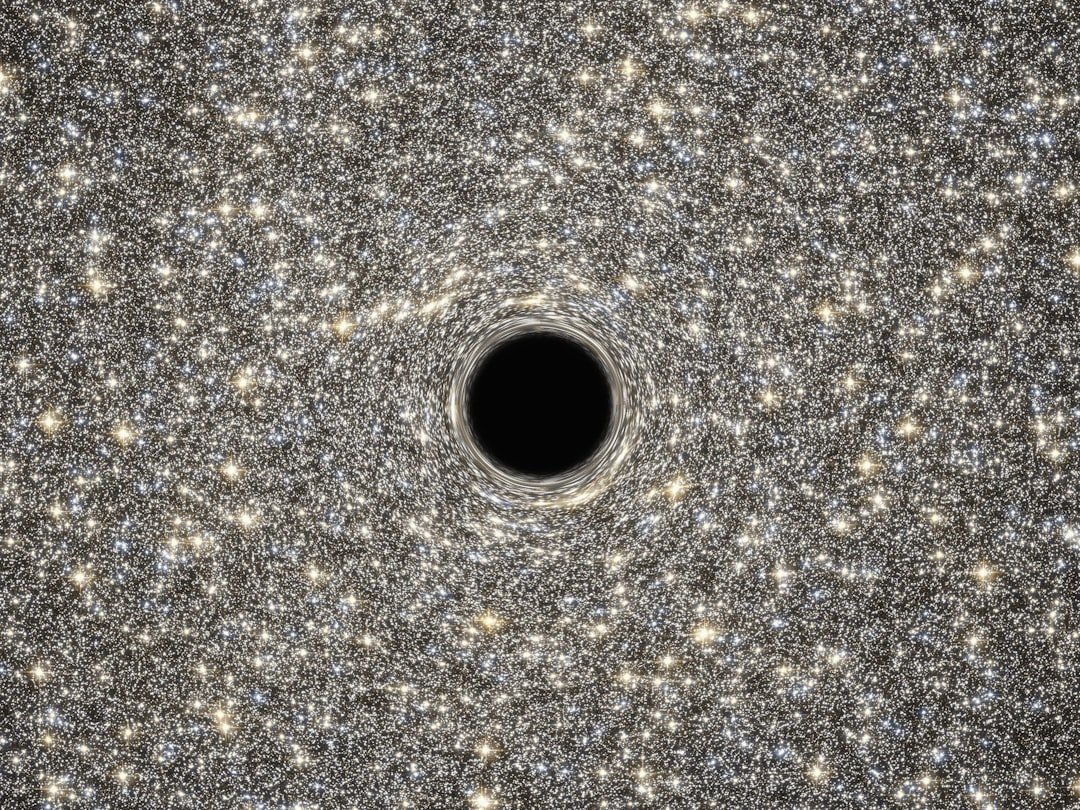
A Surprise in the Jets (Image Credits: Unsplash)
Astronomers have identified the tightest orbiting pair of supermassive black holes ever observed, located at the heart of the galaxy Markarian 501. Researchers detected compelling evidence of the duo through two decades of meticulous radio observations, revealing jets of particles that betray their intricate dance. This breakthrough offers a rare glimpse into the final stages of black hole coalescence, a process central to galaxy evolution.
The galaxy, situated in the constellation Hercules some 500 million light years from Earth, hosts black holes each boasting masses between 100 million and one billion times that of the sun. Their proximity and rapid orbit suggest a merger could unfold within as little as a century, potentially producing detectable ripples in spacetime.
A Surprise in the Jets
High-resolution radio data spanning 23 years unveiled not one, but two powerful jets emanating from Markarian 501’s core. The primary jet, aimed directly at Earth, had long appeared strikingly bright. Yet, subtler signals pointed to a second jet trailing counterclockwise around the dominant black hole, a motion captured over mere weeks.
“We searched for it for so long, and then it came as a complete surprise that we could not only see a second jet, but even track its movement,” said Silke Britzen, lead researcher from the Max Planck Institute for Radio Astronomy in Bonn. The team noted recurring brightness patterns and structural shifts, hallmarks of orbital dynamics. In June 2022, gravitational lensing briefly formed an Einstein ring, as light from the rear jet bent around the foreground behemoth.
Unraveling the Orbital Dance
Analysis of the jets’ positions and fluxes yielded an orbital period of about 121 days for the black holes. Their separation spans roughly 250 to 540 astronomical units – comparable to the span from Pluto’s orbit to the sun, minuscule for objects of such immensity. These findings appeared in the Monthly Notices of the Royal Astronomical Society.
Britzen likened the data evaluation to sailing on a moving vessel: “The entire jet system is in motion. A system of two black holes can explain this: The orbital plane sways.” No telescope, including the Event Horizon Telescope, resolves the black holes individually due to distance. Instead, indirect signatures like swaying jets provide the proof.
Pathways to Galactic Growth
Supermassive black holes anchor nearly every major galaxy, their vast masses amassed not just through gas accretion, but via mergers during galactic collisions. Such events abound across the cosmos, yet close binaries eluded confirmation until now. Markarian 501 marks the first reliable detection of a pair this intimate.
- Two jets indicate dual black holes powering relativistic outflows.
- Orbital period: ~121 days.
- Separation: 250–540 AU.
- Masses: 100 million to 1 billion solar masses each.
- Merger estimate: As few as 100 years.
Gravitational Waves on the Horizon
As the black holes spiral inward, they shed energy via gravitational waves at ultra-low frequencies. Pulsar timing arrays, which in 2023 revealed a cosmic gravitational wave hum, stand poised to pinpoint this source. Markarian 501 emerges as a top candidate linking waves to a specific binary.
“If gravitational waves are detected, we may even see their frequency steadily rise as the two giants spiral toward collision, offering a rare chance to watch a supermassive black hole merger unfold,” noted co-author Héctor Olivares. This could refine models of merger finales, long a theoretical blind spot. For more details, see the original report on SpaceDaily.com.
Key Takeaways
- Historic first: Closest confirmed supermassive black hole binary in Markarian 501.
- Merger timeline: Potentially within 100 years, emitting trackable gravitational waves.
- Observation method: 23 years of multi-frequency radio data revealing dual jets.
This discovery illuminates how black holes forge galactic destinies, bridging observation and prediction. As instruments sharpen, humanity edges closer to witnessing a cosmic cataclysm. What implications do you see for future astronomy? Share your thoughts in the comments.