

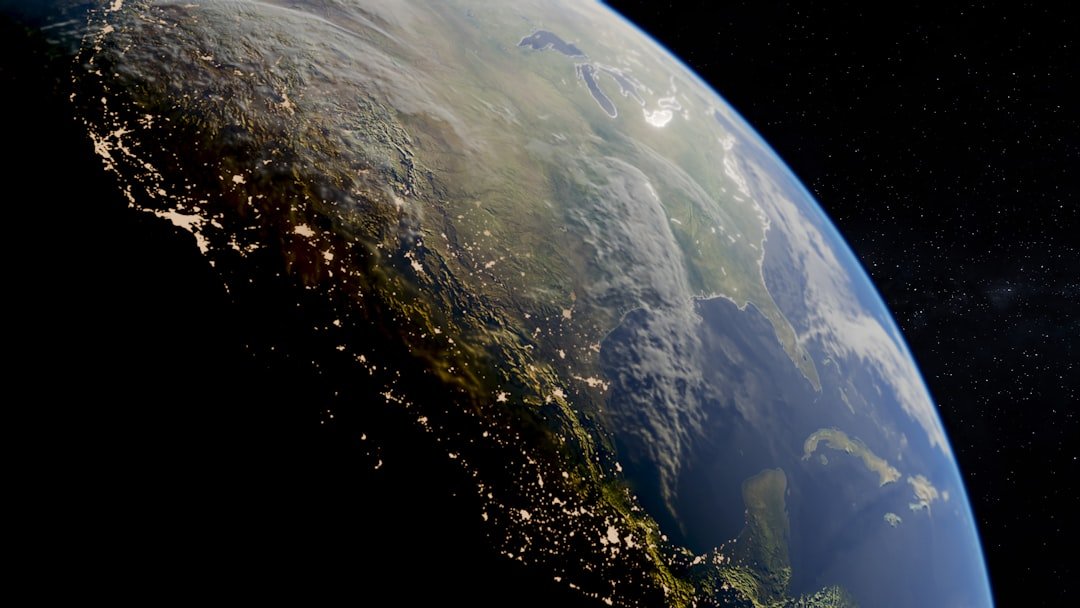
Volatility Redefines the Global Glow (Image Credits: Unsplash)
Daily satellite observations captured a dynamic shift in Earth’s nighttime illumination over nearly a decade. Researchers analyzed more than 1.16 million images from NASA’s Black Marble dataset, spanning 2014 to 2022, and uncovered a 16% net increase in global artificial light at night radiance.[1][2] This change outpaced population growth and revealed a far more volatile picture than previously assumed, with brightening and dimming occurring side by side across the planet.
Volatility Redefines the Global Glow
Locations that experienced changes averaged 6.6 distinct shifts during the study period, challenging the notion of steady brightening. Brightening accounted for a 34% rise in radiance relative to 2014 levels, while dimming offset 18% of that gain, yielding the 16% net figure.[1] Abrupt changes covered 2.05 million square kilometers, often tied to short-term events, while gradual shifts spanned 19.04 million square kilometers.
Researchers classified changes as abrupt or gradual using a specialized algorithm that accounted for viewing angles and noise. This approach highlighted how human activity pulses through the nightscape, with no region spared from flux.[3]
Mapping Brightening and Dimming Hotspots
Asia and sub-Saharan Africa led the brightening trends, driven by urbanization and electrification. China and India saw sustained increases, while countries like Somalia, Burundi, and Cambodia experienced sharp surges.[2] In the United States, the West Coast brightened by about 6% overall, reflecting population growth and economic booms.
Europe stood out for dimming, with a 4% net decrease across the continent. France reduced lights by 33%, the United Kingdom by 22%, and the Netherlands by 21%, often aligning with national borders due to policy efforts.[1] Venezuela dimmed by 26% amid economic collapse, and Ukraine saw abrupt drops during the 2022 conflict escalation.
- Top brightening areas: Eastern and central China, southern India, sub-Saharan Africa.
- Top dimming areas: Western Europe, Venezuela, parts of the Middle East.
- Volatile U.S. examples: Permian Basin oil fields with boom-bust cycles.
- Global coverage: Focused on 15.16 million km² of inhabited land from 70°N to 60°S.
- Average shifts: 6.6 per changed location over nine years.
Forces Shaping the Nighttime Pulse
Abrupt brightening often stemmed from construction, infrastructure projects, and rural electrification. Gradual increases linked to urban expansion and LED adoption in developing regions. Dimming events included power outages, conflicts, and gas flaring reductions.
Policies played a key role in Europe, where energy conservation mandates and dark-sky initiatives dimmed streets after midnight. Economic crises and natural disasters triggered sudden drops elsewhere. “The Earth’s nightscape is actually highly volatile,” lead researcher Zhe Zhu noted.[2]
| Continent/Region | Net Change Trend | Main Driver |
|---|---|---|
| Asia | Strong brightening | Urbanization, electrification |
| Sub-Saharan Africa | Surge | Energy access expansion |
| Europe | 4% dimming | LED efficiency, policies |
| United States (net) | 6% brightening | Regional economic shifts |
Consequences for Ecosystems and Skies
The expanding glow disrupts nocturnal wildlife, animal migrations, and human sleep cycles. Astronomers face fading stars, though dimming zones like European reserves provide pockets of relief. Ground observations suggest skyglow may rise faster than satellite data indicates, due to LED wavelengths and sideways light.
“Light pollution has profound ecological consequences,” Zhu stated. Efforts in France, where officials turned off late-night streetlights, demonstrate scalable solutions. Monitoring tools like these datasets now enable real-time tracking of such changes.
Christopher Kyba added, “Although there has been a total increase of 16% worldwide, that does not mean that lighting is increasing everywhere.”[4]
Key Takeaways
- Net 16% global increase hides 34% brightening offset by 18% dimming.
- Volatility averages 6.6 changes per site, driven by human events.
- Policy-driven dimming in Europe offers a model for mitigation.
Earth’s nights reflect humanity’s restless energy, brighter overall yet flickering with contrasts. As satellites continue to watch, targeted policies could temper the glow and reclaim some darkness. What steps should communities take next? Share your thoughts in the comments.