

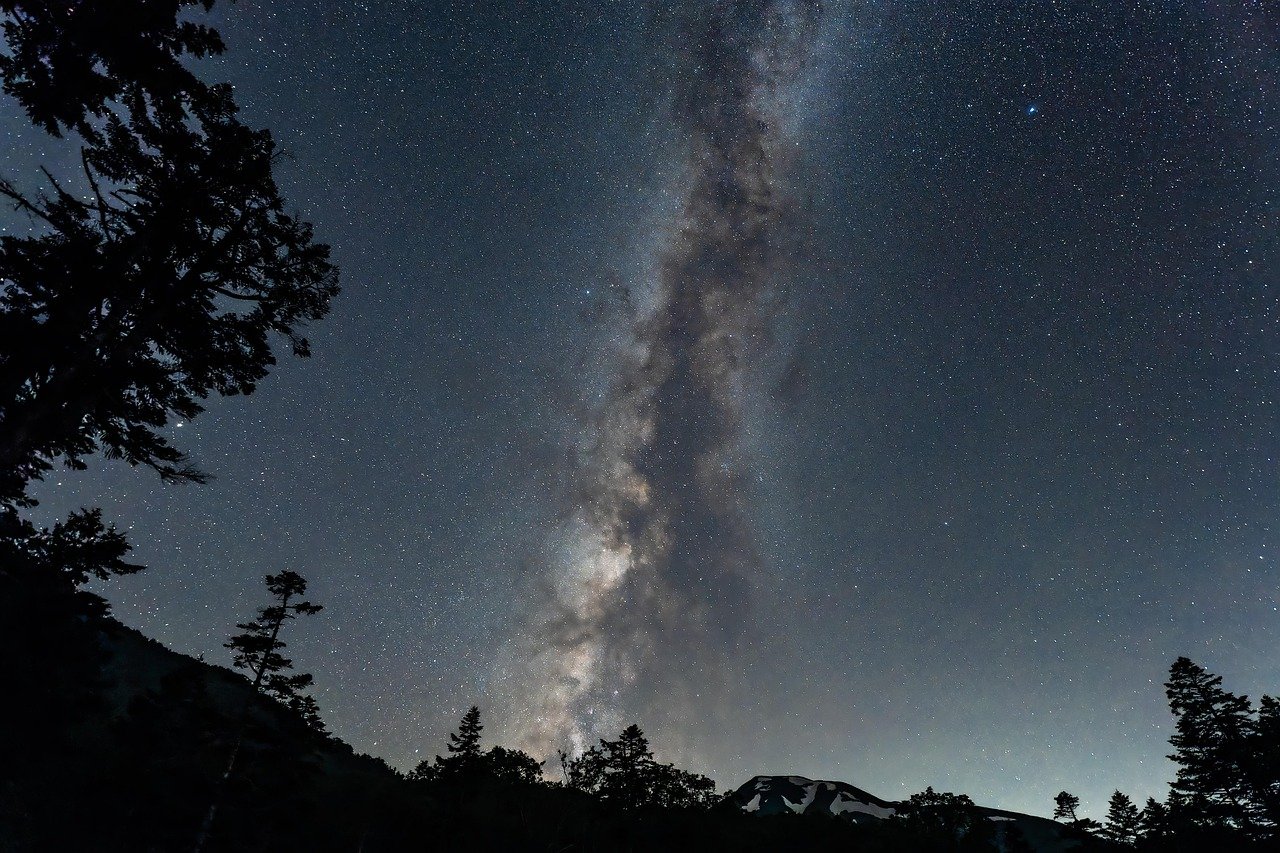
M96 Defies Galactic Norms with Its Off-Center Core (Image Credits: Pixabay)
Spring evenings in 2026 bring prime viewing conditions for deep-sky enthusiasts, particularly in the constellation Leo. On Thursday, April 9, observers can target Messier 96, a structured spiral galaxy renowned for its detailed appearance through telescopes.[1] This object stands out amid Leo’s collection of galaxies, offering a glimpse into distant cosmic structures some 31 million light-years away. With the waning gibbous Moon providing limited interference early in the night, tonight presents an ideal window to explore this celestial gem.[2]
M96 Defies Galactic Norms with Its Off-Center Core
Most spiral galaxies exhibit tidy symmetry, yet M96 challenges that expectation. Its bright nucleus sits displaced from the geometric center, while dust lanes and gas clouds distribute unevenly across its weak arms.[3][4] Astronomers classify it as an intermediate spiral, sometimes noted for double-bar features that add to its intricate profile.[5]
This asymmetry hints at dynamic internal processes, possibly interactions within its group. Apparent magnitude 9.2 makes it accessible, spanning about 7 by 5 arcminutes in the sky. Larger telescopes reveal the galaxy’s mottled texture, evoking a cosmic maelstrom of glowing gas and dark dust.[6] Even from suburban sites, its stellar core pierces the night.
Navigating Leo to Locate M96
Leo dominates the evening sky in April, its sickle shape unmistakable high overhead. Regulus, the constellation’s brightest star, anchors the hunt at magnitude 1.4. From there, trace the Lion’s belly toward Denebola in the hindquarters.
M96 resides roughly halfway along this arc, forming part of a trio with M95 and M105. Start at Regulus and sweep northwest about 4 degrees to pinpoint the cluster.[7] A detailed finder chart enhances precision, but naked-eye stars like Chertan (Theta Leonis) guide intermediate steps. Under dark skies, the galaxy appears as a fuzzy patch near magnitude 10 stars.
- Identify Leo’s sickle and Regulus in the east after dusk.
- Move to the belly region, midway to Denebola.
- Center on a tight grouping 0.7 degrees wide: M95 (southwest), M96 (northeast), M105 (north).[8]
- Use low-power eyepieces (50x-100x) to frame the field.
- Avoid zenith glare by observing before midnight.
Optimizing Views: Tips for Every Observer
Small instruments suffice for M96’s bright heart, but aperture unlocks arms and mottling. Binoculars (10×50) show a hazy glow on moonless nights, while 4-inch scopes reveal elongation.[1] Larger setups (8-inch plus) display dust lanes and stellar wisps. Patience pays off – allow eyes 20 minutes to dark-adapt.
On April 9, the waning gibbous Moon (57 percent illuminated) rises late, leaving early evening dark.[2] Target Leo between 9 p.m. and 1 a.m. local time, when it culminates south. Seek bortle 4 skies or better; light pollution dims faint extensions. averted vision sharpens details.
| Scope Size | Expected View of M96 |
|---|---|
| Binoculars | Faint glow, bright core hint |
| 4-inch | Oval haze, central bulge |
| 8-inch+ | Arm structure, asymmetry |
The Broader Leo I Group Beckons
M96 anchors the Leo I Group, a gathering of over a dozen galaxies 30 million light-years distant. Neighbors M95 (barred spiral, mag 9.7) and M105 (elliptical, mag 9.3) fit in medium fields.[9] NGC 3384 accompanies M105 closely.
This cluster rivals the more famous Leo Triplet (M65, M66, NGC 3628) to the north. Sweep the region for faint companions, turning one target into a galaxy trail. Spring’s transparency favors such hunts.[7]
Key Takeaways
- M96’s offset core and uneven arms make it visually compelling.[3]
- Locate via Leo’s belly from Regulus; small scopes suffice for basics.
- Observe early evening amid waning Moon for optimal darkness.
Gazing at M96 transports viewers to a realm of galactic evolution, where asymmetry signals ongoing tales of merger and growth. As Leo reigns supreme this spring, this structured spiral invites all levels of astronomers to connect with the universe’s grand design. For more details, see the featured guide from Astronomy Magazine. What did M96 look like through your scope? Share your observations in the comments.