

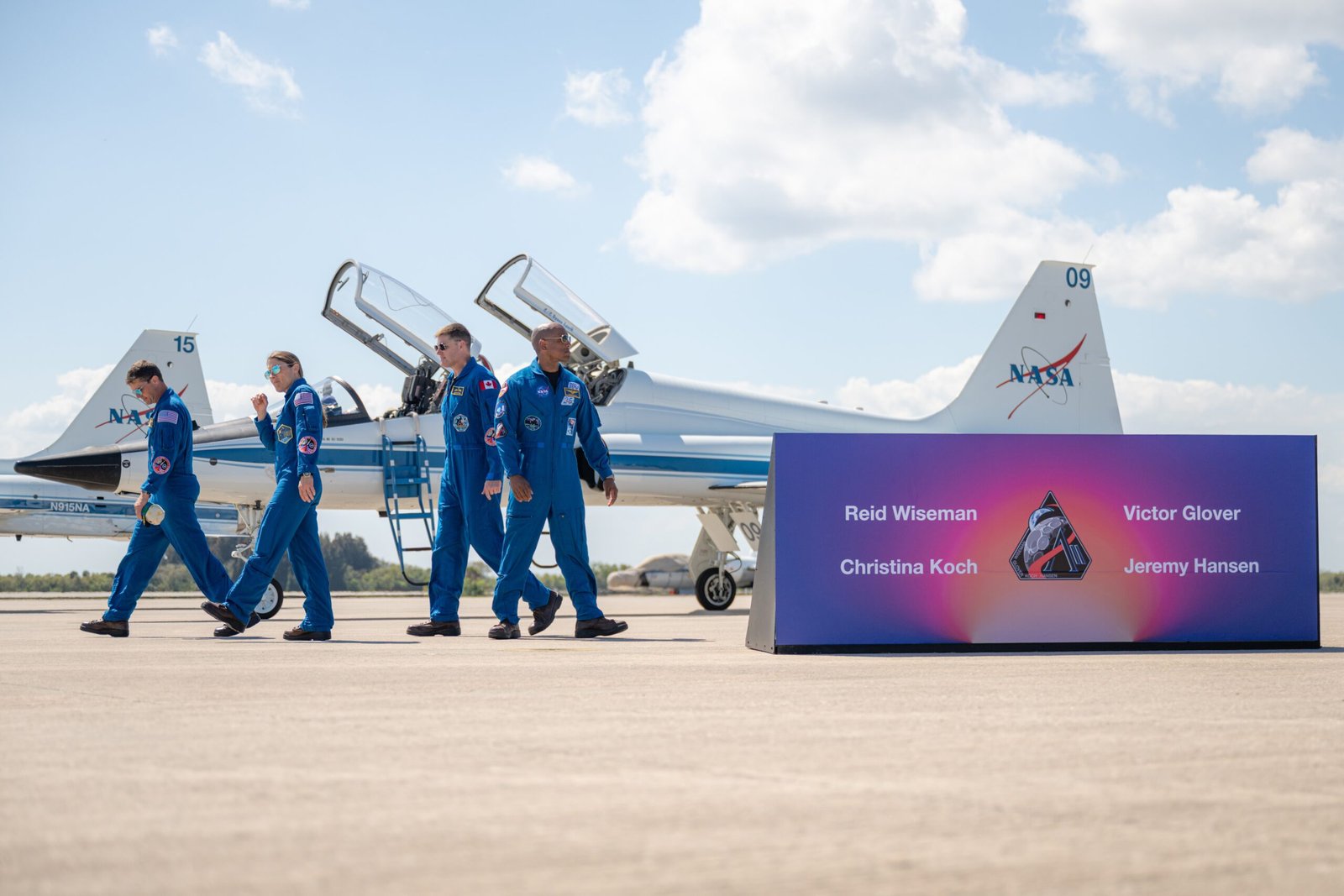
A Mission That Redefined Lunar Ambitions (Image Credits: Upload.wikimedia.org)
San Diego — NASA’s Artemis II mission reaches its dramatic finale tomorrow as the Orion capsule carrying four astronauts hurtles back to Earth. The crew, fresh from a historic lunar flyby, prepares for a high-stakes reentry into the atmosphere at blistering speeds. Recovery teams stand ready off this city’s coast for what promises to be a precise ocean landing, marking a key milestone in humanity’s return to deep space exploration.
A Mission That Redefined Lunar Ambitions
The Artemis II crew launched from Kennedy Space Center in Florida on April 1, 2026, aboard the mighty Space Launch System rocket.[1][2] Commander Reid Wiseman, pilots Victor Glover and Christina Koch, and Canadian Space Agency astronaut Jeremy Hansen embarked on a 10-day journey around the moon’s far side. This first crewed Artemis flight tested critical systems for future lunar landings.
Throughout the mission, the astronauts conducted experiments, captured stunning views, and performed key maneuvers like the translunar injection burn. Ground teams monitored every step from mission control. The voyage built on the uncrewed Artemis I success, proving Orion’s capabilities in deep space.[3]
The Perils of Atmospheric Reentry
Reentry stands as one of the mission’s toughest phases. At 7:53 p.m. EDT on Friday, Orion will pierce Earth’s atmosphere while traveling at approximately 24,000 mph, generating intense heat from friction.[4] The capsule’s heat shield, tested rigorously before launch, must withstand temperatures exceeding 5,000 degrees Fahrenheit.
A brief communication blackout will follow, lasting about six minutes as plasma envelops the spacecraft. Engineers designed Orion to emerge unscathed, with parachutes deploying for a gentler descent. Scientific American highlighted this phase as potentially the mission’s greatest challenge yet.[4]
Key reentry milestones include:
- 7:33 p.m. EDT: Crew module separates from service module.
- 7:37 p.m. EDT: Crew module raise burn.
- 7:53 p.m. EDT: Entry interface at 24,000 mph.
- 8:07 p.m. EDT: Splashdown in the Pacific Ocean.
Splashdown Preparations Off San Diego
Recovery forces position ships and aircraft near coordinates 32.7° N, 118.2° W for the 8:07 p.m. EDT splashdown, equivalent to 5:07 p.m. local time.[5][6] U.S. Navy divers and NASA teams will secure the capsule within minutes, hoisting astronauts to safety. Live coverage streams on NASA+ and YouTube, drawing global audiences.
Local excitement builds with events like the San Diego Air & Space Museum’s splashdown watch party. Weather forecasts predict favorable conditions, though officials monitor swells closely. Post-splashdown, the crew receives medical checks aboard the recovery ship before flying home.
| Phase | Time (EDT) | Details |
|---|---|---|
| Entry Interface | 7:53 p.m. | Atmospheric plunge at 24,000 mph |
| Peak Heating | ~8:00 p.m. | Heat shield endures extreme temperatures |
| Parachute Deploy | ~8:05 p.m. | Main chutes slow descent |
| Splashdown | 8:07 p.m. | Pacific Ocean off San Diego |
Paving the Way for Artemis III and Beyond
Artemis II data will refine procedures for Artemis III, targeted for lunar landing in 2027. Success here validates Orion for repeated deep-space trips. The program aims to establish a sustainable moon presence, including the Gateway station.
Challenges like heat shield performance and recovery ops inform future risks. NASA emphasized the mission’s role in preparing for Mars eventually. International partners, including Canada, celebrate this collaborative triumph.
Key Takeaways:
- Artemis II proves crewed deep-space viability post-Apollo era.
- Reentry tests push spacecraft limits at hypersonic speeds.
- Splashdown success accelerates path to lunar bases.
As Orion descends tomorrow, it closes a chapter while opening doors to the stars. This homecoming reminds us of spaceflight’s blend of peril and promise. What moments from Artemis II inspired you most? Share in the comments.