

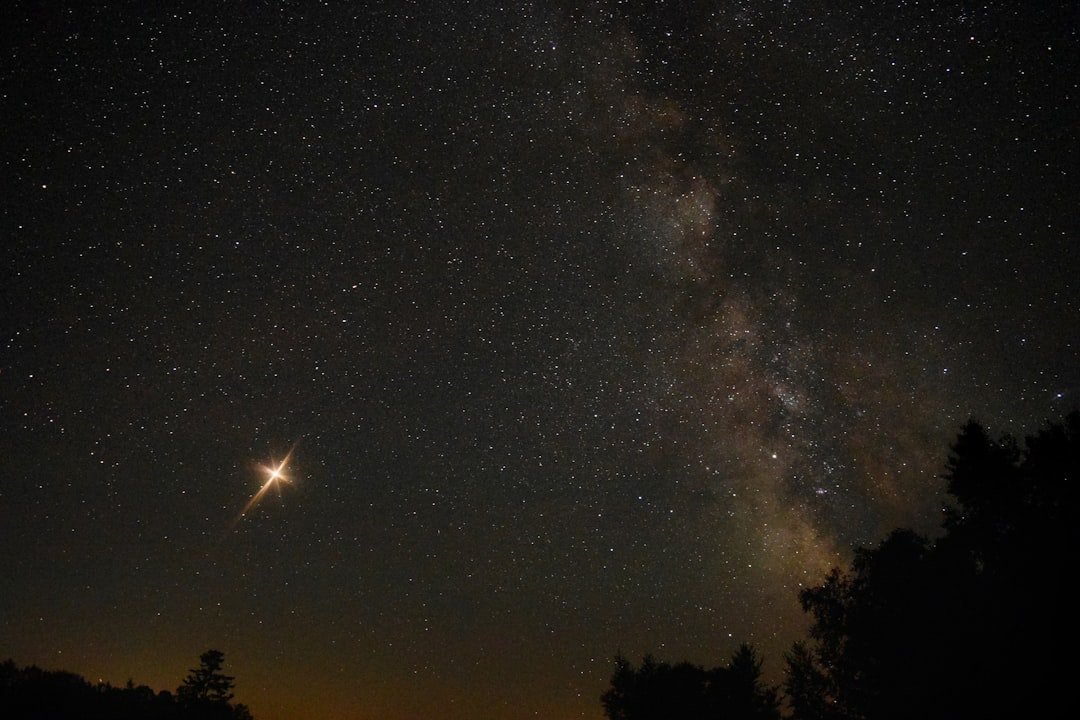
Brilliant Evening Planets Steal the Show (Image Credits: Unsplash)
April 2026 offers stargazers a rich array of celestial sights, from brilliant evening planets to a striking pre-dawn lineup. The third quarter moon graces the sky tonight, rising near midnight and appearing half-illuminated as it climbs high before dawn.[1][2] Observers worldwide can track five naked-eye planets throughout the month, alongside meteor activity and lunar phases that frame the action. Clear horizons and minimal light pollution will reveal these wonders in full.
Brilliant Evening Planets Steal the Show
Venus emerges as the undoubted star of April evenings, dazzling from the western sky shortly after sunset. Outshining every star and planet, it lingers low near the Pleiades star cluster and the reddish Aldebaran in Taurus, setting two hours after the sun by month’s end.[1][3] Jupiter joins the spectacle high overhead in Gemini, visible as twilight fades and remaining until about an hour past midnight late in the month.
These giants provide easy targets even from urban areas. A waxing crescent moon passes near Venus on April 18-19 and Jupiter on April 21-22, adding drama to the views. Binoculars reveal Venus’s gibbous phase and Jupiter’s cloud bands, while the full Pink Moon on April 2 illuminated their positions earlier this month.[1][4]
Pre-Dawn Planet Parade Captivates Early Risers
Low in the east before sunrise, Mercury, Mars, Saturn, and faint Neptune form a tight grouping around mid-month, peaking near April 18. Mercury shines brightest at greatest elongation on April 3, while Mars glows reddish and Saturn yellowish nearby.[1][5] Southern Hemisphere viewers enjoy the best sight, as the planets rise higher; Northern observers need a clear horizon 30-60 minutes before dawn.
A thin waning crescent moon joins on April 15, hovering above the trio. Mars passes Neptune on April 13, and the alignment evolves daily into a straight line by April 20. Telescopes uncover Neptune’s blue hue, but the others reward naked eyes under dark skies.[2]
Moon Phases Frame the Action
The moon’s cycle punctuates April’s sky events. It reached full phase as the Pink Moon on April 2, then hit third quarter on April 10 at 4:52 UTC. New moon follows on April 17, ideal for deep-sky observing, with first quarter on April 24.[1]
| Date | Phase | Time (UTC) |
|---|---|---|
| April 2 | Full | 02:11 |
| April 10 | Third Quarter | 04:52 |
| April 17 | New | 11:52 |
| April 24 | First Quarter | 02:32 |
Earthshine glows on the moon’s dark side during crescent phases, enhancing conjunctions with planets and clusters like the Pleiades.[2]
Lyrids and Other Sky Treats
The Lyrid meteor shower peaks before dawn on April 22, delivering up to 20 swift streaks per hour from Lyra near Vega. A waning crescent moon sets early, preserving dark conditions for fireballs.[1][6] Virgo’s galaxy cluster and the Spring Triangle asterism – Arcturus, Spica, Regulus – dominate evenings.
- Scan Leo’s Sickle for Regulus after dark.
- Follow the Big Dipper to locate these spring stars.
- Target Orion Nebula early month before it sets.
- Seek zodiacal light in moonless western skies post-twilight.
- Comet C/2025 R3 may appear predawn mid-month with binoculars.[2]
Key Takeaways
- Evening: Spot Venus low west, Jupiter high south.
- Dawn: Hunt Mercury-Mars-Saturn east, best mid-April.
- April 22: Watch Lyrids after midnight.
April 2026 reminds us of the sky’s reliable rhythms, blending planets, moon, and meteors into a monthly tapestry. Step outside tonight for the third quarter moon, then plan dawn vigils for the alignment. What celestial sight excites you most this month? Tell us in the comments.