

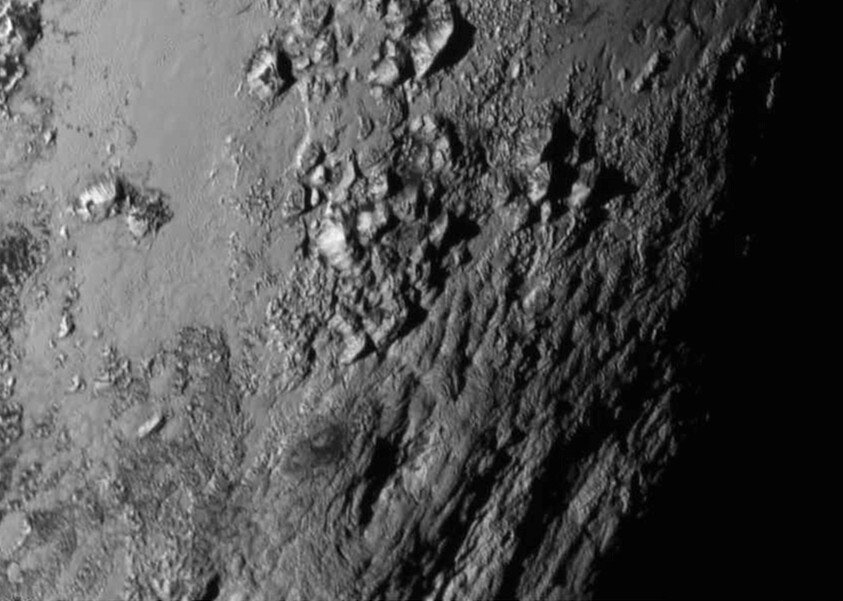
Eternal Shadows Yield Ice Clues (Image Credits: Flickr)
Deep within the moon’s south polar region, craters shrouded in perpetual darkness hold tantalizing clues to hidden water ice reserves. A recent study revealed that the longest-shadowed sites, some untouched by sunlight for billions of years, show the strongest evidence of ice buildup. These findings sharpen the focus for upcoming missions, potentially easing the path for human presence on the lunar surface.
Eternal Shadows Yield Ice Clues
Planetary scientists pinpointed a clear pattern: the moon’s oldest and darkest craters correlate with the highest ice signatures. Researchers analyzed data from NASA’s Lunar Reconnaissance Orbiter, particularly its Lyman Alpha Mapping Project instrument, which detected hints of ice in permanently shadowed regions.[1]
The team, led by Oded Aharonson from the Weizmann Institute of Science during his time at the University of Colorado Boulder, combined surface temperature readings from the Diviner instrument with computer simulations. These models traced how the moon’s axial tilt evolved, revealing when specific craters entered permanent shadow. Paul Hayne, an associate professor at CU Boulder’s Laboratory for Atmospheric and Space Physics, noted the implications: “It looks like the moon’s oldest craters also have the most ice. That implies the moon has been accumulating water more or less continuously for as much as 3 or 3.5 billion years.”[1]
This work, published April 7, 2026, in Nature Astronomy, rules out sudden delivery events like massive comet strikes. Instead, ice appears to have gathered steadily over eons.[2]
The Mechanics of Lunar Cold Traps
Cold traps form in craters where temperatures hover around minus 160 degrees Celsius, preserving volatile water ice against sublimation. Not all shadowed areas qualify; some receive heat from nearby sunlit walls, disqualifying them as effective traps. Simulations showed that permanent shadow status shifted as the moon’s tilt stabilized over time.[2]
In regions shadowed longer than 100 million years, about 3.4 percent of the surface shows exposed ice, indicating dynamic cycles of deposition, burial, and occasional loss through impacts. Younger shadows display more frequent ice exposure, underscoring the role of duration in accumulation. The study matched these ancient traps precisely with LAMP’s strongest ice signals.[3]
Haworth Crater Emerges as Top Target
Haworth Crater stands out near the moon’s south pole, having maintained shadow for over 3 billion years and functioning as a cold trap throughout that span. This makes it a leading candidate for substantial ice deposits, far surpassing better-known sites.[1]
Contrast this with Shackleton Crater, shadowed for roughly 3.5 billion years but only becoming a viable cold trap about 500 million years ago due to prior warmth. Such distinctions guide mission planners toward optimal landing zones. Multiple ancient traps over 3.3 billion years old cluster nearby, expanding the search area.[2]
| Crater | Shadow Age | Cold Trap Duration | Ice Potential |
|---|---|---|---|
| Haworth | >3 billion years | Billions of years | High |
| Shackleton | ~3.5 billion years | ~500 million years | Lower |
Sources of the Moon’s Elusive Water
Scientists propose several origins for the ice, none confirmed without samples. Volcanic outgassing from the moon’s interior may have lofted water vapor into the thin exosphere. Micrometeorite impacts from comets or asteroids delivered volatiles episodically.[1]
Solar wind hydrogen, bombarding the surface ceaselessly, could bond with oxygen to form water molecules. Hayne highlighted this process: “Through the solar wind, a constant stream of hydrogen bombards the moon, and some of that hydrogen can be converted to water on the lunar surface.”[1]
- Ancient volcanic activity releasing subsurface water.
- Comet/asteroid deliveries every few million years.
- Solar wind implantation and conversion.
- Possible primordial remnants from moon formation.
Pathways for Artemis and Beyond
Water ice promises transformative resources: potable water, breathable oxygen, and propellant via electrolysis. NASA’s Artemis program eyes south pole bases, where these craters lie. Hayne’s team develops the Lunar Compact Infrared Imaging System for 2027 deployment to probe deeper.[3]
Sample returns or in-situ analysis will settle abundance and origins, refining extraction strategies. The patchy distribution demands targeted scouting to avoid dry prospects.
Key Takeaways
- Oldest south pole craters hold the most ice after billions of years of accumulation.
- Haworth Crater tops the list for mission priorities.
- Gradual buildup from multiple sources, not cataclysmic events.
This research illuminates the moon’s icy underbelly, turning shadows into strategic assets for lunar ambitions. As rovers and astronauts venture forth, these ancient havens could quench the thirst for sustainable exploration. What do you think about targeting Haworth first? Tell us in the comments.