

Crew Gears Up for the Final Hours (Image Credits: Upload.wikimedia.org)
Pacific Ocean off San Diego – NASA’s Artemis II astronauts prepare for their historic return to Earth after a 10-day lunar flyby mission. The crew aboard the Orion spacecraft, named Integrity, faces the most demanding phase of the journey: a high-speed reentry through Earth’s atmosphere followed by a parachute-assisted splashdown. This direct ocean landing marks the first crewed return from deep space since Apollo 17 in 1972, testing systems critical for future Moon landings.[1][2]
Crew Gears Up for the Final Hours
The astronauts began their last full day in space with a wakeup call at 11:35 a.m. EDT. NASA played a special song to mark the occasion as the crew stowed gear, configured seats, and reviewed procedures. By 1:50 p.m. EDT, they started transforming Orion’s cabin for reentry, securing items and preparing for high G-forces.[1]
At 2:53 p.m. EDT, Orion’s thrusters fired for the Return Trajectory Correction 3 burn, fine-tuning the path toward the splashdown zone. The team continued preparations through a midday meal and final checks, donning their Orion Crew Survival System suits around 5:05 p.m. EDT. These steps ensure everything remains stable during the intense descent.[3]
Service Module Separation Sets the Stage
Live coverage on NASA+ kicked off at 6:30 p.m. EDT, drawing global viewers to the climax. Communications shifted to the Tracking and Data Relay Satellite System at 7:15 p.m. EDT. Then, at 7:33 p.m. EDT, the crew module separated from the European Service Module, which was jettisoned to burn up over the Pacific.[1]
A brief crew module raise burn followed at 7:37 p.m. EDT, pushing Orion away from the discarded hardware. Entry Flight Director Jeff Radigan described this as part of “13 minutes of things that have to go right.” The spacecraft reached its maximum speed of about 24,000 mph just before hitting the atmosphere southeast of Hawaii.[1]
Peak Heat and Blackout During Atmospheric Entry
Entry interface arrived at 7:53 p.m. EDT, when Orion plunged into the upper atmosphere at roughly 400,000 feet altitude. The heat shield faced temperatures up to 5,000 degrees Fahrenheit, protecting the crew who endured 3.9 Gs of force. A six-minute radio blackout ensued as superheated plasma blocked signals, leaving ground teams in tense silence.[2]
Orion followed a “lofted” entry profile to manage heat shield stress observed in Artemis I. NASA Associate Administrator Amit Kshatriya noted the shield’s design withstands “temperatures that approach the surface of the sun.” The spacecraft covered about 2,000 miles during this fiery phase, validating systems for deeper space returns.[1]
Parachutes Unfurl for Gentle Landing
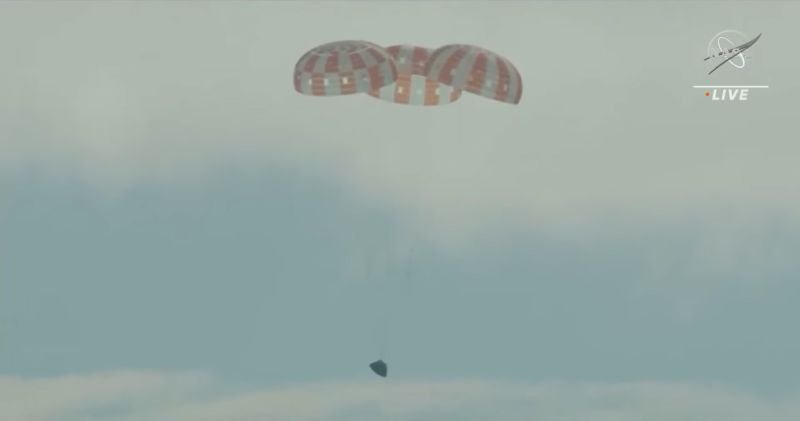
At 8:03 p.m. EDT, two drogue parachutes deployed around 22,000 feet, slashing speed from thousands of mph to about 300 mph. Pilot chutes followed, paving the way for the three massive main parachutes at roughly 6,000 feet and 8:04 p.m. EDT. These orange chutes slowed Orion to a gentle 20 mph for splashdown.[1]
- 11:35 a.m. EDT: Crew wakeup
- 1:50 p.m. EDT: Cabin reconfiguration starts
- 2:53 p.m. EDT: Final trajectory burn
- 7:33 p.m. EDT: Service module jettison
- 7:53 p.m. EDT: Atmospheric entry and blackout
- 8:03 p.m. EDT: Drogue parachutes
- 8:04 p.m. EDT: Main parachutes
- 8:07 p.m. EDT: Splashdown off San Diego
Recovery Teams Spring into Action
Splashdown occurred at 8:07 p.m. EDT in calm Pacific waters, about 100 kilometers offshore. Parachute lines were cut, and an uprighting device activated if needed. The crew powered down systems by 8:22 p.m. EDT, then opened the hatch for Navy divers from the USS John P. Murtha.[2]
Divers attached an inflatable collar, conducted medical assessments, and hoisted astronauts via basket to helicopters. The crew reached the recovery ship around 9:35 p.m. EDT for checks before heading to Houston’s Johnson Space Center. Two primary helicopters and two for imaging ensured swift extraction within two hours.[1]
Key Takeaways
- Reentry tests Orion’s heat shield and parachutes under real crew conditions.
- Splashdown revives Apollo-era ocean recovery with modern Navy assets.
- Success paves the way for Artemis III lunar landing by 2028.
As the Artemis II crew transitions from lunar explorers to Earth-bound heroes, their safe return underscores NASA’s engineering prowess. This milestone reignites dreams of sustainable Moon presence. What are your thoughts on this new chapter in space exploration? Share in the comments.