

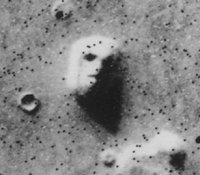
A Classic Case from the Red Planet (Image Credits: Upload.wikimedia.org)
Humans have always projected meaning onto the randomness of the universe. Pareidolia, the tendency to perceive familiar patterns like faces in unrelated stimuli, has fueled myths, sparked debates, and even influenced astronomical discoveries. Recent research reveals a striking bias in these perceptions, particularly in space imagery where shadows and craters often mimic human features.
A Classic Case from the Red Planet
The famous “Face on Mars” captured imaginations worldwide after NASA’s Viking 1 orbiter photographed it in 1976. Shadows on a Martian mesa created the illusion of a humanoid visage staring back from the Cydonia region. Higher-resolution images from Mars Global Surveyor’s orbit later exposed it as a natural hill eroded by wind.
Similar sightings persist. NASA’s Perseverance rover imaged another apparent face in September 2024 amid rocky terrain. Crescent-shaped sand dunes, known as barchans, have also tricked observers into seeing ice worms or glass tunnels snaking through Martian canyons. These examples highlight how pareidolia thrives in the alien landscapes of other worlds.
Pareidolia’s Reach Across the Cosmos
Earth’s own skies offer endless canvases for the phenomenon. The “man in the moon” emerges from lunar maria, dark basaltic plains that form eyes, nose, and mouth depending on viewing angle. Some cultures discern a rabbit there instead, pounding mochi in folklore.
Auroras provide dramatic displays. One borealis event resembled a bird soaring through the night sky. Constellations themselves may stem from pareidolia, with ancient stargazers linking stars into lions for Leo or hunters for Orion. Not all fit neatly – Cancer the Crab or Capricornus require more imagination.
Closer to home, Hurricane Milton’s 2024 satellite view evoked a grinning skull, blending weather data with eerie familiarity. Clouds frequently yield animals or faces, from barking dogs to devouring beasts at sunset.
- Man or rabbit in the moon’s dark patches
- Canals on Mars, once thought artificial
- Aurora as flying birds or dragons
- Constellation figures like Orion the hunter
- Sand dunes mimicking tunnels on Mars
- Storm systems resembling skulls
New Insights from Visual Noise Experiments
Researchers at the University of New South Wales led by Lindsay Peterson explored pareidolia through two experiments involving 70 participants. Subjects examined real objects like purses alongside abstract visual noise, identifying faces and rating traits such as age, gender, and emotion.
Results showed a consistent bias toward perceiving young, angry male faces. Participants reported diverse visions – Buddhas, angels, demons, dragons – but patterns favored threatening male expressions. “Your lizard brain is telling you that the safest thing is to assume it’s a threat and then deal with it,” Peterson explained.[1]
The study appeared in Royal Society Open Science on March 25, 2026. Previous work confirmed this male bias persists across generations, even in children as young as four. Peterson noted, “The male bias exists across generations and in children as young as four years old, which suggests that it’s hard wired.”[1]
Evolutionary Wiring and Modern Implications
This predisposition likely evolved to prioritize threat detection. Spotting a potential predator in foliage offered survival advantages, even at the cost of false alarms. Personal experiences and interests amplify it – birdwatchers see more avians, while others find dragons.
Pareidolia varies among individuals; some detect patterns more readily. It sparks wonder in astronomy but can fuel obsession or paranoia. Balancing pattern-seeking with scrutiny remains key for scientists interpreting rover photos or telescope data.
Read the full study for deeper methodology: Facing Your Expectations.[1]
Key Takeaways
- Pareidolia drives iconic space illusions like the Face on Mars.
- Brains favor angry male faces in noise, a hard-wired survival trait.
- From moons to storms, it reveals our innate search for meaning.
Pareidolia reminds us that perception blends reality with expectation, turning cosmic chaos into stories. Next time you spot a face in the clouds or craters, consider the ancient instincts at play. What patterns do you see in the sky? Share in the comments.