

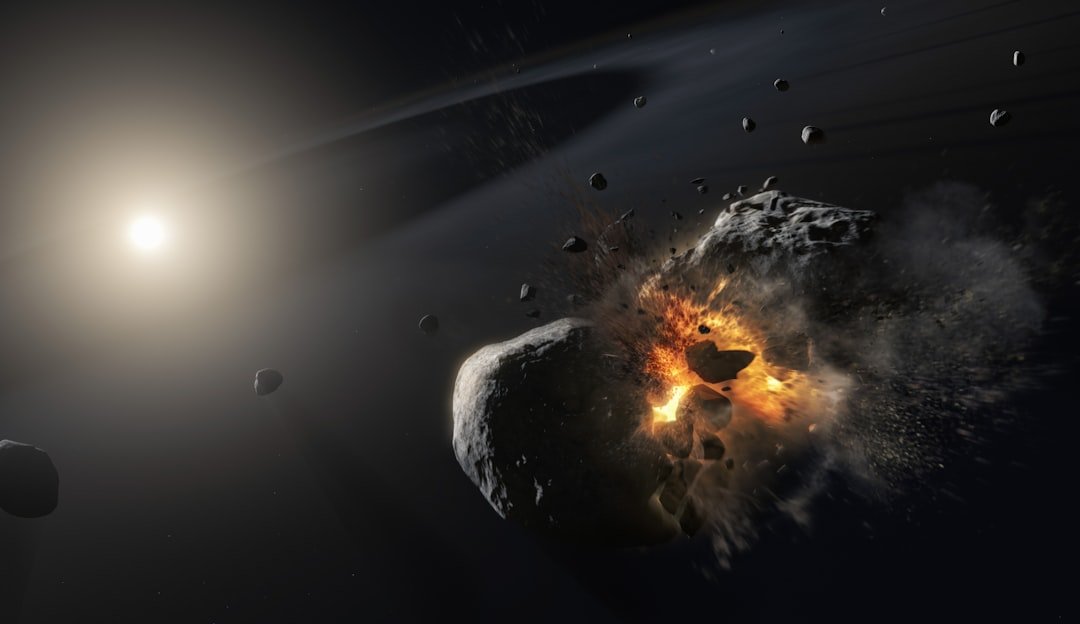
Newly Spotted Rock Captures Attention (Image Credits: Unsplash)
Asteroid 2026 GD, roughly the size of a small house, approaches Earth on this evening of April 9, 2026, marking one of the closer encounters with a near-Earth object this year. Space agencies have tracked the rock since its discovery earlier this week, confirming it will pass safely at a distance equivalent to about two-thirds of the way to the Moon. This event underscores ongoing efforts to monitor cosmic visitors that occasionally swing near our planet.[1][2]
Newly Spotted Rock Captures Attention
Astronomers first detected 2026 GD on April 6, 2026, using ground-based telescopes as part of routine surveys for near-Earth objects. The asteroid measures approximately 16 meters (54 feet) across, fitting the “house-sized” description often used for such space rocks.[2] Its absolute magnitude of 26.6 suggests a compact body, with estimates placing its diameter between 13 and 28 meters.
Traveling at speeds exceeding 28,000 miles per hour, 2026 GD follows an orbit that brings it into Earth’s neighborhood periodically. This trajectory classifies it as a near-Earth object, prompting close scrutiny from observatories worldwide. Scientists value these detections because they refine our understanding of solar system dynamics.
Precise Path of the Close Approach
The asteroid reaches its nearest point to Earth at 22:58 UTC on April 9, about 250,694 kilometers (156,000 miles) away – or 0.652 lunar distances. This places it well beyond satellites but closer than the Moon’s average position.[1][3] A few hours later, around 00:12 UTC on April 10 (8:12 p.m. EDT April 9), it passes even nearer the Moon.
Key statistics for the flyby include:
- Closest Earth distance: 250,694 km (0.652 LD)
- Relative velocity: 12.7 km/s (28,030 mph)
- Maximum brightness: 14.9 magnitude (requires telescope)
- Estimated size: 13-28 meters diameter
Such details come from NASA’s Jet Propulsion Laboratory and the European Space Agency’s tracking systems, ensuring precise predictions.[1]
Why It Appears on ESA’s Risk List
Despite the safe passage tonight, 2026 GD earned a spot on the European Space Agency’s Risk List due to its orbit occasionally aligning closely with Earth’s path. This catalog tracks objects with even minuscule non-zero impact probabilities in the future, serving as a precautionary measure rather than an alarm.[2]
Current assessments show no collision threat for this approach or the foreseeable future. Experts emphasize that listing reflects proactive monitoring, not imminent danger. Ongoing observations will further refine its trajectory, potentially removing it from the list as data accumulates.
| Agency | Assessment |
|---|---|
| NASA | No impact risk; safe flyby |
| ESA | On Risk List for orbital monitoring; no threat tonight |
Boost for Planetary Defense Research
Events like this provide critical opportunities to test detection and tracking technologies. Ground telescopes and radar systems captured early images of 2026 GD, allowing rapid orbital calculations. These efforts contribute to broader planetary defense strategies aimed at identifying potential hazards years in advance.
Recent close approaches, including several in early 2026, demonstrate improved capabilities. For instance, smaller rocks passed safely in March, honing skills for larger threats. 2026 GD’s flyby adds to this dataset, helping predict behaviors of similar objects.
Can You Spot It?
At its brightest, 2026 GD reaches only 14.9 magnitude, far too dim for naked-eye viewing. Amateur astronomers with mid-sized telescopes might glimpse it under dark skies, particularly in the hours around closest approach. Apps and tools from NASA or ESA offer real-time positions for enthusiasts.
Professional observatories lead the effort, using radar for detailed shape and composition analysis. Public interest surges during such events, fostering awareness of space situational awareness.
Key Takeaways
- 2026 GD poses zero risk during tonight’s flyby at 156,000 miles.
- Its ESA Risk List status highlights vigilant tracking, not worry.
- These encounters advance science on near-Earth threats.
This harmless cosmic brush-by reminds us of the dynamic solar system we inhabit. While 2026 GD speeds away unscathed, it reinforces the importance of global vigilance. What do you think about these regular close calls? Tell us in the comments.