

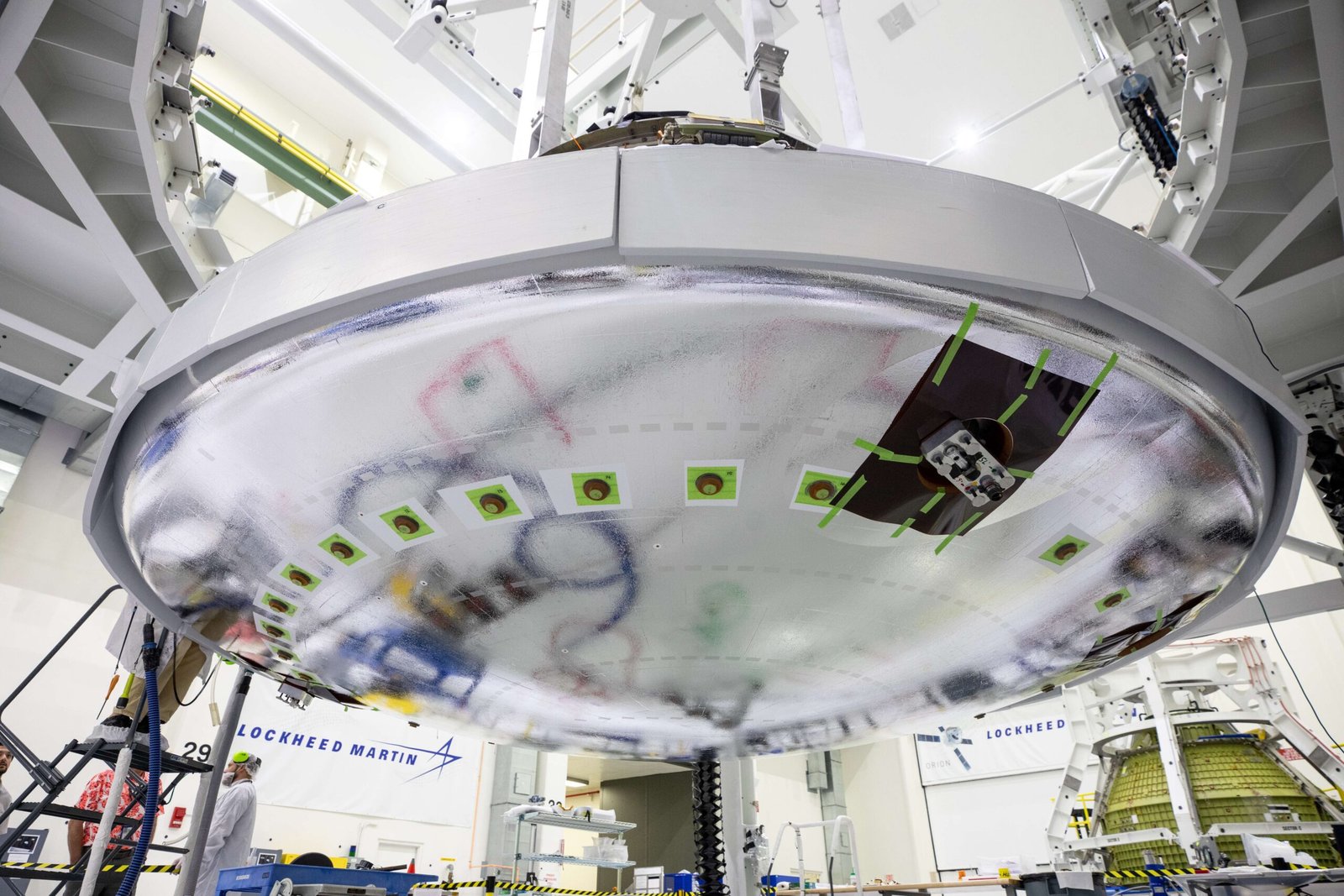
The Intense Physics of Re-Entry (Image Credits: Upload.wikimedia.org)
NASA’s Artemis 2 mission, launched on April 1 from Kennedy Space Center, has captivated the world with its crewed lunar flyby. The four astronauts aboard the Orion capsule now approach the most perilous phase of their 10-day journey: atmospheric re-entry at nearly 24,000 miles per hour.[1][2] Tomorrow’s descent will test the spacecraft’s heat shield like never before, marking the fastest crewed re-entry in history.
The Intense Physics of Re-Entry
Orion will slam into Earth’s atmosphere at speeds exceeding 24,000 mph, generating friction that heats the exterior to thousands of degrees Fahrenheit.[1] This hypersonic plunge compresses air molecules ahead of the capsule, creating a plasma sheath hotter than the surface of the sun in spots. The crew inside will feel forces up to 5 Gs as deceleration begins about 75 miles above Earth.
Unlike low-Earth orbit returns, lunar missions demand direct atmospheric braking from deep space velocities. Apollo capsules topped out around 25,000 mph, but Orion’s design pushes boundaries for future Mars returns. Engineers monitored every second during Artemis 1 to refine this profile.
Heat Shield: Lessons from Artemis 1
The Orion heat shield, coated in Avcoat ablative material, bore unexpected damage during the uncrewed Artemis 1 flight in 2022. Chunks charred off in over 100 locations due to trapped gases during a skip re-entry maneuver, which bounced the capsule off the upper atmosphere.[3] Though it protected the crew compartment, the erosion exceeded predictions.
For Artemis 2, NASA adjusted the trajectory to a steeper loft path, avoiding skips and reducing time in the problematic zone. Commander Reid Wiseman voiced confidence: “If we stick to the new reentry path that NASA has planned, then this heat shield will be safe to fly.”[3] Officials emphasize the underlying composite structure provides redundancy, even if outer layers ablate heavily.
Parachute Sequence Ensures Safe Slowdown
Once peak heating passes, Orion deploys a precise parachute system to cut speed from hundreds to tens of miles per hour. The setup includes 11 parachutes in total, starting with drogue chutes to stabilize the capsule.[1] These precede the main parachutes for final descent.
The deployment unfolds in stages:
- Two drogue parachutes deploy first at about 25,000 feet, halting wild oscillations.
- Five pilot parachutes pull out the four massive main parachutes.
- Main chutes inflate fully by 5,000 feet, targeting a 15-20 mph splashdown speed.
- Reserve systems stand ready if primaries fail.
This multi-redundant design draws from decades of capsule recoveries, tailored for Orion’s mass and shape.
Crew Bonds Forged in Lunar Orbit
Reid Wiseman, Victor Glover, Christina Koch, and Jeremy Hansen shared profound moments during their lunar flyby on April 7. Overwhelmed by naming a crater “Carroll” after Wiseman’s late wife, the team bonded deeply, with Wiseman recalling, “We all pretty much broke down right there.”[2] Such unity steels them for re-entry stresses.
Now on final approach, the astronauts configure Orion’s cabin, stow gear, and suit up. Ground teams track telemetry, ready for Pacific recovery ships off San Diego.[2] Every system check confirms nominal performance post-flyby.
Splashdown and Mission Legacy
Expected around midday Pacific time on April 10, the capsule will float briefly before divers and helicopters secure it. Medical teams will extract the crew for quick health checks, echoing Apollo triumphs. This direct return validates Orion for Artemis 3’s lunar landing.
| Phase | Approximate Time (ET) | Key Event |
|---|---|---|
| Atmospheric Interface | 8:00 PM April 9 | 24,000 mph entry, heat shield engages |
| Peak Heating | Minutes later | 5,000°F temperatures |
| Parachute Deploy | ~30 min post-entry | 11 chutes sequence |
| Splashdown | ~11:00 PM April 9 | Pacific Ocean recovery |
Key Takeaways
Artemis 2’s safe return will pave the way for sustained lunar presence. The heat shield’s performance stands as a pivotal milestone in deep-space exploration. What moments from this mission inspired you most? Share in the comments.