


Space headlines in early 2025 were hard to ignore. A team of astronomers from the University of Cambridge announced they had picked up chemical fingerprints in the atmosphere of a world 124 light-years away that, on Earth, are only made by living things. The story ricocheted around the internet within hours, landing somewhere between genuine scientific excitement and understandable public overstatement.
The honest version is more nuanced than the headlines suggest. No confirmed oxygen has been definitively detected on any exoplanet as a biosignature gas. What has been found is something almost as interesting: a tentative chemical signal that has divided the scientific community and forced a serious reckoning with what it means to look for life from afar.
The Planet at the Center of Everything: K2-18b
K2-18b, also known as EPIC 201912552 b, is an exoplanet orbiting the red dwarf K2-18, located 124 light-years from Earth. The planet is a sub-Neptune about 2.6 times the radius of Earth, with a 33-day orbit within the star’s habitable zone, and it receives approximately a similar amount of light as the Earth receives from the Sun.
It may have a water ocean beneath a hydrogen-rich atmosphere, suggested by its carbon-bearing molecules like methane and carbon dioxide, with low ammonia levels. That combination of traits turned K2-18b into one of the most scrutinized exoplanets in recent memory.
JWST discovered water vapour, carbon dioxide, and methane in its atmosphere. JWST’s data has been variously interpreted as indicating a water ocean planet with a hydrogen-rich atmosphere, and a gas-rich mini-Neptune. Neither interpretation has been definitively ruled out.
How JWST Actually Reads an Exoplanet’s Atmosphere
To determine the chemical composition of the atmospheres of faraway planets, astronomers analyze the light from its parent star as the planet transits, or passes in front of the star as seen from Earth. As K2-18b transits, JWST can detect a drop in stellar brightness, and a tiny fraction of starlight passes through the planet’s atmosphere before reaching Earth.
The NASA/ESA/CSA James Webb Space Telescope has scored a series of firsts with this technique. While Webb and other space telescopes, including Hubble, had previously revealed isolated ingredients of distant planets’ atmospheres, the new readings provide a full menu of atoms, molecules, and even signs of active chemistry and clouds.
Webb’s coronagraphs block light from bright stars as happens in a solar eclipse to reveal otherwise hidden worlds. This allows teams to look for infrared light in wavelengths that reveal specific gases and other atmospheric details. It is a genuinely powerful method, though far from infallible.
The Sulfur Signal That Shocked the World
Using data from the James Webb Space Telescope, the astronomers led by the University of Cambridge detected the chemical fingerprints of dimethyl sulfide (DMS) and/or dimethyl disulfide (DMDS) in the atmosphere of exoplanet K2-18b, which orbits its star in the habitable zone. On Earth, DMS and DMDS are only produced by life, primarily microbial life such as marine phytoplankton.
While an unknown chemical process may be the source of these molecules in K2-18b’s atmosphere, the results were described as the strongest evidence yet that life may exist on a planet outside our solar system. The observations reached the three-sigma level of statistical significance, meaning there is a 0.3% probability that they occurred by chance.
The concentrations of DMS and DMDS in K2-18b’s atmosphere are very different than on Earth, where they are generally below one part per billion by volume. On K2-18b, they are estimated to be thousands of times stronger, over ten parts per million. That gap in scale immediately drew scrutiny from other researchers.
The Immediate Pushback from Independent Scientists

Jake Taylor of the University of Oxford, who studies the atmospheres of far-away planets with the James Webb Space Telescope, did a quick reanalysis of the starlight filtering through K2-18b’s atmosphere. He used a simple method to look for the tell-tale signals of gas molecules of any kind. Rather than seeing a bump or a wiggle that indicated a signal, he found “the data is consistent with a flat line.”
Laura Kreidberg, an expert on the atmospheres of distant planets at the Max Planck Institute for Astronomy in Germany, noted that “the strength of the evidence depends on the nitty gritty details of how we interpret the data, and that doesn’t pass the bar for me for a convincing detection.”
Established inverse methods to interpret observed spectra, already known to be highly averaged representations of intricate three-dimensional atmospheric processes, can lead to disparate interpretations even with JWST’s quality of data. Characterizing rocky or sub-Neptune-size exoplanets with JWST is an intricate task, and moves us away from the notion of finding a definitive “silver bullet” biosignature gas.
What the Independent Reanalyses Actually Found
While the MIRI binning scheme adopted by Madhusudhan et al. supports a tentative detection of DMS and DMDS in K2-18b, one independent analysis found that the vast majority of retrievals using a different MIRI binning scheme do not. When considering the full transit spectrum, the independent team confirmed the detection of methane and carbon dioxide, but found the presence of DMS and C2H4 to be interchangeable.
Researchers found that the tentative presence of large features in the MIRI transit spectrum is in tension with the more robust, yet smaller, features observed in the near-infrared. They concluded that red noise, rather than an astrophysical signal, plagues the mid-IR data, and that there is, as yet, no statistically significant evidence for biosignatures in the atmosphere of K2-18b.
The robustness of the detections, particularly the tentative inference of DMS, is the subject of active scrutiny. A reanalysis confirmed methane at 4-sigma confidence, but found no statistically significant evidence for either carbon dioxide or DMS. The science here is real, active, and unresolved.
The Hycean World Hypothesis Explained
Findings from JWST were interpreted as evidence supporting a hycean scenario, a world covered by a water ocean beneath a thin hydrogen-rich atmosphere, potentially offering habitable conditions. If K2-18b truly is a hycean world, it would represent a whole new category of potentially life-bearing planets.
The existence of a liquid water ocean is uncertain. Before the James Webb Space Telescope observations, a supercritical state of water was believed to be more likely. JWST observations were initially considered to be more consistent with a fluid-gas interface and thus a liquid ocean.
Subsequent work found that a magma ocean may also be capable of dissolving ammonia and explaining the observation results, though not explaining the observed carbon oxide concentrations. Whether the carbon oxide concentrations can be explained by a mini-Neptune deep hydrogen atmosphere model remains uncertain. The planet continues to resist a clean classification.
Rocky Planets and the TRAPPIST-1 Challenge

Rocky planets are very common around other stars, with tens of billions predicted to exist in our galaxy alone. Until recently, however, it was not possible to characterize these planets in detail, or learn about their atmospheric properties. Thanks to JWST’s new observing capabilities, the first constraints on realistic atmospheres for rocky exoplanets are now possible.
Astronomers using the James Webb Space Telescope have already ruled out the possibility of an atmosphere on the three innermost worlds in the TRAPPIST-1 system: TRAPPIST-1b, TRAPPIST-1c, and the habitable-zone planet TRAPPIST-1d. That was not the result many had hoped for.
While JWST has observed at least two transits of each planet in the TRAPPIST-1 system, interpreting the data has been slowed by contamination from unocculted stellar heterogeneities, which dominates the measured transmission spectra, sometimes producing signals from starspots in one transit and faculae in the next. This short-term variability is consistent with a heterogeneous stellar photosphere rotating with a roughly three-day period. The star itself keeps complicating the picture.
Why Oxygen Specifically Is So Hard to Confirm
The search for signs of life in the Universe has entered a new phase with the advent of the James Webb Space Telescope. Detecting biosignature gases via exoplanet atmosphere transmission spectroscopy is in principle within JWST’s reach. The word “in principle” carries a lot of weight in that sentence.
Oxygen itself has not been credibly claimed as detected in any exoplanet atmosphere to date, in the biosignature sense. Researchers have reached the sobering realization that with JWST, we may never be able to definitively claim the discovery of a biosignature gas in an exoplanet atmosphere. This realization is largely motivated by the challenge of interpretation and the risks of false positives amid unknown planetary environments.
Characterizing rocky or sub-Neptune-size exoplanets with JWST is an intricate task, and moves us away from the notion of finding a definitive “silver bullet” biosignature gas. Indeed, JWST results necessitate “parallel interpretations” that will perhaps not be resolved until the next generation of space telescopes comes online.
What K2-18b Tells Us Even Without a Confirmed Biosignature
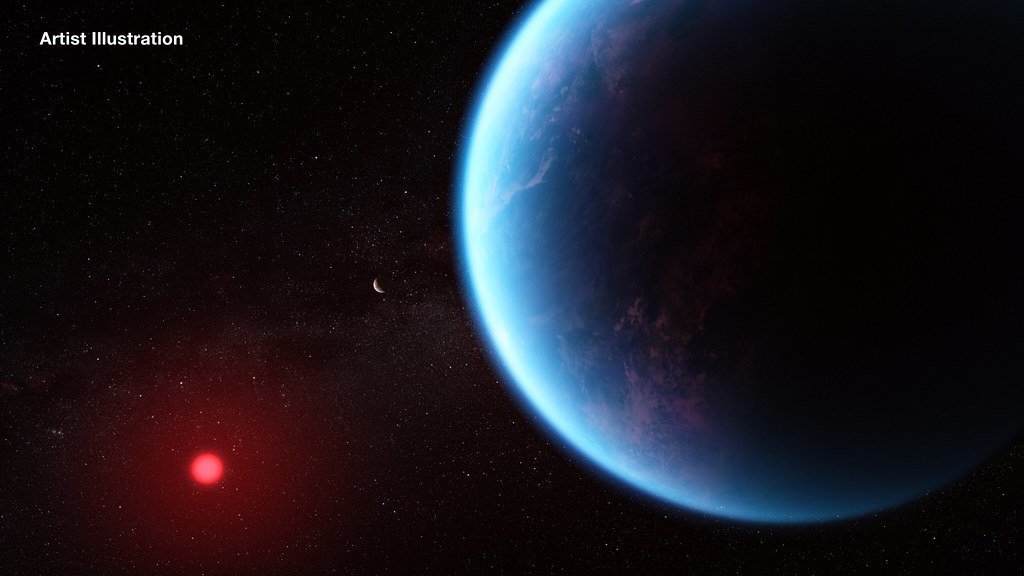
The result is a nuanced portrait of K2-18b: a world with an atmosphere rich in water, perhaps comprising as much as half its mass, and the presence of methane and carbon dioxide. That alone is extraordinary by any historical standard of planetary science.
Laboratory experiments in 2024 demonstrated abiotic DMS formation under simulated exoplanetary conditions. DMS has also been detected in cometary and interstellar environments, far removed from life as we know it. The molecule is not uniquely biological, which complicates every interpretation.
While the latest studies do not confirm or disprove life on K2-18b, they advance the field by clarifying what the data do and do not reveal. The planet remains an exciting laboratory for studying water-rich worlds beyond our solar system, with JWST observations pushing the limits of what we can detect.
Where Science Goes From Here
In the last several years, scientists from a range of disciplines have started putting their heads together to think about the best ways to use biosignatures in the search for life beyond Earth. Researchers say that more detections of these hints of life are inevitable as people learn more about the universe, identify more exoplanets, and build more powerful instruments to study them.
Observations of K2-18b led to inferences of methane and carbon dioxide, as well as of dimethyl sulfide and dimethyl disulfide, both potential biosignatures. However, robust identification of DMS and DMDS requires further observations to increase the detection significances. More JWST time on this planet has already been allocated.
These results motivate a push toward higher precision data, as well as observations of cooler planets that may be more likely to retain atmospheres. Detecting rocky planet atmospheres remains challenging, but with JWST’s excellent performance and a continuing investment of telescope time, researchers are optimistic these uncharted atmospheres will be detected in coming years.
Reading the Evidence Honestly

Claims of discoveries of extraterrestrial life have a long history of being contentious or disproven. Finding life outside of Earth is difficult, and no such claim has as of 2025 been widely accepted by the scientific community. Global news media reports and press releases of publications about K2-18b’s possible biosignatures have often been much more definitive than the often carefully-qualified papers they rely on.
Although the claims of life on K2-18b may be overblown, the findings demonstrate how powerful telescopes like JWST have given scientists new abilities to use chemical clues to study far-off worlds and broaden the search for extraterrestrial life. That shift in capability is real and irreversible.
As Jake Taylor put it plainly: “If we want to claim biosignatures, we need to be extremely sure.” That standard has not yet been met. But the fact that it is now a standard worth arguing about at all says something remarkable about where planetary science stands in 2026.
The question of whether life exists beyond Earth may not be answered by a single headline or a single telescope. What JWST has done is bring that question within striking distance of real evidence. That alone is one of the more consequential shifts in science in recent human history. The answer, when it comes, will probably arrive not as a bombshell but as a slow and careful accumulation of certainty.