

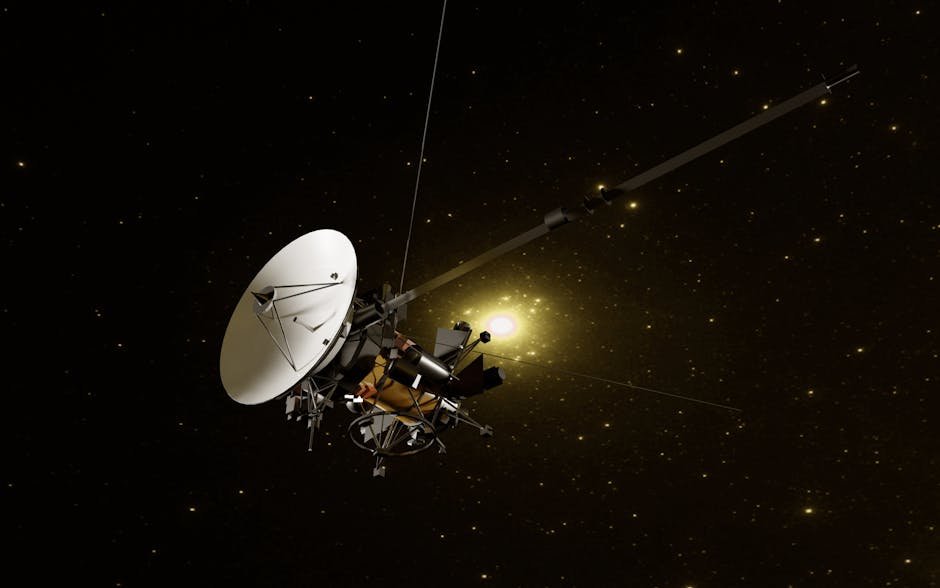
A Rare Cosmic Window Propels Voyager’s Grand Tour (Image Credits: Pexels)
Deep in interstellar space, NASA’s Voyager 1 holds the title of humanity’s most distant creation. Launched almost 49 years ago, the probe has ventured more than 15 billion miles (24 billion kilometers) from Earth as of April 2026.[1][2] Engineers at the Jet Propulsion Laboratory still receive faint signals from its instruments, revealing whispers of the cosmos beyond our solar system. This enduring mission highlights human ingenuity in exploring the unknown.
A Rare Cosmic Window Propels Voyager’s Grand Tour
Engineers designed Voyager 1 in the early 1970s to capitalize on a planetary alignment that occurs roughly every 175 years. This gravitational assist opportunity allowed the probe to visit multiple outer planets efficiently. NASA launched Voyager 1 on September 5, 1977, just 16 days after its twin, Voyager 2.[1]
The spacecraft reached Jupiter in January 1979, capturing detailed images during a close flyby completed by early April. Voyager 1 then hurtled toward Saturn, arriving in November 1980. No prior mission had traveled so far. Together, the Voyagers snapped over 33,000 pictures of Jupiter and its moons, transforming our understanding of the gas giant’s turbulent atmosphere and diverse satellites.
Key milestones from the planetary encounters include:
- First close-up views of Jupiter’s Great Red Spot and volcanic activity on Io.
- Detailed mapping of Saturn’s rings and discovery of new moons.
- Over 4 billion miles away in 1990, Voyager 1 turned its cameras homeward for the solar system’s first “family portrait.”
Breaking Free: The Leap into Interstellar Space
Voyager 1 crossed the heliopause in 2012, marking the first human object to exit the sun’s protective bubble and enter interstellar medium. This boundary separated the solar wind from charged particles between stars. The probe detected a faint, monotone hum from this new realm in 2021 data.[1]
Though Voyager 2 followed into interstellar space later, Voyager 1 pulled ahead, maintaining its lead. Astronomers used the Hubble Space Telescope in 2017 to peer along their paths, confirming the probes’ positions. Former project scientist Ed Stone noted the spacecraft’s durability: “We built the spacecraft with enough redundancy – that is, backup systems – so that they could keep going.”[1]
Today, both Voyagers sample plasma waves, magnetic fields, and cosmic rays in this uncharted territory. Their instruments continue to operate despite decades of radiation exposure.
Tracking a Distant Signal: Power, Speed, and Real-Time Stats
Radioisotope thermoelectric generators power Voyager 1, converting heat from decaying plutonium into electricity. Output has dwindled over time, prompting careful management of resources. Signals take about 22.5 hours one-way at current distances, with commands crafted meticulously at NASA’s Deep Space Network.[3]
The probe travels at roughly 3.5 astronomical units per year, where one AU equals the Earth-sun distance of 93 million miles. Live tracking appears on sites like NASA’s Voyager mission page and TheSkyLive.[1] Voyager 1 outpaces Voyager 2 by a few billion miles, solidifying its record.[4]
| Spacecraft | Status | Key Distance Note |
|---|---|---|
| Voyager 1 | Interstellar, operational | >15 billion miles (April 2026)[1] |
| Voyager 2 | Interstellar, operational | Trailing by billions of miles |
| New Horizons | Outer solar system | Significantly closer |
Onward to Eternity: Future Path and Enduring Legacy
By November 2026, Voyager 1 will reach one light-day from Earth – 16.1 billion miles (25.9 billion km) – where signals will take a full day round-trip.[5][6] Power constraints may silence science instruments around 2025-2030, but the probe will coast silently.
In roughly 40,000 years, it will pass within 1.6 light-years of Gliese 445. Voyager 2 heads toward Ross 248 similarly. Each carries a golden record with Earth’s sounds, images, and greetings – a message in a bottle for any finders.
Key Takeaways:
- Voyager 1 remains humanity’s farthest outpost at over 15 billion miles.
- It pioneered interstellar exploration, crossing the heliopause in 2012.
- Approaching one light-day in late 2026, it tests the limits of deep-space communication.
Voyager 1 embodies relentless curiosity, pushing boundaries long after its prime objectives ended. Its data still shapes cosmic models, reminding us of exploration’s timeless pull. What milestone should we celebrate next for this trailblazer? Share your thoughts in the comments.