

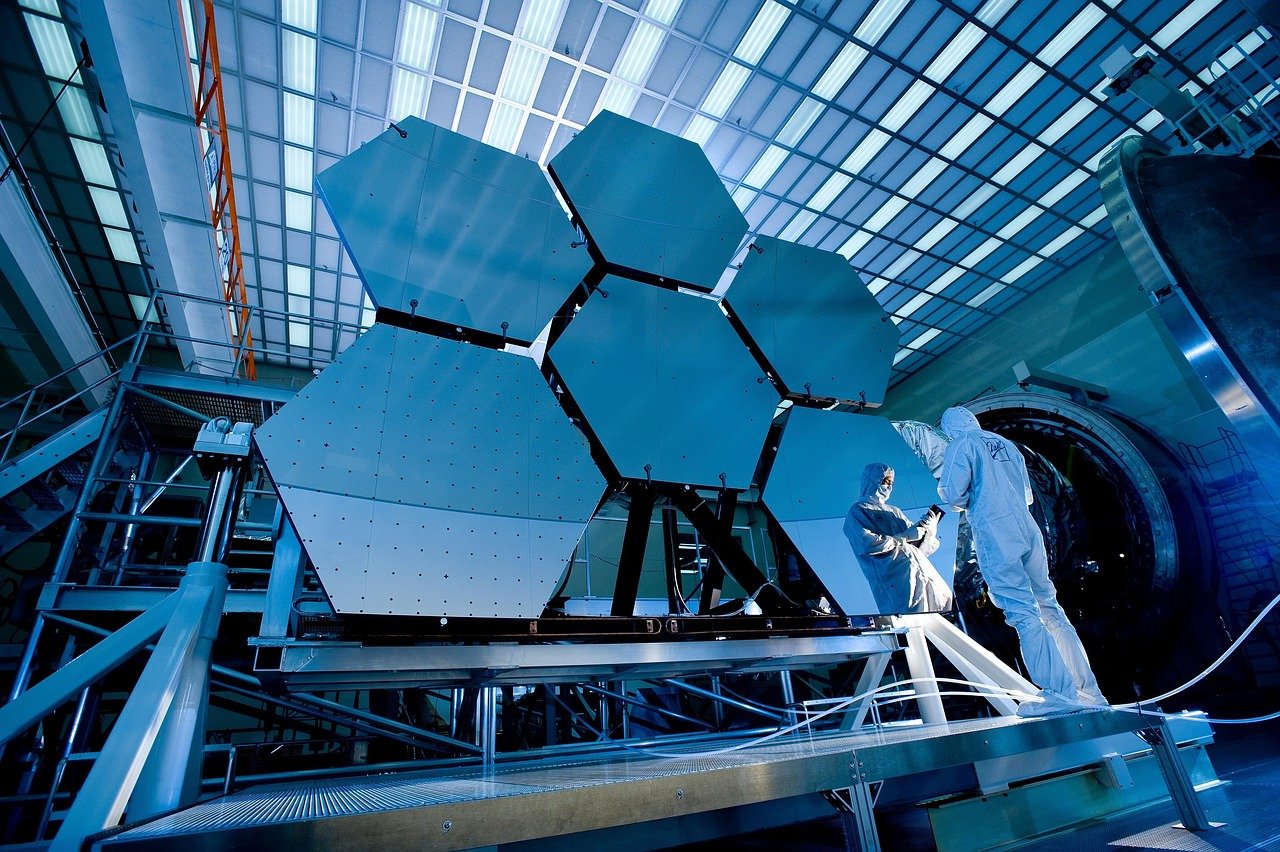
Precision Engineering Culminates in Historic Integration (Image Credits: Pixabay)
The Nancy Grace Roman Space Telescope stood fully assembled for the first time on November 25, 2025, marking a pivotal achievement for NASA’s astrophysics program. Technicians at the agency’s Goddard Space Flight Center joined the observatory’s inner and outer segments in a precise operation inside the facility’s largest clean room.[1][2] This milestone positions the telescope for rigorous prelaunch testing before shipment to Kennedy Space Center in Florida. Set to launch as early as September 2026 aboard a SpaceX Falcon Heavy rocket, Roman promises to deliver unprecedented views of the infrared universe.[1]
Precision Engineering Culminates in Historic Integration
Teams spent hours meticulously connecting the spacecraft bus and telescope components, a process captured in time-lapse footage that highlights the delicate balance of engineering and cleanliness required.[1] The 2.4-meter primary mirror, comparable to Hubble’s, anchors the design, but Roman’s innovations lie in its speed and scale. Completion arrived under budget and ahead of schedule, demonstrating NASA’s ability to deliver flagship missions efficiently.[2]
Now undergoing environmental tests to simulate launch vibrations, thermal extremes, and space vacuum, the observatory must prove its resilience. NASA Associate Administrator Amit Kshatriya noted, “Completing the Roman observatory brings us to a defining moment for the agency.”[1] These steps ensure the telescope will operate flawlessly from its halo orbit at Sun-Earth L2, about one million miles from Earth.
Powerful Instruments Redefine Sky Surveys
Roman’s Wide Field Instrument, a 288-megapixel infrared camera, captures sky patches larger than the full moon’s apparent size in a single exposure.[1] This yields a field of view at least 100 times wider than Hubble’s, enabling surveys hundreds of times faster. The Coronagraph Instrument demonstrates starlight suppression to image exoplanets directly, blocking glare from host stars.
Over its five-year primary mission, Roman will generate up to 20 petabytes of data – enough to fill thousands of hard drives.[1] Here are the telescope’s core capabilities:
- Image billions of galaxies to map cosmic structure.
- Monitor millions of stars for microlensing events revealing hidden planets.
- Observe time-variable phenomena like supernovae over vast areas.
- Probe exoplanet atmospheres and disks with unprecedented contrast.
- Deliver public data immediately for global analysis.
Targeted Surveys to Probe Universe’s Deepest Secrets
The mission dedicates 75 percent of its time to three flagship surveys using the Wide Field Instrument. The High Latitude Wide Area Survey will image over a billion galaxies, tracing dark matter distribution and galaxy evolution.[1] A High Latitude Time Domain Survey will revisit sky regions repeatedly to study expansion driven by dark energy.
The Galactic Bulge Time Domain Survey targets the Milky Way’s core, hunting for tens of thousands of exoplanets via gravitational microlensing, including those in habitable zones and rogue worlds.[3] Julie McEnery, Roman’s senior project scientist, stated, “With Roman’s construction complete, we are poised at the brink of unfathomable scientific discovery.”[1] Remaining time supports community-selected programs, fostering broad research.
From Goddard to the Stars: Launch Preparations Accelerate
After final integrations and checkouts, Roman will ship to Kennedy Space Center this summer for spacecraft mating and launch rehearsals.[1] The Falcon Heavy, with a perfect record in its missions, will propel the 4,000-kilogram observatory to L2. Nicky Fox, NASA Science Mission Directorate associate administrator, emphasized Roman’s role in unraveling cosmic acceleration.
Once operational, the telescope will complement Hubble, James Webb, and Euclid, each peering at different depths and wavelengths. Expected yields include over 100,000 exoplanets, insights into 95 percent of the universe’s unseen components, and serendipitous discoveries that redefine astronomy.[2]
Key Takeaways
- Roman’s field of view surpasses Hubble’s by 100 times, accelerating surveys dramatically.[4]
- Core surveys target dark energy, exoplanets, and galactic dynamics with 20 petabytes of data.
- Launch as early as fall 2026 positions it for immediate cosmic impact.
Roman not only honors its namesake, NASA’s pioneering astronomer Nancy Grace Roman, but also equips humanity to confront fundamental questions about existence. As testing wraps and launch nears, this observatory stands ready to illuminate the cosmos’s hidden realms. What mysteries do you hope it uncovers? Share your thoughts in the comments.