

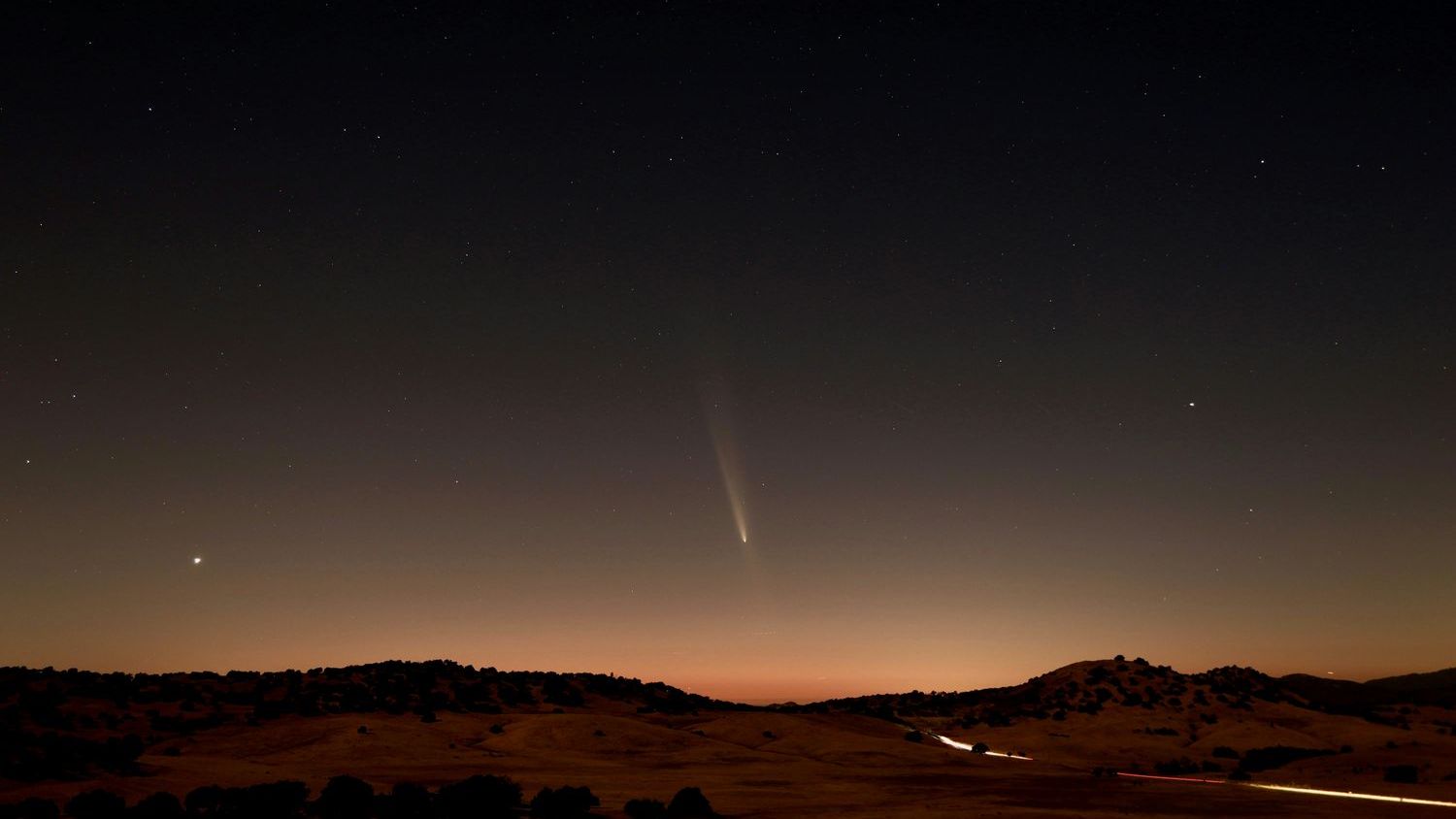
A Historic Flyby Unfolds (Image Credits: Unsplash)
Comet C/2025 R3 (PanSTARRS) reached its nearest point to Earth on April 26, 2026, passing just 45 million miles (72 million kilometers) away.[1][2]) Astronomers captured the moment when the comet’s ion tail suddenly became prominent, creating a striking visual display amid its solar system journey. This rare event marked the hyperbolic visitor’s only pass through the inner solar system in human history.[2])
A Historic Flyby Unfolds
The comet swung past Earth at a distance of 0.489 AU, or roughly half the average separation between our planet and the Sun. This close shave followed its perihelion on April 19, when it grazed as near as 0.499 AU to the Sun itself, heating its icy nucleus and triggering outbursts of gas and dust.[2]) Discovered in September 2025 by the Pan-STARRS survey telescopes on Hawaii’s Haleakala, the object had brightened steadily from magnitude 20 to naked-eye visibility by mid-April.[2])
Solar conjunction complicated direct viewing on the day of closest approach, as the comet positioned itself nearly between Earth and the Sun, just 3.5 degrees away. Yet remote telescopes and spacecraft like SOHO documented its activity, including entry into coronagraph fields of view on April 23 and 24.[2]) The timing aligned perfectly with the ion tail’s emergence, a phenomenon fueled by intensified solar radiation at these distances.
Decoding the Dual Tails
Comets develop two primary tails as they near the Sun: a curved dust tail pushed by radiation pressure and a straighter ion tail sculpted by the solar wind. For PanSTARRS, the ion tail took center stage around the Earth flyby, stretching over 7 degrees by early April and exceeding 4 degrees in later images, with intricate filaments and kinks from magnetic interactions.[2])[3]
Prior observations showed a broad tail shortly after discovery, evolving into a one-degree structure by late March. By April 8, the ion tail dominated with minimal dust visible, but post-perihelion forward scattering dramatically brightened the dust component as sunlight reflected off particles aligned toward Earth. This “switching on” effect highlighted the ion tail’s sudden clarity against the cosmic backdrop.[4]
- Dust Tail: Curved, reflective particles; enhanced post-perihelion.
- Ion Tail: Straight, glowing gases; prominent at closest approach, showing disconnection events.
- Coma: Blue-green glow from carbon compounds, expanding to 3 arcminutes.
Skywatchers Document the Spectacle
Amateur astronomers worldwide turned their lenses skyward in the preceding weeks. On April 13, images from India revealed a greenish coma with a steep, narrow ion tail piercing star fields in Pegasus, its filamentary details shaped by solar wind.[4] Czech photographer Petr Horálek captured a 14-degree tail on April 9, framing it near the Great Square asterism and Andromeda Galaxy.
In Utah on April 12, José J. Chambó’s remote telescope image showed a fan of jets from the nucleus, a dominant streamer, and a “tail disconnection event” trailing like shed skin. “Sometimes you don’t need a perfect night or hours of integration. It’s about just being there at the right moment,” Chambó noted.[3] These pre-flyby shots peaked as the comet hovered low in the eastern dawn sky, accessible via binoculars until solar glare overwhelmed it.
Origins in the Distant Oort Cloud
This interloper hailed from the Oort Cloud, a spherical reservoir of icy bodies encircling the solar system at up to 6300 AU. Its inbound orbital period spanned about 170,000 years, perturbed likely by passing stars or galactic tides. Hyperbolic trajectory confirmed its one-way ejection outbound, ensuring no return.[2])
Early precovery images from September 2025 revealed a diffuse head without a tail, which grew as solar heat vaporized ices into gas jets. The comet’s eccentricity near 1 underscored its interstellar wanderer status, with Jupiter’s gravity influencing but not capturing it.
Legacy of a Fleeting Visitor
Post-flyby, PanSTARRS fades into evening skies for southern observers, dimming as it recedes. Northern Hemisphere viewers may glimpse it faintly in telescopes, but the prime window has closed. Spacecraft data from SOHO and beyond will refine models of its outbursts and composition.
This encounter offered a glimpse into primordial solar system materials, unchanged since formation. As it hurtles toward interstellar space, PanSTARRS leaves behind images of ethereal tails – a reminder of the dynamic forces shaping our cosmic neighborhood.