

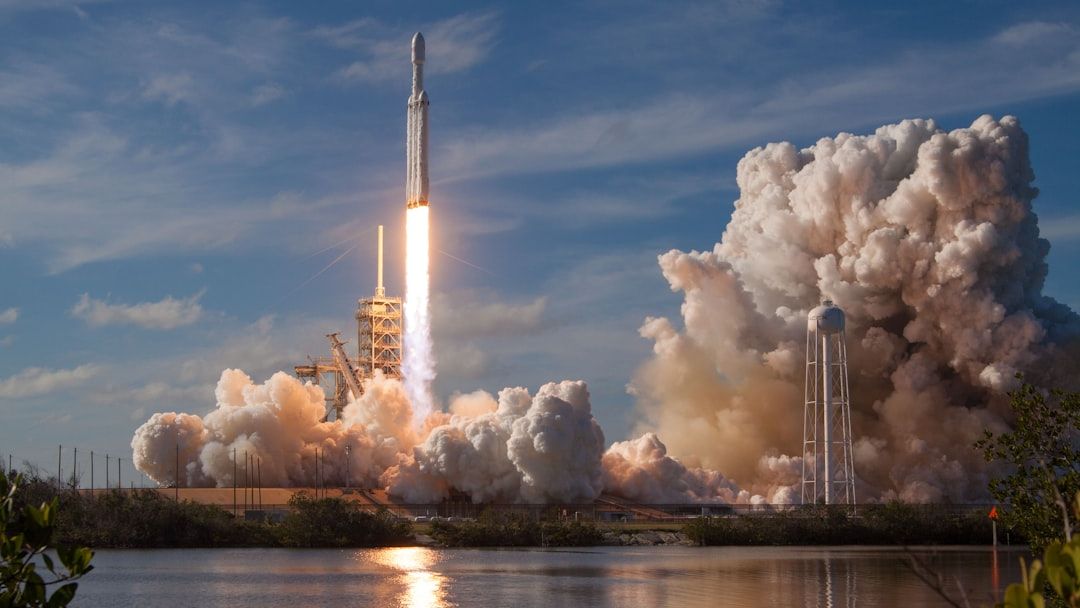
Mission Profile and Execution (Image Credits: Unsplash)
Vandenberg Space Force Base, California – A Falcon 9 rocket soared from Space Launch Complex 4 East on Sunday morning, April 26, delivering 25 Starlink satellites to low-Earth orbit.[1][2] The liftoff at 7:37 a.m. PDT marked SpaceX’s 50th mission of the year, underscoring the company’s relentless pace in orbital operations. All missions this year have used the reliable Falcon 9 vehicle.
Mission Profile and Execution
The Starlink Group 17-16 mission targeted a sun-synchronous orbit, ideal for consistent global coverage. The payload consisted of 25 v2-mini satellites, each designed for high-speed internet delivery to remote areas.[2] Deployment occurred on schedule about 61 minutes after liftoff, as confirmed by SpaceX updates.
First stage separation followed the standard profile, with the booster proceeding to a droneship landing in the Pacific Ocean. The upper stage then performed a deorbit burn to dispose of itself responsibly. No anomalies disrupted the flight, continuing SpaceX’s strong reliability record.[1]
Booster B1088’s Remarkable Reuse Record
Booster B1088 powered this flight on its 15th mission, a testament to SpaceX’s reusability advancements. Previous assignments included national security launches like NROL-126 and NROL-57, science missions such as Transporter-12 and SPHEREx/PUNCH, plus 10 prior Starlink deployments.[1][3] The booster touched down successfully on the autonomous spaceport drone ship, marking its 15th recovery.
This reuse milestone highlights how SpaceX has transformed launch economics. Turnaround times have shortened dramatically, enabling the high cadence seen in 2026. B1088’s performance showed no degradation from repeated flights.
Starlink Constellation Gains Momentum
These 25 satellites joined a network approaching 10,300 active units, the largest satellite constellation in history.[1] More than 80 percent of SpaceX’s 2026 launches – 42 out of 50 – have carried Starlink payloads, fueling rapid expansion. The v2-mini models offer improved capabilities over earlier generations, including better efficiency and direct-to-cell features in testing.
Operators worldwide now rely on Starlink for connectivity in underserved regions. The constellation supports maritime, aviation, and rural broadband services, with user numbers climbing steadily.
- 50th Falcon 9 launch of 2026
- 15th flight for booster B1088
- 25 Starlink v2-mini satellites deployed
- Nearly 10,300 active Starlink satellites
Accelerating Pace Sets New Benchmarks
This launch represented SpaceX’s 633rd Falcon 9 mission overall.[2] The company now eyes around 160 orbital attempts this year, challenging its 2025 record of 165. Vandenberg has hosted multiple Starlink flights recently, balancing loads across U.S. sites.
Future missions include more Starlink batches and diverse payloads. SpaceX’s cadence positions it far ahead of competitors, driving down costs and opening space access.