

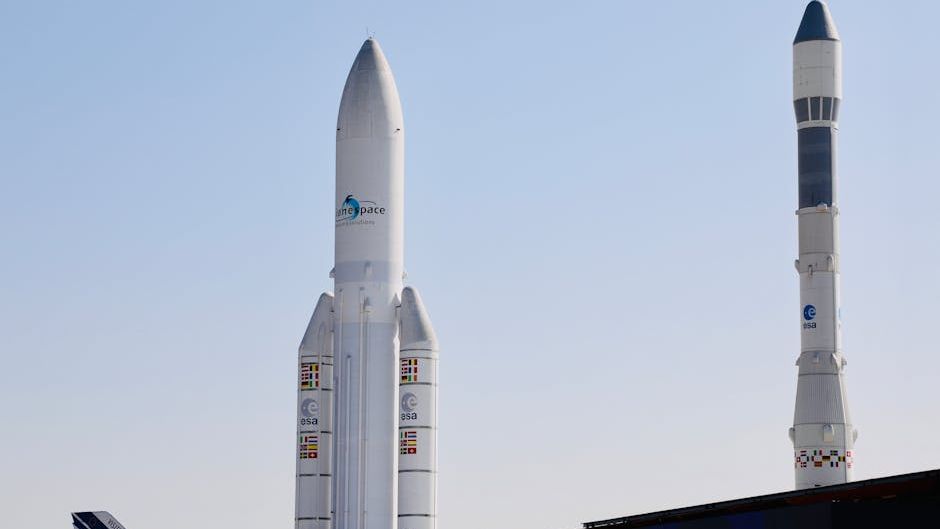
Ariane 6 Enters Heavy-Lift Milestone (Image Credits: Pexels)
French Guiana — Arianespace’s Ariane 64 rocket, Europe’s heaviest-lift vehicle, completed final preparations at the Guiana Space Centre for a dawn launch carrying 32 satellites from Amazon’s Leo constellation. The mission, designated VA268 and LE-02 by Amazon, represents the second such flight for the partnership and underscores the accelerating pace of satellite internet deployments worldwide.[1][2] Set against a backdrop of tight regulatory deadlines, this liftoff advances Amazon’s ambitious network while affirming Ariane 6’s reliability after six prior successes.
Ariane 6 Enters Heavy-Lift Milestone
The Ariane 64 configuration debuted successfully in February 2026, when it deployed an identical batch of 32 Amazon Leo satellites during Flight VA267.[1] Equipped with four solid rocket boosters and a 20-meter-long fairing, the rocket maximizes payload capacity for dense low-Earth orbit missions. This upcoming flight marks the seventh overall for Ariane 6 since its 2024 maiden voyage and Arianespace’s 360th launch.
Teams integrated the satellites atop the launcher after their arrival in Kourou on March 10 and 12. The full campaign, including testing, positioned the stack for a mission duration under two hours from liftoff to deployment.[2] Such efficiency highlights Europe’s renewed independence in heavy-lift capabilities following the Ariane 5 retirement.
Amazon Leo’s Rapid Constellation Buildout
Amazon Leo, formerly Project Kuiper, aims to deliver high-speed broadband via a network initially planned for 3,236 satellites in low Earth orbit. As of April 2026, roughly 270 production units orbited, bolstered by 10 prior missions including a ULA Atlas V launch of 29 satellites on April 27.[3][1] This VA268 delivery will add significant capacity toward the U.S. FCC mandate requiring half the constellation operational by July 30, 2026.
The company secured 18 Ariane 6 missions as part of a diverse launch manifest involving ULA, Blue Origin, and others. Recent approvals expanded potential to over 7,700 satellites, intensifying competition with networks like Starlink.[2]
Launch Timeline and Viewing Guide
Liftoff targets 4:08 a.m. EDT (08:08 UTC) on April 30 from ELA-4 at Europe’s Spaceport, with a window extending nearly an hour. The sequence unfolds rapidly: boosters ignite seconds after main engine start, fairing jettison follows ascent, and satellites separate into orbit roughly 114 minutes post-launch.[1]
- Pre-launch countdown begins hours earlier at the control center.
- Solid boosters burn for under two minutes, propelling the stack skyward.
- Upper stage performs multiple burns for precise LEO insertion.
- Post-deployment, the rocket achieves disposal orbit compliance.
Strategic Stakes for Europe and Global Connectivity
Ariane 6’s track record now includes multiple 2026 flights, building momentum after four in 2025. The Ariane 64 variant proves ideal for mega-constellations, with its boosters enabling heavier payloads than the two-booster 62 model.[4]) For Arianespace, these missions solidify commercial viability amid rising demand.
Amazon’s push reflects broader industry shifts, where low-Earth orbit networks promise internet access to underserved regions. Yet challenges persist, including spectrum coordination and orbital debris mitigation. As VA268 approaches, observers anticipate flawless execution to sustain the tempo.
Key Mission Facts:
- Rocket: Ariane 64 (7th flight overall)
- Payload: 32 Amazon Leo satellites (LE-02 batch)
- Liftoff: 08:08 UTC, April 30, 2026
- Watch: Arianespace live coverage
This launch not only propels hardware but also Europe’s space ambitions, bridging terrestrial gaps one orbit at a time. With the window opening soon, the world tunes in for another chapter in satellite supremacy.