

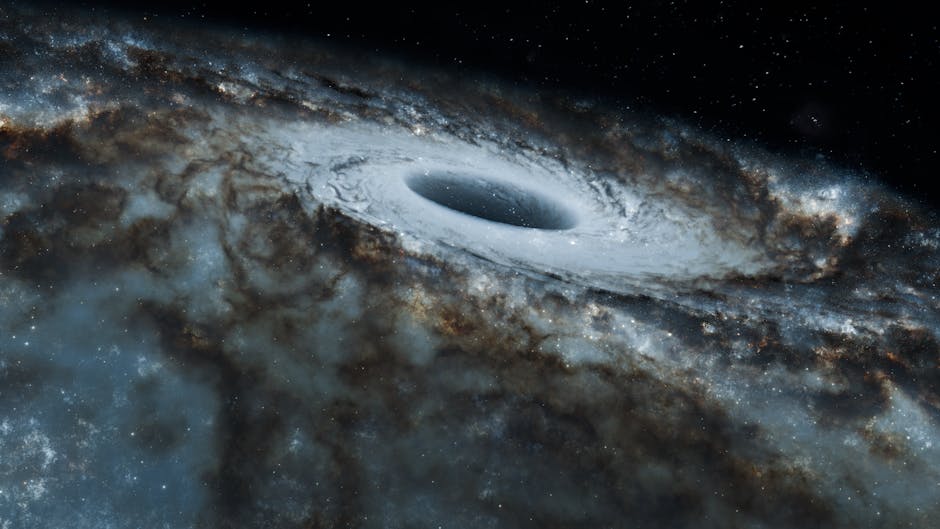
The Rise of Ansky (Image Credits: Pexels)
A supermassive black hole located 300 million light-years away stirred to life in 2019, captivating astronomers with sudden bursts of light. Known as ZTF19acnskyy or “Ansky,” the object resides in the galaxy SDSS J133519.91+072807.4. Recent observations revealed an intriguing twist: its X-ray flares, once thought to accelerate, have instead grown farther apart.
The Rise of Ansky
The Zwicky Transient Facility first detected Ansky nearly seven years ago when the galaxy brightened unexpectedly at optical wavelengths. Astronomers soon observed similar increases across other wavelengths, suggesting a dormant supermassive black hole had begun feeding actively. This event marked a potential milestone as the first documented awakening of such a giant from slumber.
By 2024, Ansky displayed a pattern of X-ray flares known as quasi-periodic eruptions. These phenomena, seen in several closer galaxies, typically involve a smaller object interacting with the black hole’s surroundings. Researchers anticipated that the intervals between these eruptions would shorten over time as the dynamics intensified.
Observations Challenge Expectations
A team led by Joheen Chakraborty from the Massachusetts Institute of Technology examined Ansky’s behavior from January 2025 to January 2026. They drew on data from the Neil Gehrels Swift Observatory’s X-ray Telescope, XMM-Newton, and the Neutron star Interior Composition Explorer. This effort captured 23 bursts, including a record 19 in sequence from any quasi-periodic eruption source.
Each outburst lasted roughly three days, with consistent peak luminosities and total energies. However, the intervals between them lengthened steadily, from 9.9 days early in 2025 to 13.5 days by early 2026. This slowdown contradicted models predicting ever-closer repetitions.
Testing Leading Theories
Chakraborty and colleagues evaluated five explanations for the flares’ stable energy, three-day duration, and expanding gaps. None fully accounted for the observations. A star orbiting the black hole might shed mass periodically, yet maintaining identical burst energies as it diminishes remains unclear, as does achieving the precise duration.
Other scenarios fared no better. A partially disrupted star could drift outward due to uneven mass loss, but it struggles to explain uniform burst properties. General relativistic precession around an accretion disk failed to match the timing shifts. A companion supermassive black hole might induce reflex motion, though the effect proved far too weak – by three orders of magnitude. Finally, disk instabilities could spark recurrent accretion, but their predictability in this case lacks a clear mechanism.
- Star-mass transfer: Inconsistent energy output and duration mismatch.
- Partial stellar disruption: Fails on burst uniformity.
- Relativistic precession: No fitting parameters found.
- Binary black hole motion: Effect too small.
- Accretion disk instabilities: Predictability unexplained.
Key Observations at a Glance
Intervals: 9.9 days (Jan 2025) to 13.5 days (Jan 2026)
Burst duration: ~3 days each
Luminosity and energy: Roughly constant
Total bursts monitored: 23 (19 consecutive)
Future Insights Await
The study, detailed in “A Positive Period Derivative in the Quasiperiodic Eruptions of ZTF19acnskyy” published in The Astrophysical Journal Letters, highlights gaps in current understanding. While no model fits perfectly, the findings open fresh research paths. Continued monitoring could reveal whether the intervals stabilize, reverse, or evolve further.
Astronomers now watch Ansky closely for its next move. Such anomalies often refine theories, potentially reshaping views on black hole feeding processes.