

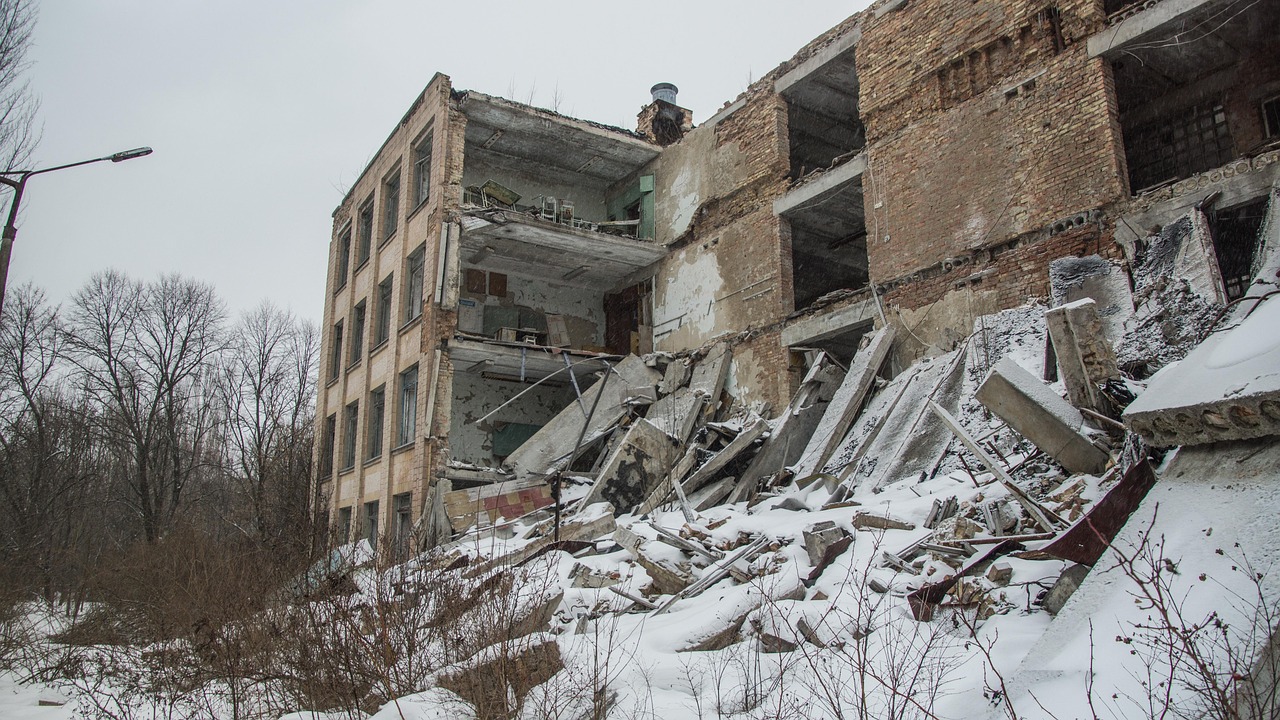
A Legacy of Evacuation and Abandonment (Image Credits: Pixabay)
Workers at the Chernobyl nuclear plant still monitor radiation levels daily, their dosimeters ticking faster whenever they stray from cleared paths. Four decades after the 1986 explosion that spewed radioactive material across Europe, the exclusion zone has become a place where humans tread carefully amid overgrown ruins and thriving wildlife.[1][2] Yet recent conflicts have introduced new dangers, turning a managed disaster site into a militarized buffer zone.
A Legacy of Evacuation and Abandonment
The catastrophe unfolded in the early hours of April 26, 1986, when Reactor No. 4 at the Chernobyl power plant exploded during a safety test. Poor design flaws combined with operator errors led to a fire that released vast amounts of radioactive isotopes, including plutonium, iodine, strontium, and caesium. Soviet authorities evacuated about 116,000 people from the immediate area within days, with the total number relocated exceeding 200,000 over time.[1][2]
Pripyat, the purpose-built town for plant workers, stood frozen in time after its overnight abandonment. Vines now climb through shattered windows, and mature trees envelop crumbling buildings, transforming the site into what resembles ancient ruins. The 1,000-square-mile exclusion zone, roughly the size of Cyprus, remains largely off-limits due to persistent hotspots of contamination.[3][1]
Wildlife Flourishes in the Void Left by Humans
Without human interference, the zone has become a de facto nature reserve. Populations of wolves have surged to seven times the levels in nearby reserves, supported by plentiful prey like deer and wild boar. Eurasian lynx have returned after decades of absence, while brown bears – unseen in the region for over a century – now roam the forests.[4]
Other species thrive as well. Przewalski’s horses graze alongside feral dogs descended from abandoned pets, and oversized catfish patrol the cooling ponds. Forests shifted from radiation-sensitive pines to resilient birches, fostering a denser ecosystem. Studies suggest subtle adaptations, such as darker tree frogs possibly using higher melanin for radiation protection, though researchers debate direct causation versus environmental factors.[4][2]
- Wolves: Sevenfold increase compared to surrounding areas.
- Brown bears: Documented via camera traps since 2014.
- Bank voles: Higher genetic diversity and DNA damage resistance in contaminated zones.
- Feral dogs: Fed by guards, showing potential genetic influences from radiation.
Engineering Feats Meet Modern Vulnerabilities
Efforts to contain the disaster began hastily with a concrete sarcophagus over the ruined reactor, designed for just 20-30 years but now rusting after four decades. In 2016, the New Safe Confinement – a $2.5 billion steel arch funded by 45 nations – slid into place, designed to last 100 years and enable future fuel removal. The European Union contributed €423 million to this project and recently pledged €37 million more after damage from a Russian drone strike.[5][1]
On February 14, 2025, a low-cost Geran-2 drone pierced the NSC’s roof, creating a 15-square-meter hole, igniting a fire in the sealing membrane, and compromising airtightness and humidity controls. No radiation escaped immediately, but experts warn repairs – estimated at up to €500 million – must begin soon to prevent sarcophagus collapse and release of over 100 tonnes of nuclear fuel. Plant director Serhii Tarakanov stressed the peril: “If the sarcophagus collapses, over a hundred tonnes of nuclear fuel would be released into the air.”[1]
Two solar farms now operate within the zone, opened in 2018, feeding power to the grid and providing backup for waste cooling. A third is under construction, capitalizing on the area’s isolation.[2]
War Turns Sanctuary into Stronghold
Russia’s full-scale invasion in 2022 brought troops to the zone for 35 days, using it as a staging ground for the Kyiv assault. They dug trenches near the contaminated “Red Forest,” looted equipment, and stirred radioactive dust with vehicles. Since then, blackouts from grid strikes have forced reliance on diesel generators for fuel cooling, while drones and missiles fly overhead.[1][2]
The zone now bristles with defenses: tank traps, razor wire, drone nets, and sand berms to avoid digging contaminated soil. Ukrainian National Guard units train in Pripyat’s ruins, lobbing grenades into abandoned homes. Battalion commander “Skif” emphasized the stakes: “Everything depends on security.” Tourism, which drew 70,000 visitors yearly before the war, has halted, and foreign scientists have fled.[3][2]
Enduring Human Presence and Uncertain Future
About 600 workers rotate through the site daily for maintenance and monitoring, with cleanup projected to continue until the 2060s. A few dozen elderly self-settlers persist in villages, foraging mushrooms after decontamination and rejecting relocation. Hospitals treat staff and locals with routine checks.[3]
Deputy chief engineer Oleksandr Skomarokhov, with nearly 40 years on site, recalled the 2025 strike: “We witnessed shelling before, but I knew they would only wake me if something critical had happened.” As repairs loom and threats persist, the zone embodies resilience shadowed by risk, a reminder that some disasters evolve rather than end.[1]
For the workers and soldiers stationed there, the balance between containment and conflict remains precarious, with every drone hum carrying the weight of history’s lessons unheeded.