

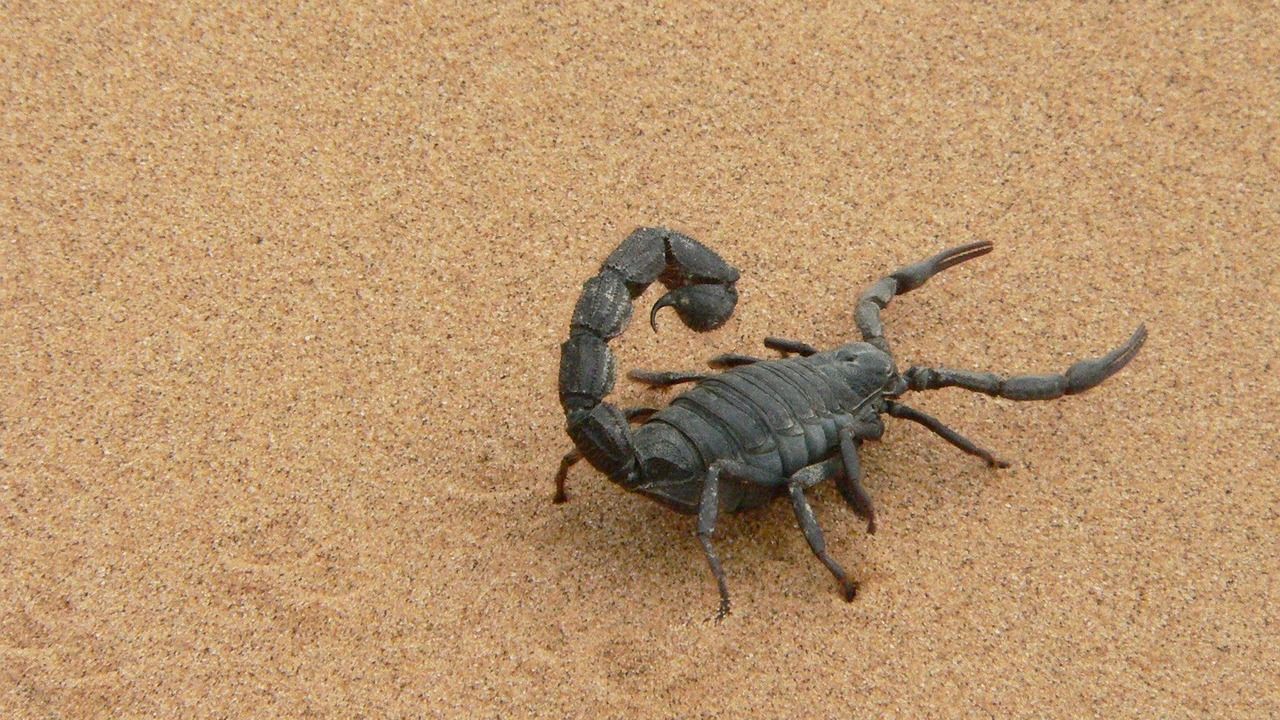
Scorpions go terminator mode and reinforce their weapons with metal – Image for illustrative purposes only (Image credits: Pixabay)
In the arid deserts and dark crevices where scorpions thrive, these arachnids rely on razor-sharp pincers and a potent tail stinger for survival. Recent research has uncovered that these weapons pack an extra punch, thanks to deliberate infusions of metals such as zinc, manganese, and iron. Far from random accumulation, the placement of these elements suggests an evolutionary strategy honed over millennia.
Armed for Battle: Scorpion Anatomy Basics
Scorpions possess a distinctive arsenal centered on their front pincers, known scientifically as chelae or pedipalp appendages, and a rear telson that delivers venom through its stinger. These structures enable the creatures to grasp prey, defend against threats, and inject paralyzing toxins. The pincers vary in size and power across species, with some favoring brute force crushing and others precise pinching.
Examinations dating back to the 1990s first detected metals within these appendages. Zinc, manganese, and iron appeared in concentrations that hinted at more than environmental coincidence. Researchers long wondered if scorpions actively incorporated these elements or simply absorbed them passively from their surroundings.
Unraveling the Mystery of Metal Presence
Biologist Sam Campbell from the University of Queensland in Australia led efforts to settle the debate. “That the metals are there has been known since the 1990s,” Campbell noted. “What we didn’t know was whether scorpions evolved to be like that or if it was accidental and they were just picking the metals up from the environment.”
His team turned to chemical analysis to map metal distribution precisely. They focused on both stingers and pincers from multiple scorpion species, seeking patterns that would reveal intent. The work, published in the Journal of The Royal Society Interface, provided clear evidence against mere happenstance. Metals concentrated in critical zones, enhancing mechanical properties like hardness and resilience.
Strategic Distribution Across Species
Detailed scans revealed zinc dominating in the pincers’ cutting edges, bolstering their ability to shear through tough exoskeletons. Manganese and iron showed up in the stinger’s tip, potentially sharpening its penetration and resisting wear during strikes. These patterns held consistent yet varied subtly by species, reflecting adaptations to specific hunting styles or habitats.
Not every part of the appendages contained high metal levels; the team observed selective enrichment in high-stress areas. This precision implied biological mechanisms, such as specialized cells or dietary targeting, that direct metals to weaponized zones. Such findings elevate scorpions from passive survivors to active architects of their defenses. The study ruled out uniform environmental uptake, as control tissues showed far lower concentrations.
Across the examined species, the metal profiles aligned with functional demands. Burrowing scorpions, for instance, exhibited reinforced pincers suited for digging and subduing underground prey. Tree-dwelling varieties prioritized stinger enhancements for aerial strikes. These differences underscored evolution’s fine-tuning, where metals served as natural alloys in an organic forge.
What This Means for Arachnid Evolution
The discovery reshapes views on how invertebrates weaponize chemistry. Scorpions join a select group of animals that metallurgically upgrade their tools, akin to how some spiders lace silk with metals for strength. Yet questions linger: exactly how do scorpions sequester and deploy these elements? Future studies may probe genetic controls or dietary sources.
Broader implications extend to biomimicry, where scientists eye nature’s metalworking for durable materials. For now, the research affirms scorpions’ calculated lethality, turning everyday minerals into instruments of predation. In a world of fierce competition, these arachnids demonstrate evolution’s ingenuity one metallic claw at a time.