

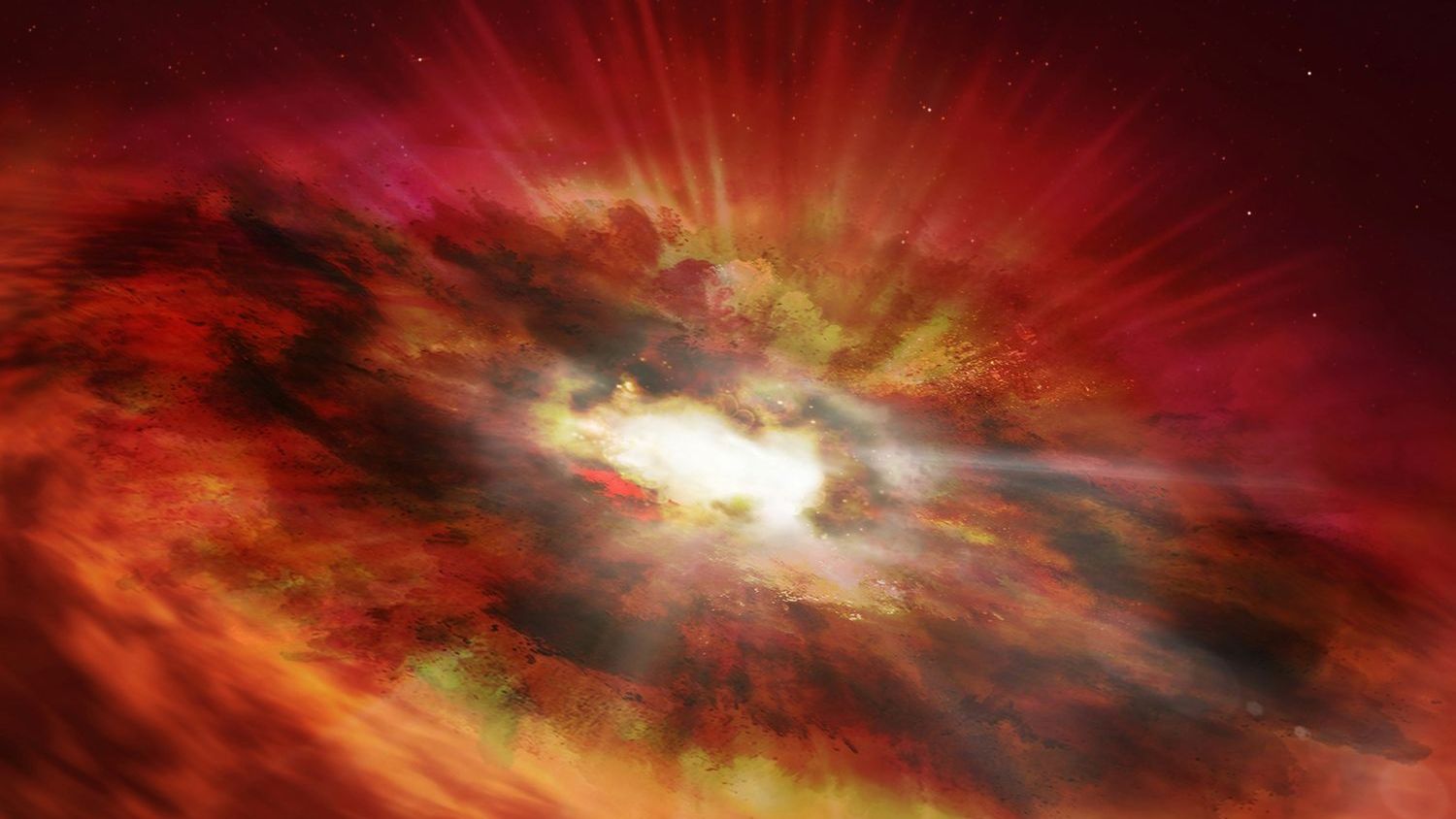
Why do some stars become ‘supernova impostors’? Astronomers still don’t quite know – Image for illustrative purposes only (Image credits: Unsplash)
Massive stars sometimes unleash bursts of light and energy that fool astronomers into thinking a supernova has occurred. These events, known as supernova impostors, produce dramatic flares resembling the early stages of a true stellar explosion but leave the progenitor star intact.[1][2] Eruptive mass loss drives these outbursts, yet scientists remain puzzled by the precise mechanisms behind them.
Spotting the Pretenders Among Cosmic Explosions
Astronomers first identify supernova impostors when distant galaxies light up with what appears to be a faint supernova. These transients often receive a Type IIn classification due to narrow spectral lines from hydrogen-rich material moving at relatively low speeds.[1] Unlike genuine core-collapse supernovae, which peak at absolute magnitudes brighter than -17, impostors top out at -11 to -16, making them sub-luminous by comparison.[2]
The light curves provide further clues. Impostors brighten gradually over months or years before fading, rather than exploding in days. Follow-up observations frequently reveal the original star recovering, confirming the event was non-terminal.[3] This survival distinguishes them from novae, which involve smaller ejections from white dwarf companions.
Iconic Cases of Stellar Deception
Eta Carinae stands as the prototype for these phenomena. During its Great Eruption from 1837 to 1858, the star peaked as the second-brightest in the night sky, ejecting around 20 solar masses of material into a dual-lobed nebula expanding at 210 kilometers per second.[3] The star endured and remains visible today, albeit dimmer.
Other notable examples include P Cygni, which underwent a similar brightening in the 17th century, and extragalactic events like SN 1961V, SN 1954J, and SN 1997bs. More recent transients such as SN 2008S, SN 2010dn, and the 2004 outburst in UGC 4904 – later followed by the true supernova SN 2006jc – further illustrate the pattern.[1] SN 2009ip generated controversy with repetitive eruptions before a possible terminal explosion in 2012.[2]
- Eta Carinae (1837-1858): Ejected ~20 solar masses; survived.
- P Cygni (17th century): Historical giant eruption; ongoing variability.
- SN 2009ip: Multiple peaks; debated final fate.
- UGC 4904 OT (2004): Precursor to SN 2006jc.
Key Traits of Supernova Impostors
– Progenitors: Luminous blue variables (LBVs), often >50 solar masses.
– Peak brightness: Absolute magnitude -11 to -16.
– Duration: Months to years.
– Outcome: Star survives with reduced mass.[1][2]
Mechanisms Behind the Eruptions
Eruptive mass loss characterizes these events, with stars shedding several solar masses in super-Eddington outflows driven by radiation pressure. The Eddington limit marks the point where outward radiation balances gravity; exceeding it triggers instability.[2] Observations show apparent temperatures of 7,000 to 9,000 Kelvin and non-spherical ejecta.
Theories point to photospheric or interior instabilities. Some suggest nuclear cascades in the star’s core, where fuel depletion in outer layers causes contraction and runaway fusion. Binary interactions or transitions to Wolf-Rayet phases may also contribute.[3] For Eta Carinae, the outflow parameter Gamma reached 2 to 10, far above unity.
| Event | Peak Magnitude | Ejected Mass (solar masses) | Progenitor Survival |
|---|---|---|---|
| Eta Carinae | ~ -14 (apparent peak) | ~20 | Yes |
| SN 1961V | -14 to -16 | Several | Debated |
| SN 2008S | ~-11 | ~0.1-1 | Yes |
The Broader Puzzle for Astronomers
Despite decades of study, astronomers lack a unified model for why these eruptions occur. The diversity in progenitors – ranging from classical LBVs to obscured post-red supergiants – complicates explanations. Some impostors precede true supernovae, raising questions about their role in final stages.[1]
These events dominate mass loss for stars above 50-60 solar masses, shaping their evolution toward core collapse. Understanding eruptive mass loss could reveal how very massive stars avoid premature explosions or influence early universe Population III stars.[2] Ongoing surveys continue to uncover more examples, fueling hope for breakthroughs.
Supernova impostors remind researchers that stellar deaths hold more surprises than expected. As telescopes peer deeper into distant galaxies, the line between fake-outs and finales blurs, keeping the mystery alive.