

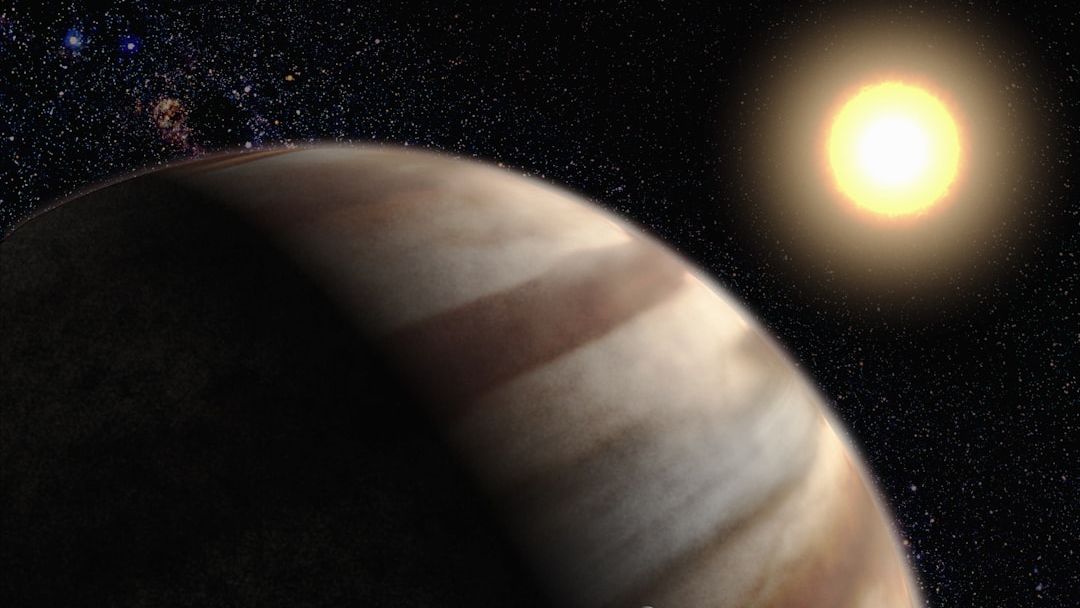
Astronomers pin down the origins of a planetary odd couple – Image for illustrative purposes only (Image credits: Unsplash)
Recent observations from NASA’s James Webb Space Telescope have provided the first detailed look at the atmosphere of a mini-Neptune orbiting inside the path of a hot Jupiter, offering fresh insights into how such rare configurations form. Located 190 light-years away around the star TOI-1130, this planetary duo has intrigued astronomers since its detection in 2020. The findings challenge long-held assumptions about planet formation near stars and suggest both worlds originated far from their current close-in positions.
A Puzzling Discovery Challenges Expectations
Astronomers first spotted the unusual pair using NASA’s Transiting Exoplanet Survey Satellite. The mini-Neptune, designated TOI-1130b, completes an orbit every four days, while its larger hot Jupiter companion takes eight days. Hot Jupiters typically dominate their inner systems, scattering smaller bodies with their immense gravity, which made this close companionship particularly baffling.
Chelsea X. Huang, who led the initial discovery as a postdoctoral fellow at MIT, described the system as one-of-a-kind. “Hot Jupiters are ‘lonely,’ meaning they don’t have companion planets inside their orbits,” she noted. “But somehow, with this hot Jupiter, an inner companion has survived.” This anomaly prompted deeper investigation into the planets’ histories.
Capturing the Perfect Observation Window
Observing TOI-1130b proved tricky due to the planets’ mean motion resonance, where gravitational tugs slightly alter their orbital timings. The research team, including scientists from MIT’s Kavli Institute for Astrophysics and Space Research, compiled past data to model precise transit moments. Led by Judith Korth of Lund University, they pinpointed when the James Webb Space Telescope could capture clear spectra.
Saugata Barat, a postdoc at MIT and lead author of the study published in Astrophysical Journal Letters, emphasized the precision required. “It was a challenging prediction, and we had to be spot-on,” Barat said. JWST’s ability to observe across multiple wavelengths allowed the team to analyze how the planet absorbed light, revealing its atmospheric makeup.
Heavy Molecules Point to Distant Origins
The telescope detected a rich composition in TOI-1130b’s atmosphere: abundant water vapor, carbon dioxide, sulfur dioxide, and traces of methane. These heavier molecules contrasted with expectations for a planet forming so near its star, where only light hydrogen and helium atmospheres should accumulate. Instead, the evidence indicated formation beyond the star’s frost line, the boundary where water freezes into ice.
In that colder protoplanetary disk region, the mini-Neptune could gather volatiles like icy pebbles that later evaporated during inward migration. The hot Jupiter likely followed a similar path, allowing both to retain their atmospheres while drawing closer together gradually. “This measurement tells us this mini-Neptune indeed formed beyond the frost line,” Barat explained, confirming a new formation pathway for such worlds.
What This Means for Exoplanet Science
Mini-Neptunes, gas dwarfs smaller than Neptune with rocky cores, rank as the galaxy’s most common planets, yet none orbit our Sun. This system’s architecture represents one of the rarest observed, providing a natural laboratory for testing migration theories. The results mark the first confirmation of a mini-Neptune forming outside a hot Jupiter’s current domain.
What matters now: These observations validate gradual inward migration as a viable process, preserving heavy atmospheres on close-in worlds. They open doors to studying similar systems with JWST.
The international collaboration, spanning MIT, Harvard-Smithsonian Center for Astrophysics, University of South Queensland, University of Texas at Austin, and Lund University, relied on NASA support. Future observations could refine models of disk dynamics and planet interactions.
Barat highlighted the system’s uniqueness: “This system represents one of the rarest architectures that astronomers have ever found.” As JWST continues its survey, discoveries like this refine our understanding of planetary diversity across the Milky Way.