

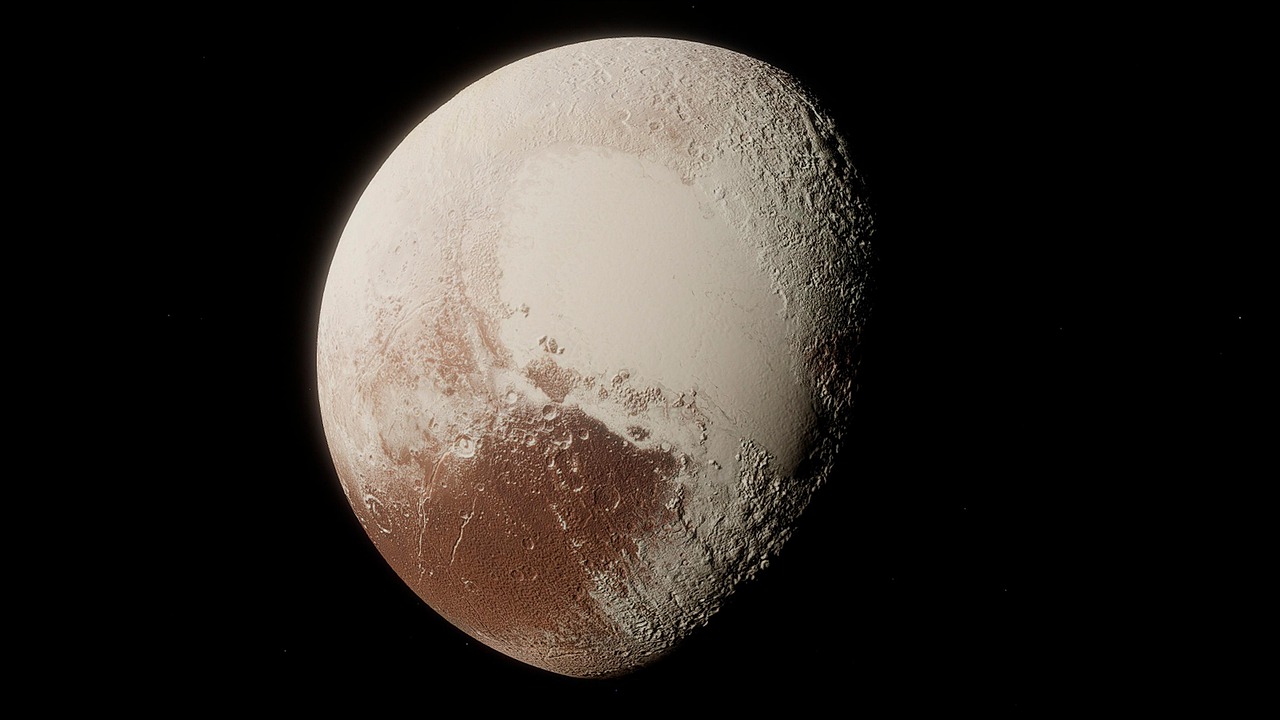
The science case for why Pluto still isn’t a planet – Image for illustrative purposes only (Image credits: Pixabay)
In 2006 the International Astronomical Union settled a long-running debate by reclassifying Pluto as a dwarf planet rather than a full member of the solar system’s planetary family. The decision rested on clear astrophysical criteria that Pluto simply fails to meet. Decades later the classification holds firm, even as new discoveries continue to reshape our understanding of the outer solar system.
The Moment the Rules Changed
Before 2006 astronomers had grown uneasy with Pluto’s place among the planets. Its orbit crosses Neptune’s path, and it shares the region with thousands of similar icy bodies. When larger objects like Eris were found farther out, the need for a consistent definition became urgent. The IAU responded by adopting three specific requirements for planethood.
Those requirements were not arbitrary. They reflected how planets actually form and behave over billions of years. Objects that meet all three criteria stand apart from the countless smaller bodies that orbit the Sun. Pluto satisfied the first two but fell short on the third, sealing its new status.
What It Takes to Be a Planet
Astronomers now require any planet to orbit the Sun directly. It must also be massive enough for its own gravity to pull it into a nearly round shape. Most importantly, it must have cleared the neighborhood around its orbit of other comparable objects. This last condition distinguishes true planets from everything else.
Clearing the neighborhood does not mean an empty path. It means the planet’s gravitational influence dominates so completely that no other body of similar size shares the same orbital region. Earth, for example, has done this over time. Pluto has not.
Why Pluto Falls Short
Pluto travels through the Kuiper Belt, a vast ring of icy remnants left over from the solar system’s formation. Thousands of objects of comparable size move in similar orbits nearby. Its gravity has never swept this zone clean. That single failure keeps it in the dwarf-planet category alongside Eris, Haumea, and Makemake.
Size alone never decided the issue. Several moons are larger than Pluto yet remain moons because they orbit planets rather than the Sun. The IAU’s framework focuses on dynamical behavior, not appearance or historical naming. Pluto’s orbit and surroundings simply do not match the pattern set by the eight recognized planets.
What the Classification Means Today
The dwarf-planet label carries no judgment on Pluto’s scientific value. Missions like New Horizons revealed a complex world with mountains, plains, and a thin atmosphere. Those findings enrich our knowledge of the outer solar system without altering the orbital criteria. Future surveys will likely identify more dwarf planets, each adding detail to the same framework.
Public attachment to Pluto as the ninth planet remains strong, yet the astronomical community treats the 2006 definition as settled science. No new evidence has emerged that would allow Pluto to clear its orbital neighborhood. The classification therefore stands as a practical tool for organizing the growing catalog of solar-system bodies.