

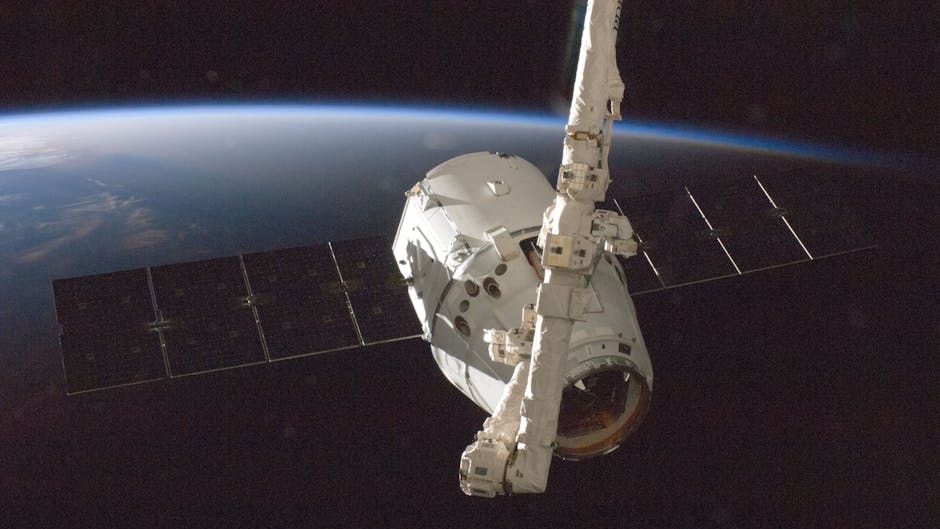
The Material Science Behind A Spacecraft’s Impact Armor – Image for illustrative purposes only (Image credits: Pexels)
Space missions carry crews and equipment into an environment where even the smallest fragments can create outsized risks. Engineers must now account for micro-meteoroids and orbital debris that travel at speeds capable of piercing conventional structures. These particles, often no larger than a grain of sand, have already forced adjustments in mission planning and hardware design. The pressure to balance protection with strict mass limits has become a defining constraint for long-duration flights.
The Everyday Stakes of Orbital Debris
Every spacecraft launched today operates within a growing cloud of uncontrolled material left from previous missions and natural sources. A single high-velocity impact can disable sensors, puncture fuel lines, or compromise life-support systems. Mission planners therefore treat these encounters not as rare events but as predictable hazards that shape every structural decision. The human cost appears in delayed timelines, higher insurance premiums, and the constant need to verify that critical components remain intact after years in orbit.
Design teams have learned that traditional shielding approaches consume too much of the allowable launch mass. Adding layers of metal or composite material quickly exceeds budget limits, leaving less room for scientific instruments or crew supplies. This trade-off forces engineers to seek solutions that deliver equivalent protection at lower weight. The result is a steady shift toward lighter, more efficient materials that still absorb or deflect the energy of hypervelocity strikes.
Why Mass Budgets Drive Innovation
Launch vehicles impose strict limits on total spacecraft weight, and every kilogram allocated to armor reduces capacity for other essential systems. Engineers therefore evaluate new shielding concepts against both impact performance and mass efficiency. Materials that perform well in ground tests must also survive the vibrations and thermal cycles of launch and orbital operations. These combined requirements narrow the field of viable options and push researchers toward hybrid or layered designs.
Recent work has examined how different material combinations respond when struck at speeds exceeding several kilometers per second. The goal is to dissipate impact energy across multiple thin layers rather than relying on a single thick barrier. Such approaches can reduce overall mass while maintaining the same level of protection. Yet the exact performance of each configuration still depends on variables such as particle size, angle of impact, and temperature at the moment of collision.
What a New Review Reveals
A detailed survey by Binkal Kumar Sharma of the University of Bremen and independent researcher Harshitha Baskar examines the latest candidate materials and structural concepts for micro-meteoroid and orbital debris protection. Their analysis highlights several families of advanced composites and multi-layer arrangements that show promise in laboratory simulations. The review also notes that many of these options remain at early stages of validation, with limited flight heritage to confirm long-term durability.
Key uncertainties persist around how these materials age under continuous exposure to atomic oxygen, ultraviolet radiation, and thermal cycling. Laboratory tests cannot fully replicate the combined effects of years in orbit. Consequently, designers continue to apply conservative safety margins that add back some of the mass savings originally achieved. The paper underscores that further ground testing and, ultimately, on-orbit demonstrations will be required before any new approach can be adopted for crewed missions.
Looking Ahead for Mission Planners
Space agencies and commercial operators now weigh these material choices against mission duration and destination. Shorter flights to low Earth orbit may tolerate heavier traditional shields, while deep-space or crewed lunar missions demand every possible kilogram of savings. The ongoing accumulation of orbital debris adds urgency, because future impacts will occur against a denser background of fragments. Continued refinement of protective systems therefore supports not only individual missions but the broader sustainability of space operations.
Progress in this area ultimately determines how confidently humans can extend their presence beyond Earth. Each incremental improvement in shielding efficiency opens possibilities for longer stays, larger payloads, or more ambitious trajectories. Until those gains are fully realized and proven, mission teams will keep balancing protection against the fundamental limits of mass and cost.