

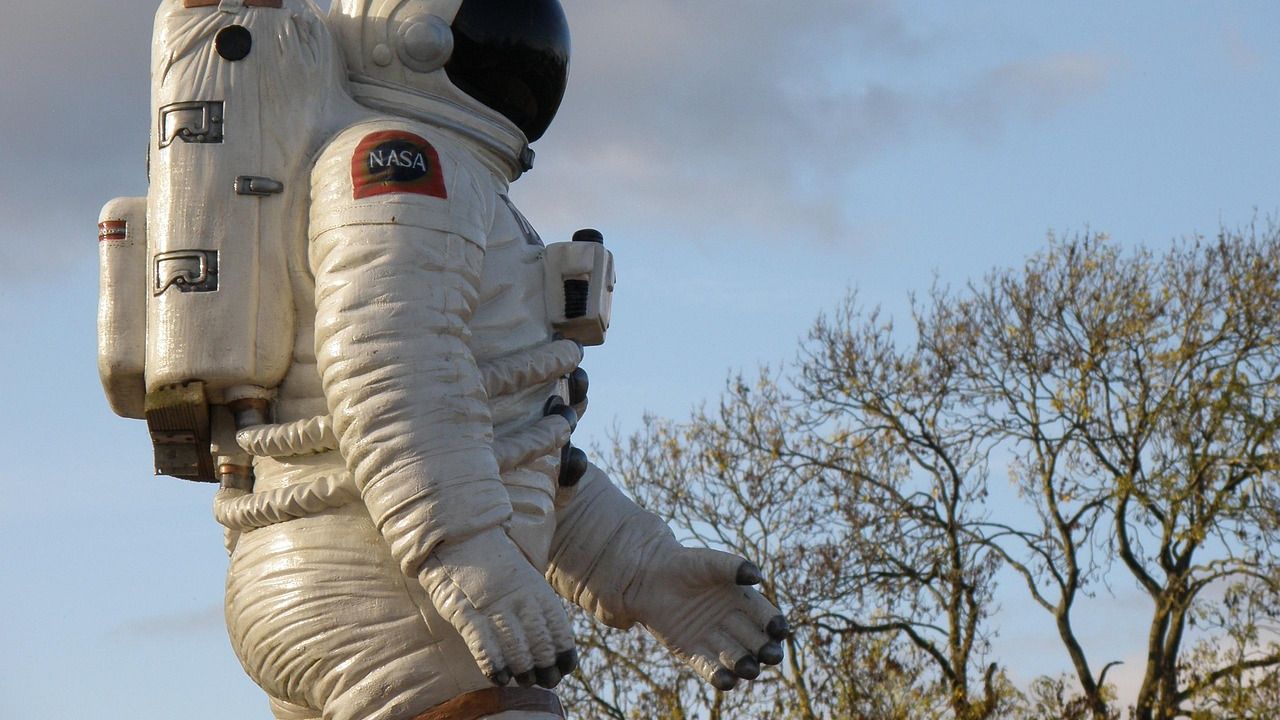
The Artemis 2 astronauts came home from 252,756 miles away with the same line – “planet Earth, you are a crew” – and it’s the kind of thing that sounds like a slogan until you hear who said it and why – Image for illustrative purposes only (Image credits: Pixabay)
Houston, April 11, 2026 – Four astronauts stepped into an auditorium at Ellington Field Joint Reserve Base after completing a ten-day flight that carried them to a maximum distance of 252,756 miles from Earth. The Artemis 2 crew had become the first humans in fifty-three years to reach the vicinity of the moon, where they observed the far side directly and captured images of a solar eclipse from lunar orbit. Christina Koch addressed the gathering with a carefully developed observation that emerged from her own experience rather than from prepared slogans.
What the Word ‘Crew’ Came to Mean
Koch began by recalling a question posed to her years earlier at a public event: what distinguishes a crew from a team. At the time she offered a conventional reply focused on cooperation, yet the answer felt incomplete. The mission itself supplied the missing clarity. During the flight the four astronauts operated under conditions that required constant mutual dependence, silent sacrifices, shared purpose, and mutual accountability.
She described a crew as a group that remains committed at every moment, strokes together toward one objective, extends grace while holding one another responsible, and recognizes that its members share identical cares and needs. The configuration, she noted, creates an inescapable link among its members. These elements formed the precise standard she applied once the spacecraft windows revealed Earth against the surrounding darkness.
The Lifeboat Seen from Lunar Distance
From inside Orion, Koch observed that the planet appeared not merely as a familiar globe but as a vessel suspended in blackness. That surrounding void, she explained, supplied the structural identity of the object below. The planet functioned as a lifeboat whose occupants depend on one another by the simple fact of their shared enclosure.
A lifeboat, in her account, transforms whoever occupies it into a crew because survival hinges on coordinated action and mutual reliance. The same conditions now applied to the eight billion people on Earth, whether they recognized the arrangement or not. The view from 252,756 miles away made visible a linkage that daily life on the surface tends to obscure.
A Diagnosis Rather Than an Inspiration
The statement Koch delivered was not offered as an uplifting slogan. It functioned instead as a structural assessment: the planet meets every criterion of the crew definition she had outlined, yet its inhabitants frequently fail to act in accordance with that reality. Conflicts, indifference to distant suffering, and refusals to acknowledge shared dependence represent departures from the configuration the mission had made plain.
Reid Wiseman, the mission commander, added that the four crew members now remain bonded in a way no one on the ground can fully replicate. The direct visual experience of Earth as a lifeboat cannot be transferred through photographs or descriptions alone. What can be carried forward is the concise formulation Koch chose: planet Earth, you are a crew.
The Line That Remains
The remark was earned through ten days of continuous observation rather than through rhetorical exercise. It compresses a perspective gained at record distance into a form that others can retain. Whether the wider population will treat the observation as a prompt to adjust conduct inside the shared vessel remains an open matter. The line itself, however, now stands in the public record as one of the more precise descriptions of humanity’s actual situation.