

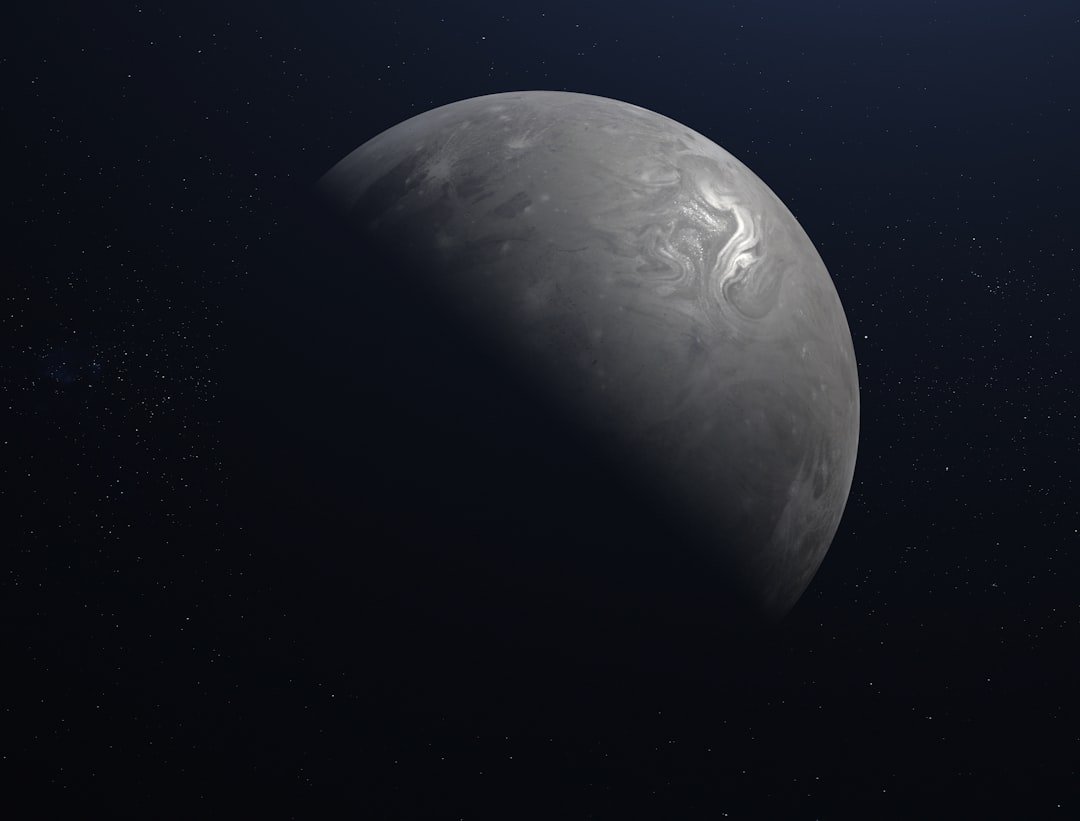
A Shadow Emerges on the Giant Planet (Image Credits: Unsplash)
Jupiter dominates the western sky during early morning hours on Friday, April 10, treating observers to the striking sight of Ganymede’s shadow crossing its cloud tops. This event unfolds as the largest Jovian moon casts a prominent dark spot from east to west across the planet’s disk. Skywatchers in the central and western United States hold the best vantage for this celestial drama, which highlights the intricate orbital dance of Jupiter’s major satellites.
A Shadow Emerges on the Giant Planet
The transit kicks off shortly after midnight Central Daylight Time. Ganymede’s shadow first touches Jupiter’s southeastern limb at 12:57 A.M. CDT. Observers notice a dark notch forming over the next eight to ten minutes as the shadow fully materializes.
By 1:30 A.M. CDT, the feature stands out clearly against the planet’s banded atmosphere for viewers across the western two-thirds of the U.S. The shadow requires more than three hours to traverse the disk completely. Jupiter dips below the horizon nationwide while the event remains in progress, urging prompt observation.
East Coast stargazers face a challenge, as the planet hugs the horizon below 3 degrees altitude during prime viewing. Steady air and dark sites enhance the view, particularly with telescopes of 4-inch aperture or larger.
Finding Jupiter in Gemini’s Glow
Jupiter shines brightly in central Gemini, positioned below the prominent twins Castor and Pollux. It lies just 2.5 degrees west of magnitude 3.5 Wasat, Delta Geminorum, making location straightforward. As the brightest object in the western sky, the planet outshines nearby stars effortlessly.
Telescopes reveal Jupiter’s familiar cloud belts and polar regions alongside the intruding shadow. Ganymede itself appears just west of the planet, while Europa stands alone to the east. Skywatchers should avoid mistaking Europa for the shadow’s source.
Io and Callisto orbit farther west, often falling outside typical telescope fields. This configuration adds context to the scene, showcasing Jupiter’s bustling satellite system.
Observation Tips for Clear Views
Preparation ensures success during these fleeting hours. Select a site with an unobstructed western horizon and minimal light pollution. Allow telescopes time to cool to ambient temperature for sharp images.
Here are essential steps for capturing the transit:
- Arrive by 12:30 A.M. local time to settle equipment.
- Center Jupiter at low power, then switch to 150x or higher magnification.
- Track the shadow’s progress from the limb inward.
- Sketch or image the event, noting belts crossed.
- Monitor moon positions to confirm identifications.
A recent precursor event occurred after midnight on April 9 in Central time zones, offering another shadow transit preview. Such alignments recur periodically, rewarding dedicated observers.
Bonus: Hunt for Faint Comet Tempel 2
Extend the session toward dawn with Comet 10P/Tempel 2 in Scutum. This periodic visitor rises around 1 A.M. local daylight time, reaching 12th magnitude and brightening ahead of summer visibility.
Large telescopes prove necessary, as the comet demands dark skies and patience. On April 10, it sits under 2 degrees southwest of 4th-magnitude Alpha Scuti. Nearby, 5.3 degrees east, globular cluster NGC 6712 glows at 8th magnitude across 7 arcminutes.
Compare the comet’s fuzzy form and evolving brightness against the cluster’s compact, concentrated core. By 5 A.M., both stand 35 degrees above the southern horizon.
| Event | Time (Local, 40°N 90°W) |
|---|---|
| Sunrise | 6:29 A.M. |
| Sunset | 7:34 P.M. |
| Moonrise | 2:58 A.M. |
| Moonset | 12:12 P.M. |
The waning crescent Moon illuminates at 41 percent by 10 P.M. the previous evening, posing little interference pre-dawn. For full details, consult Astronomy Magazine.
Key Takeaways
- Ganymede’s shadow enters at 12:57 A.M. CDT, visible widely by 1:30 A.M.
- Best from central/western U.S.; East Coast limited by low altitude.
- Pair with Comet Tempel 2 for an extended observing run.
This Ganymede shadow transit reminds us of Jupiter’s enduring allure, blending scale and subtlety in the night sky. Grab your gear before the planet sets – what will you see through your eyepiece? Share your observations in the comments.