

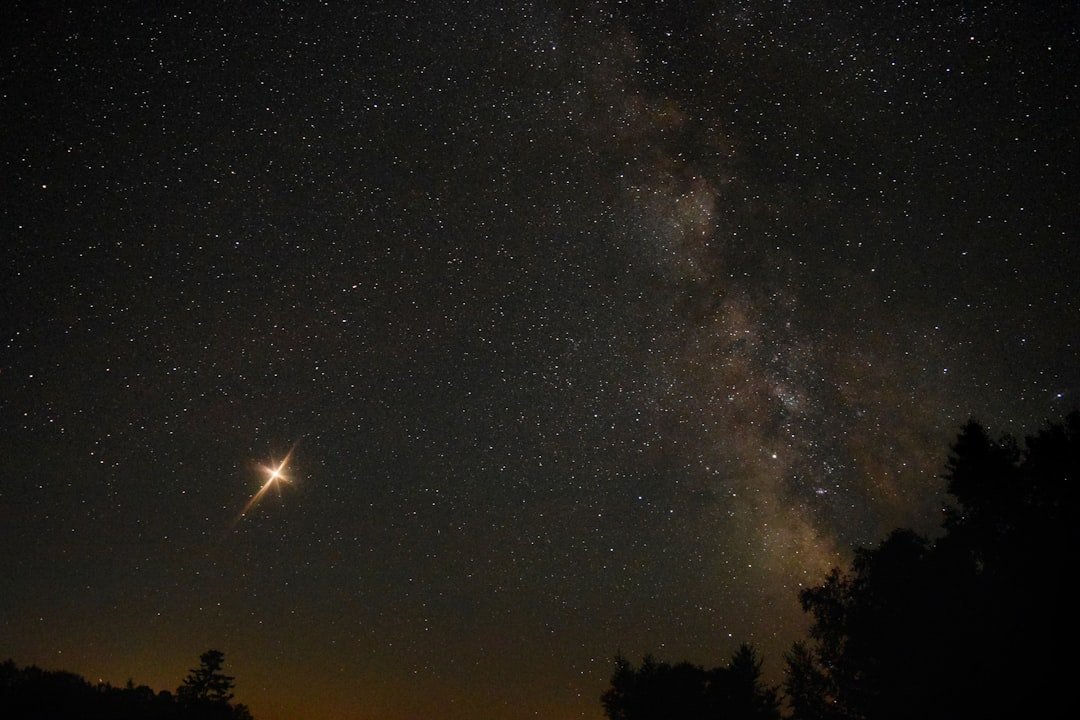
Venus and Jupiter Command the Evening Sky (Image Credits: Unsplash)
April 2026 delivers a captivating array of celestial sights for stargazers worldwide. A slender waning crescent moon lingers low in the east about an hour before sunrise on April 14, its earthshine illuminating the darkened portion of its disk. This quiet prelude sets the stage for brighter spectacles, including prominent evening planets and a rare pre-dawn alignment of four worlds later in the month.[1][2]
Venus and Jupiter Command the Evening Sky
Venus emerges as the brightest object after the sun, gleaming at magnitude -3.9 in the western sky shortly after sunset. Observers spot it low among the stars of Aries early in the month, transitioning into Taurus by mid-April. The planet stands about 13 degrees high 30 minutes after sunset on April 1, with the sparkling Pleiades cluster overhead.[2]
Jupiter follows closely, shining at magnitude -2.1 high in Gemini. It remains visible throughout the evening, setting later initially but dipping toward the horizon by month’s end. Telescopes reveal its 39-arcsecond disk crossed by dark belts and the occasional Great Red Spot. The gas giant’s four largest moons dance around it, offering events like shadow transits on April 2-4 and Ganymede’s reappearance on April 28.[2]
A waxing crescent moon enhances these views. It passes 6 degrees from Venus on April 18, displaying earthshine against the Pleiades backdrop. Three nights later, on April 21-22, the moon sits 2.7 degrees north of Jupiter near the star Wasat.[3]
Pre-Dawn Lineup of Mercury, Mars, Saturn, and Neptune
Early risers gain rewards from a compact gathering of morning planets low in the east. Mercury leads at magnitude -0.2 following its greatest elongation on April 3. Mars glows reddish at magnitude 1.2, while Saturn appears yellowish at magnitude 0.9. Neptune, faint at magnitude around 8, challenges even telescopes amid twilight.[1]
The group tightens dramatically from April 16 to 23, spanning just a few degrees 30 minutes before sunrise. On April 20, Mercury, Mars, and Saturn huddle within 2 degrees, rising barely 2 degrees high. Southern Hemisphere viewers enjoy clearer sights, though northern observers need pristine horizons and binoculars.[2][3]
A thin waning crescent moon joins briefly on April 15 in southern skies, hovering above the trio. These planets trace the ecliptic, hugging the horizon in Pisces and Cetus.[1]
Moon Cycles and Key Pairings
The moon’s phases frame April’s action. It reached third quarter on April 10 and heads toward new moon on April 17 at 11:52 UTC. First quarter follows on April 24. Perigee arrives April 19, making it a near-supermoon at new phase.[1]
Beyond Venus and Jupiter, the moon nears Regulus in Leo on April 24-25 and Spica in Virgo by April 28-30. These encounters provide easy markers for constellation spotting. Earthshine accentuates thin phases, like the current waning crescent.[2]
Lyrid Meteors Light Up the Night
The Lyrid meteor shower activates from April 14 to 30, peaking overnight April 21-22. Radiant in Lyra rises late evening near Vega, gaining altitude toward dawn. Expect 20 meteors per hour under dark skies after the moon sets around 1 a.m.[2]
Swift Lyrids streak from comet Thatcher debris. The new moon ensures moonless nights, ideal for viewing. Face east after midnight for the best show.[3]
Essential Tips for Skywatchers
Clear horizons prove crucial, especially for morning planets. Seek elevated spots to combat atmospheric haze. Binoculars aid faint targets like Uranus near Venus on April 23.
- Observe evenings within 30-60 minutes after sunset for Venus and Jupiter.
- Rise 60-90 minutes before dawn for the planetary huddle; use apps like Stellarium for local times.
- Choose dark sites away from city lights for Lyrids and moon details.
- Telescopes unlock Jupiter’s moons and Venus’s phases; steady mounts help low objects.
- Track via EarthSky for updates.
Key Takeaways:
- Evening: Venus (west, near Pleiades) and Jupiter (Gemini) dominate.
- Morning: Mercury-Mars-Saturn-Neptune align April 16-23 low east.
- Lyrids peak April 22 under dark skies; new moon April 17 aids viewing.
April 2026 reminds us of the solar system’s dynamic beauty, with alignments bridging day and night skies. Step outside soon to witness these fleeting displays. What celestial event excites you most this month? Tell us in the comments.